ACC News Brief
Clean Energy China
Sub-10-nanometer particles lift solar hydrogen output in a lab test
What happened
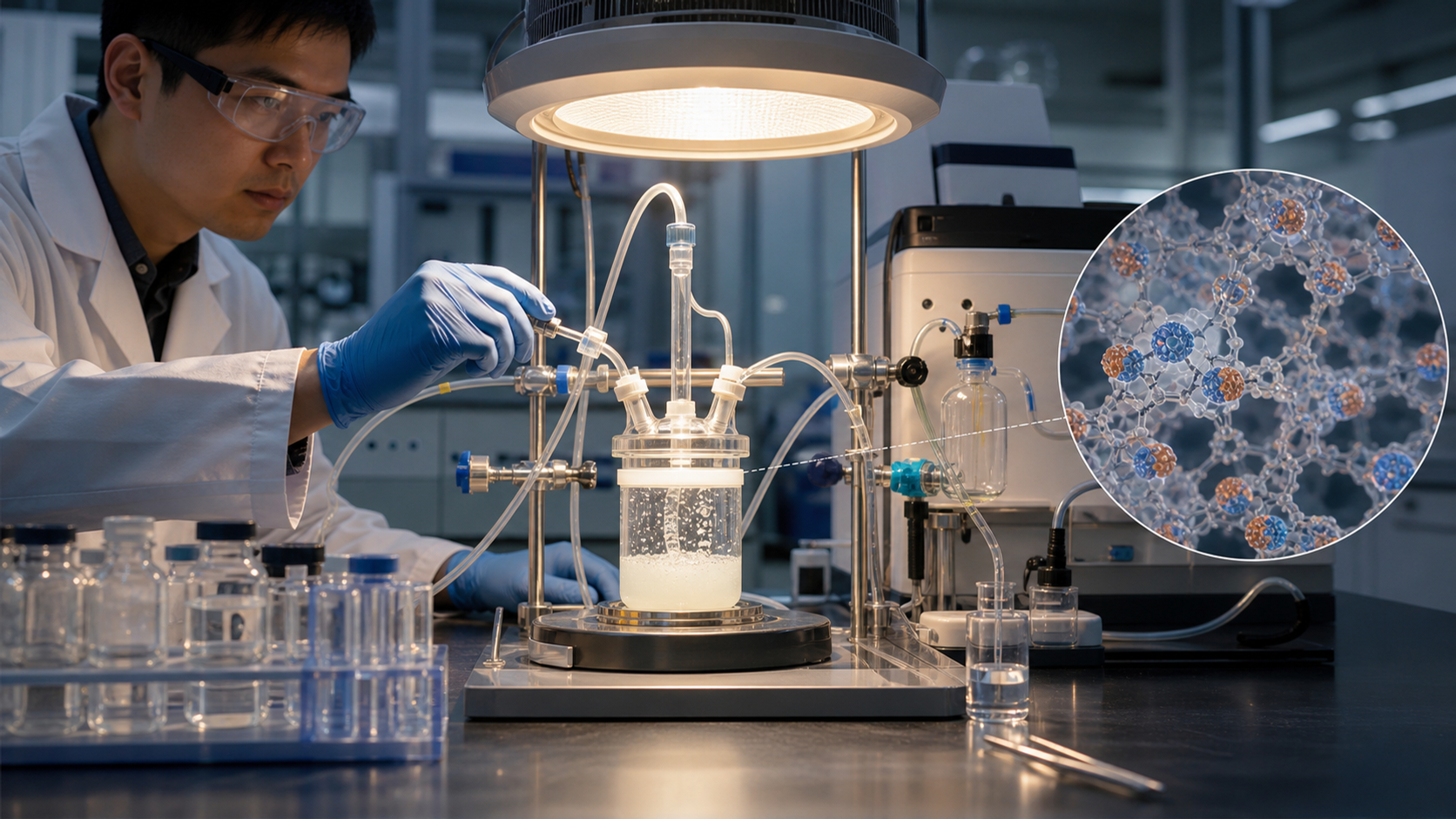
Researchers made polymer-free organic heterojunction particles one to ten nanometers wide and anchored them to a covalent organic framework to reduce aggregation. Under four-hour simulated-sunlight tests using a platinum cocatalyst and ascorbic acid as a sacrificial electron donor, an optimized formulation reached a mass-normalized hydrogen-evolution rate of 3,180.7 plus or minus 234.5 millimoles per hour per gram and 32.8% external quantum efficiency at 808 nanometers; this remains sacrificial laboratory hydrogen evolution, not a standalone water-splitting system or a commercial hydrogen plant.
Why it matters
Low-emission hydrogen could help decarbonize industrial uses that are difficult to electrify directly, but a useful photocatalyst must work efficiently, durably, safely, and cheaply without relying on costly cocatalysts or consumed sacrificial chemicals. This study advances particle design while leaving those system-level questions open.
What to watch
- Performance without sacrificial reagents and with sharply reduced or eliminated platinum loading.
- Independent durability, recovery, toxicity, lifecycle, and scale-up tests in complete solar water-splitting reactors.
- Hydrogen output per illuminated area, full-system solar-to-hydrogen efficiency, material cost, and performance in real rather than simulated water sources.
Sources & evidence
- Solar-driven fast photocatalytic hydrogen evolution using size-minimized organic heterojunctionsPeer-reviewed open-access Article in Nature Communications, published December 30, 2025, DOI 10.1038/s41467-025-67811-4; led by the Institute of Chemistry, Chinese Academy of Sciences with University of Chinese Academy of Sciences and Chinese University of Hong Kong collaborators. The headline result used simulated AM1.5G light, 0.2 M ascorbic acid, and 30 wt.% platinum loading; it is a laboratory photocatalysis result rather than commercial green-hydrogen production.
- Source data for the organic nanoparticle solar-hydrogen studyFigshare source-data record cited by the paper. The journal notes that the Fig. 3 source data were corrected on May 13, 2026; the amended record is the current supporting dataset.
Continue learning with ACC
Explore ACC's alternative fuels guide