ACC News Brief
Solar Laboratory Research
A graded contact lifts n-i-p perovskite solar-cell efficiency
What happened
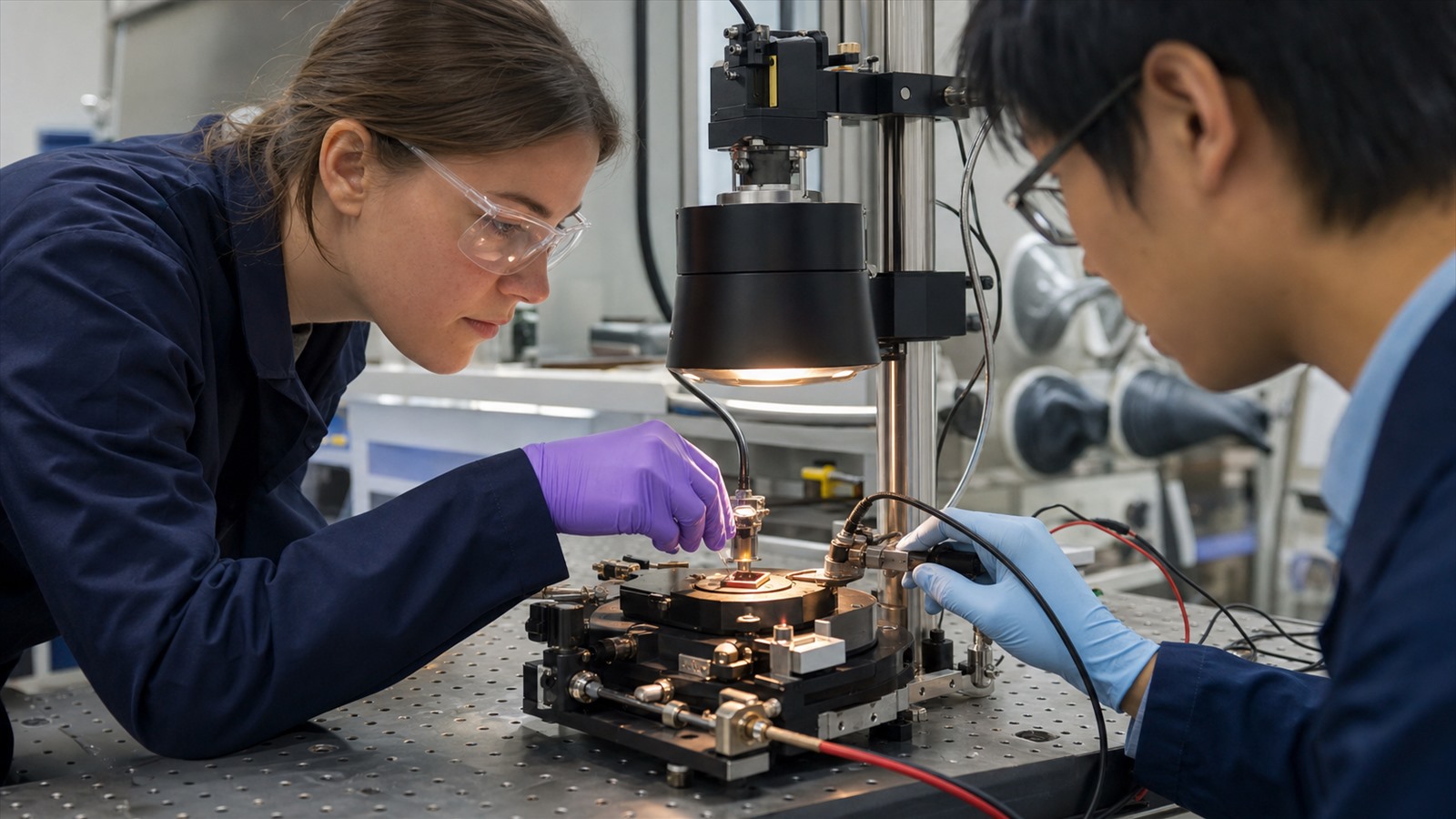
A peer-reviewed Nature study traced an efficiency bottleneck in conventional n-i-p perovskite solar cells to band misalignment and electron accumulation at a buried interface. The team built a continuously graded doped tin-oxide electron-transport layer and reported a certified steady-state efficiency of 27.17%, with 27.50% in reverse scan, plus 25.79% for a 1-square-centimeter device and 23.33% for a 16.02-square-centimeter module. These are laboratory devices, not commercial panels; long-term durability, manufacturing yield, cost, scale, and lead management remain unresolved.
Why it matters
The result identifies and addresses a specific loss mechanism in a solar-cell architecture designed with scalability in mind. That is useful progress toward better solar materials, while the path to climate impact still runs through independent replication, durable modules, responsible materials, mass manufacturing, and real-world economics.
What to watch
- Independent replication and standardized stability testing under heat, humidity, light, electrical load, and repeated day-night cycling.
- Larger modules, manufacturing yield, lifecycle impacts, lead containment and recovery, cost, and bankable outdoor performance.
Sources & evidence
- Continuously graded-doped SnO2 for efficient n-i-p perovskite solar cellsPeer-reviewed Nature article, volume 654, pages 69-75, DOI 10.1038/s41586-026-10587-4, published April 30, 2026. The certified efficiencies come from laboratory cells and a 16.02-square-centimeter module; the paper does not establish commercial-scale manufacturing, bankable lifetime, cost, or complete lifecycle performance.
Continue learning with ACC
Explore ACC's renewable energy and grid guide