ACC News Brief
Clean Energy China
China's wind and solar can balance each other better across regions
What happened
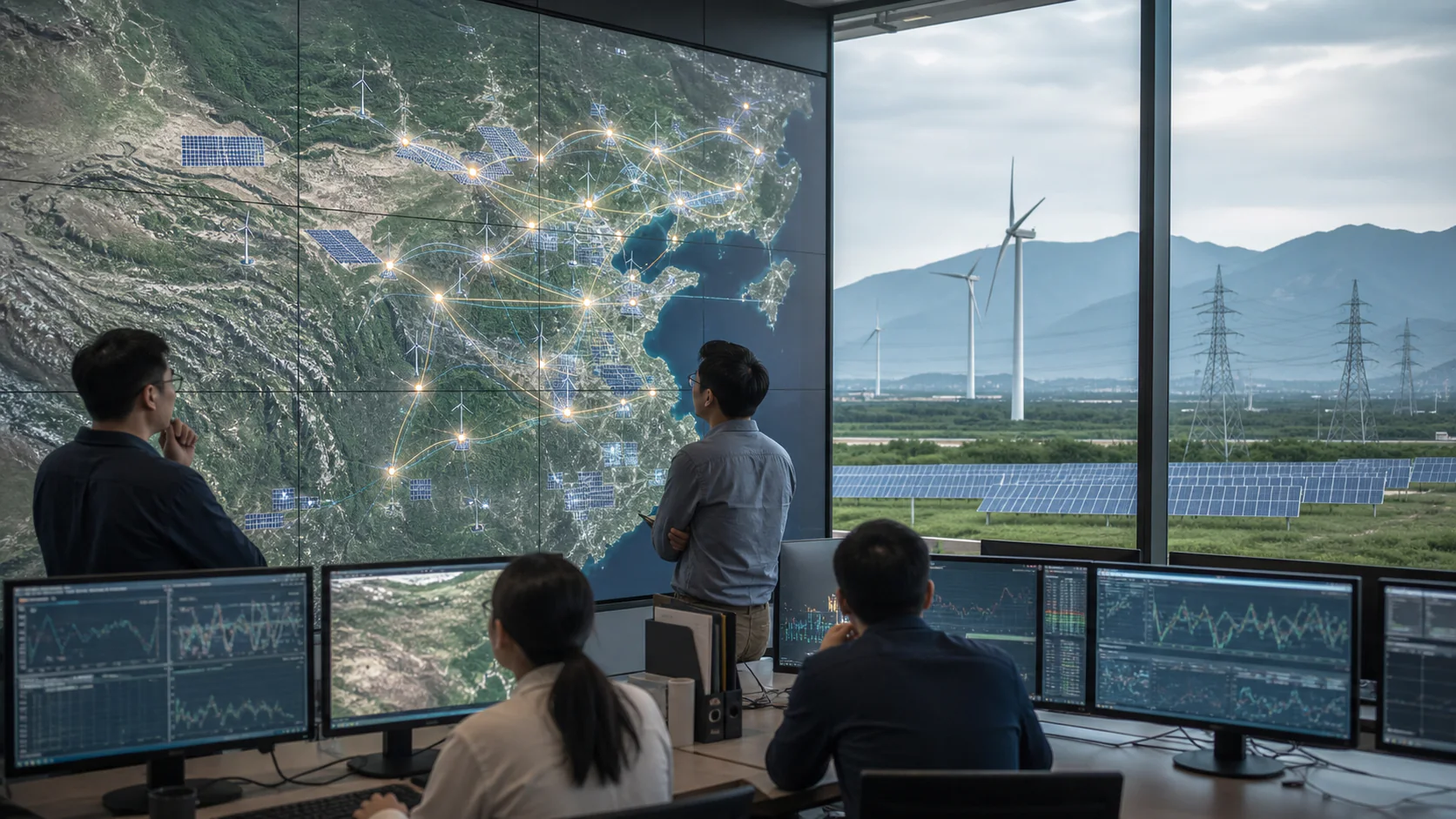
Researchers used sub-meter satellite imagery and deep learning to build a 2022 inventory of 319,972 solar facilities and 91,609 wind turbines across China. Their power-system analysis found that wind and solar variability falls as coordination expands geographically. Under an assumed system with 80% dispatchable flexibility, modeled nationwide interprovincial coordination raised effective renewable penetration by 99.88 terawatt-hours - 9.1% of mapped wind and solar generation, or about 120 hours of average national load. The infrastructure inventory is observed; the grid benefit is a counterfactual model result, not measured dispatch performance.
Why it matters
A cleaner grid is not only a question of adding equipment. Better transmission, scheduling, storage, and regional cooperation can help existing wind and solar resources cover one another when weather and demand differ across places.
What to watch
- Operational tests using real congestion, market rules, storage, demand response, reserve needs, and transmission losses rather than a simplified national coordination case.
- How much interprovincial transfer capacity and institutional cooperation would be needed, where upgrades would create the most value, and who pays for them.
- Updated infrastructure maps and public aggregate data that let independent teams test the conclusions without exposing sensitive facility-level information.
Sources & evidence
- Advancing solar and wind penetration in China through energy complementarityPeer-reviewed Nature research article, DOI 10.1038/s41586-026-10570-z, published May 20, 2026. The Peking University-led team combined a real 2022 infrastructure inventory with modeled generation, load, flexibility, and coordination scenarios.
- Aggregated solar-wind data and complementarity analysis codeZenodo repository with aggregated county-level generation series, processed provincial load profiles, example geospatial data, and analysis code. Facility-level national coordinates are restricted because of critical-infrastructure sensitivity.
Continue learning with ACC
Explore ACC's renewable energy and grid guide