ACC News Brief
Ecosystems Northern Trinidad
Dense tropical canopies could slow local temperature shifts—but only temporarily
What happened
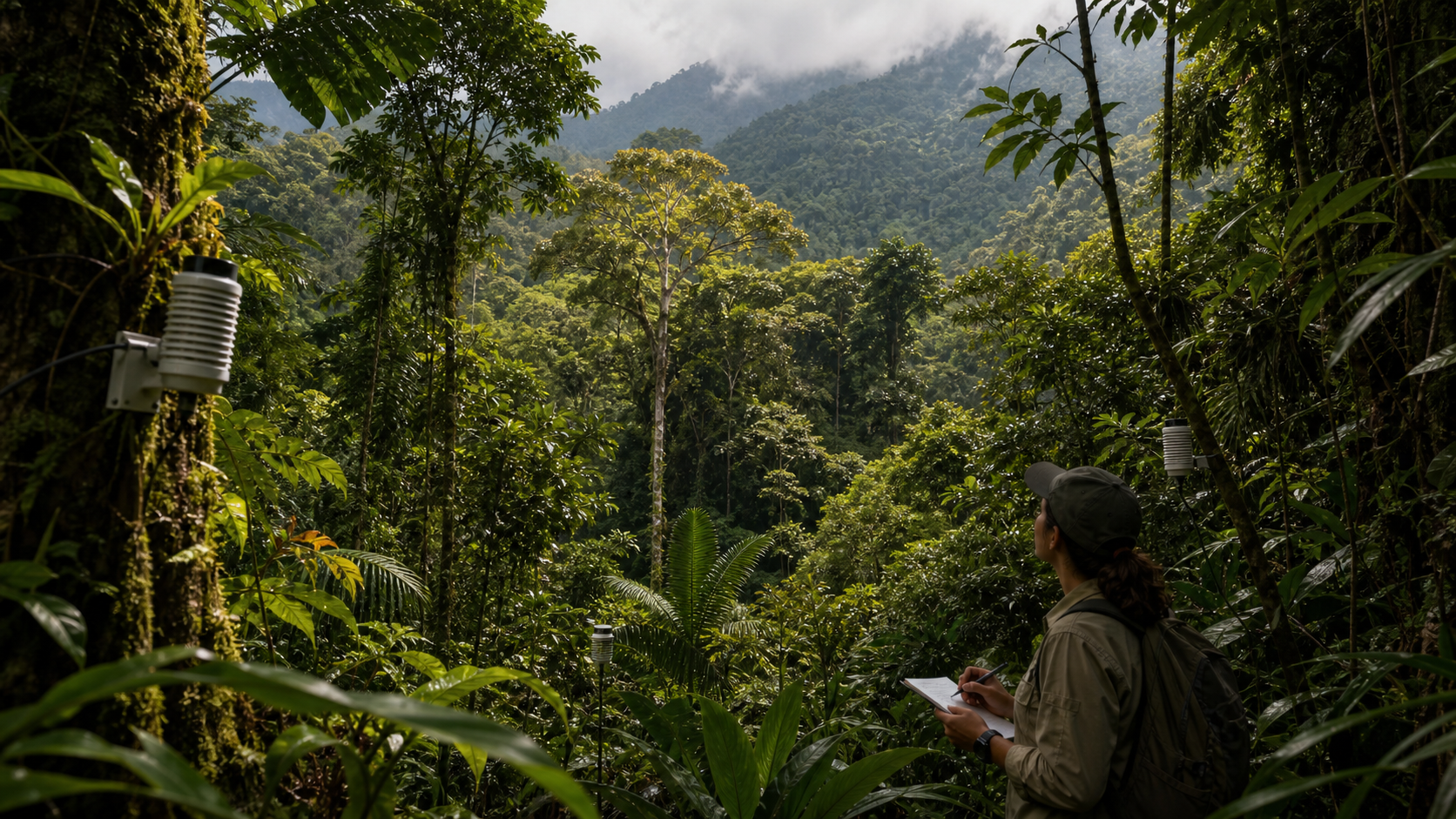
Researchers modeled forest microclimates across a 1,300-square-kilometer tropical mountain range in northern Trinidad using detailed topography and three-dimensional vegetation maps. Vegetation complexity halved the modeled maximum-temperature climate velocity for organisms in the understory, while canopy maximum-temperature velocity was nearly zero. More than 88 percent of modeled maximum-temperature vectors pointed downward across spatial scales, leading the authors to describe dense vegetation as short-term microrefugia.
Why it matters
Forest structure can shape the local conditions species experience, so protecting dense, complex canopies may preserve short-term thermal refuges better than treating all forest cover as interchangeable. This was a mechanistic modeling study in one landscape, not an intervention trial or a guarantee that forests can shield biodiversity from continued warming; populations already near their warm limits may still lose suitable habitat.
What to watch
- Field validation across more tropical regions, elevations, species, seasons, and extreme-heat events.
- Whether degradation, fragmentation, fire, drought, and edge effects erode the modeled canopy buffering.
- Evidence that restoration can reproduce the microclimate benefits of mature, structurally complex forest.
Sources & evidence
- Microclimates slow and alter the direction of climate velocities in tropical forestsPeer-reviewed Nature Climate Change study published online November 27, 2025, DOI 10.1038/s41558-025-02496-7. Results come from mechanistic modeling of one northern Trinidad landscape and describe short-term microrefugia, not elimination of climate risk.
- Microclimates slow and alter the direction of climate velocities in tropical forests — DOI recordStable DOI for the study. Its 2026 volume and page assignment should be distinguished from the November 27, 2025 online-publication date used for this brief.
Continue learning with ACC
Explore how climate change affects forests, biodiversity, and ecosystem services