ACC News Brief
Climate Science Central Amazon, Brazil
Hot droughts pushed a central Amazon forest past tree-stress thresholds
What happened
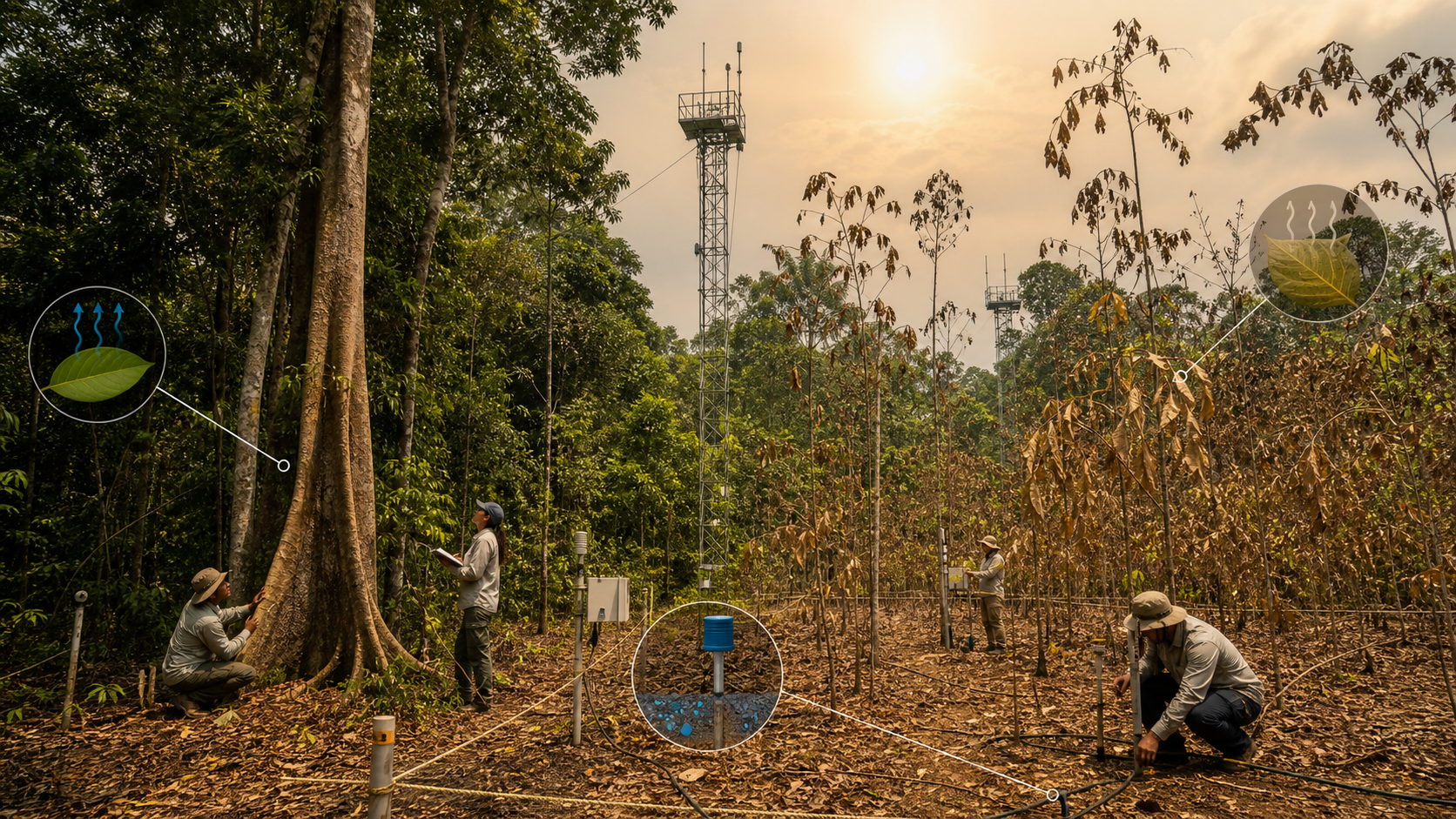
A long-running central Amazon forest study found higher tree mortality during intense hot droughts, with fast-growing, low-wood-density trees especially vulnerable. Measurements collected during the 2015 and 2023 droughts also showed that transpiration dropped rapidly after soils crossed a critical moisture threshold. A University of California, Berkeley summary reports that mortality rose 55 percent under the observed hot-drought conditions.
Why it matters
Amazon forests store carbon, recycle moisture, and support exceptional biodiversity. The results show how heat can compound water stress and shift which trees survive, potentially weakening forest carbon storage. They come from a central Amazon research site with a selective-logging experiment, however, so they should not be generalized unchanged to every Amazon forest.
What to watch
- Independent measurements across wetter, drier, intact, logged, burned, and recovering Amazon forests.
- Whether species turnover and acclimation can offset some mortality without eroding biodiversity or long-term carbon storage.
- How often forests cross the observed stress thresholds under lower- and higher-emissions pathways; projections of as many as 150 threshold days per year by 2100 apply to a high-emissions scenario, not a present observation.
Sources & evidence
- Hot droughts shift Amazon forest demography and functioningPeer-reviewed Nature paper published December 10, 2025, DOI 10.1038/s41586-025-09728-y, combining more than three decades of forest-demography data with measurements from the 2015 and 2023 droughts.
- A new 'hypertropical' climate is emerging in the AmazonUniversity of California, Berkeley research explanation dated December 10, 2025, providing study context and the reported 55 percent mortality increase. Future threshold-day estimates are model projections under a high-emissions scenario.
Continue learning with ACC
Explore how climate change affects forests, biodiversity, and ecosystem services