ACC News Brief
Climate Science Sahel / West and Central Africa
Peer-reviewed climate projection — regional confidence and emissions pathway matter
Sahel rainfall may grow more erratic even where average rain increases
What happened
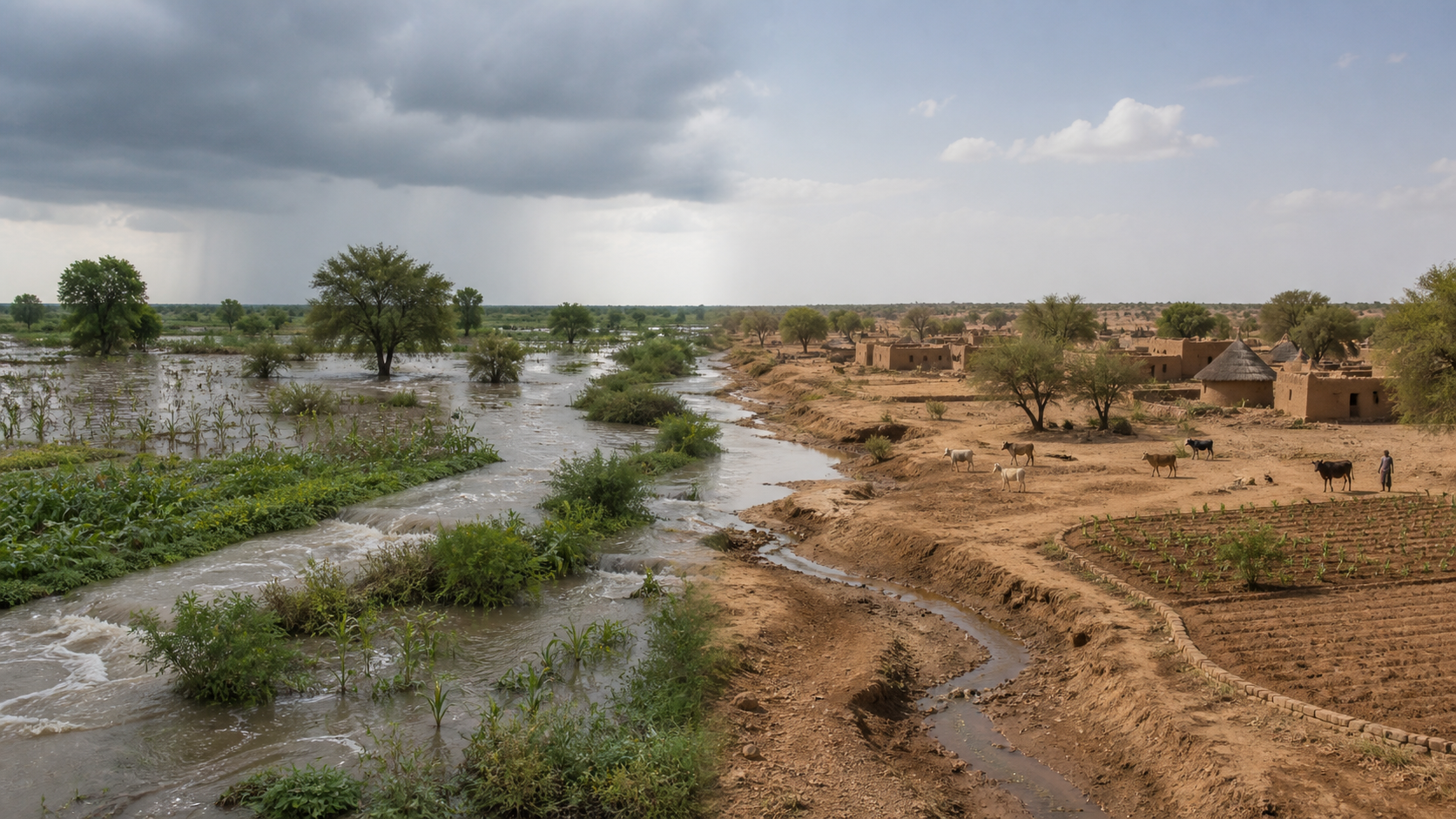
A 42-model CMIP6 analysis projects larger year-to-year swings in July-through-September rainfall across much of the Sahel under greenhouse warming. Under the high-emissions SSP5-8.5 pathway, 39 of 42 models showed increased Sahel-wide variability; all 42 showed an increase in the central-eastern Sahel, where 40 projected more extreme wet seasons and 33 projected more extreme dry seasons. The western Sahel result was less certain: 33 models showed increased variability, but the multi-model mean change was not statistically significant and models did not agree on more extreme dry seasons. Under the low-emissions SSP1-2.6 pathway, the modeled increase was smaller and agreement was weaker.
ACC context
Rainfall risk is not captured by the average alone. Farms, reservoirs, cities, ecosystems, and humanitarian systems can be stressed by larger swings between seasons even if the long-term mean becomes wetter, and the evidence requires different conclusions for the western and central-eastern Sahel.
Why it matters
Greater variability could raise the chances of alternating flood and drought pressures in communities whose food, water, and livelihoods depend on a short rainy season. The lower-emissions comparison also indicates that the magnitude of change is not fixed, while careful regional distinctions are essential for credible adaptation planning.
What to watch
- Observed rainfall-variability trends as records lengthen and whether seasonal forecast systems improve at locally useful lead times.
- Regional-model and impact studies that translate rainfall anomalies into flood, crop, pasture, groundwater, health, and displacement risks without treating the entire Sahel as uniform.
- Investment in water storage, drainage, forecasting, crop and livelihood diversity, insurance and safety nets, alongside global emissions reductions.
Sources & evidence
- Increased interannual variability of Sahel rainfall under greenhouse warmingPeer-reviewed open-access Article in Nature Communications, published December 27, 2025, DOI 10.1038/s41467-025-67885-0. It compares 20th- and 21st-century rainfall variability in CMIP6 simulations and reports stronger central-eastern than western Sahel agreement. These are projections, not observations of future seasons, and the SSP5-8.5 and SSP1-2.6 results must remain distinct.
Continue learning with ACC
Learn how communities can prepare for compounding drought and flood risks