ACC News Brief
Clean Energy United States
Solar-powered hydrogen prototype completes an 11-day outdoor test
What happened
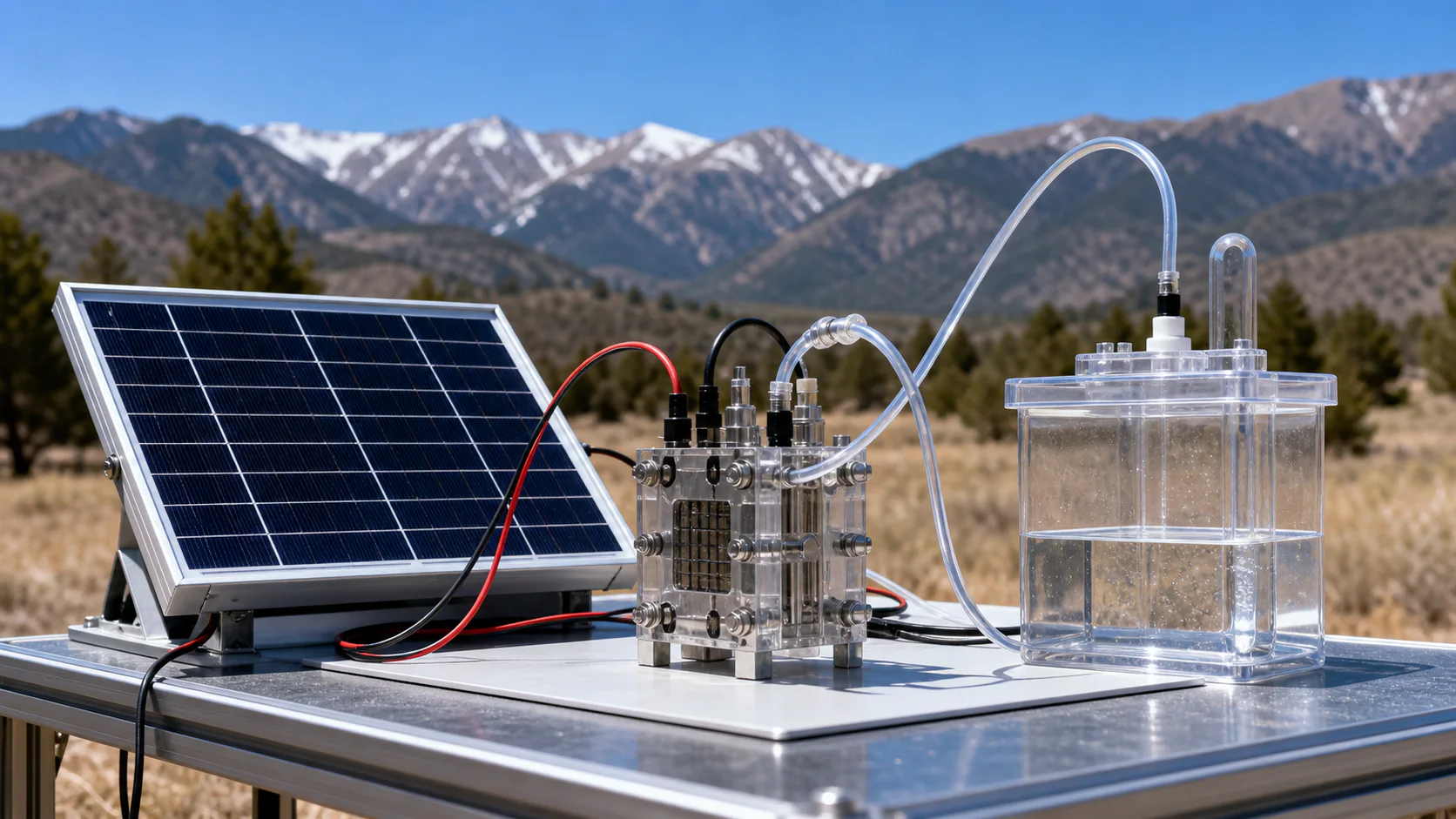
Researchers at the National Laboratory of the Rockies directly coupled an 84-square-centimeter commercial silicon mini-module to a water-fed anion-exchange-membrane electrolyzer and tested the system outdoors for 11 days. The best configuration averaged 6.6 percent solar-to-hydrogen efficiency, with minimal measured corrosion and no efficiency loss across the observed day-night cycles; the authors present this as a proof of concept, not commercial hydrogen production.
Why it matters
Direct solar-to-hydrogen systems could simplify small-scale production by avoiding separate power conversion and supporting electrolytes, but usefulness depends on much longer durability tests, larger devices, safe gas capture, lifecycle emissions, and cost.
What to watch
- Longer outdoor testing across seasons and at larger device and stack sizes.
- Catalyst and membrane durability, water-quality requirements, safe hydrogen capture, lifecycle emissions, and cost.
Sources & evidence
- Water-Fed, Photovoltaic-Driven Anion-Exchange Membrane Water Electrolysis for Solar Hydrogen ProductionPeer-reviewed research article, ACS Applied Energy Materials, DOI 10.1021/acsaem.6c01262, published June 28, 2026; National Laboratory of the Rockies.
Continue learning with ACC
Explore ACC's renewable energy and grid guide