Precise proposition checked
This volcano just spewed more CO2 than every car driven in history.
Full post context: This volcano just spewed more CO2 than every car driven in history. Climate change is natural. Taxing us into poverty isn't the answer.
Scope of this check: This verdict evaluates only the eruption-versus-cars CO2 claim. The accompanying climate and taxation statements are preserved as context and are not separately rated in this case.
What the evidence shows
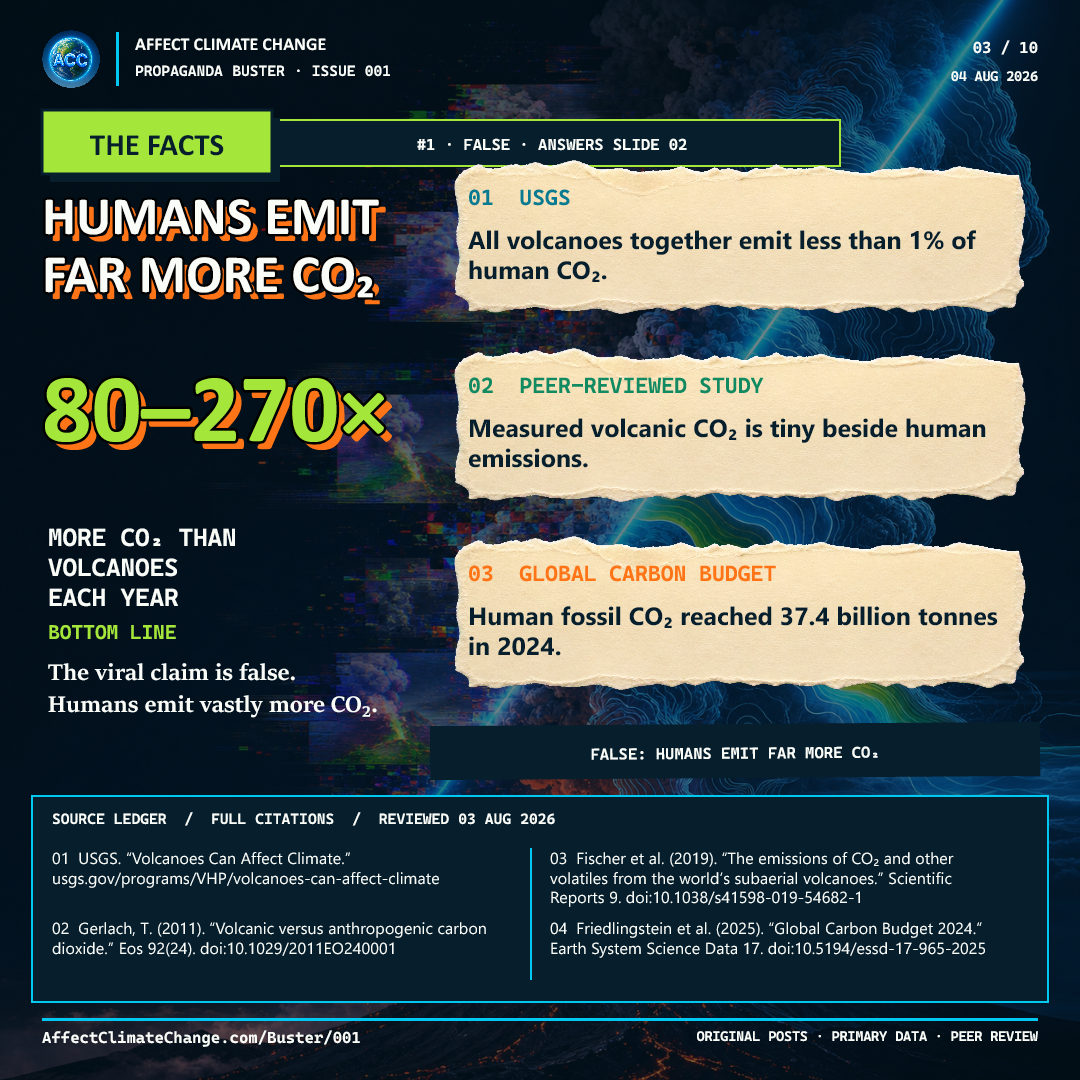
The post supplied no eruption-specific CO2 measurement. USGS estimates all present-day volcanoes combined emit 0.13–0.44 GtCO2 per year, while the Global Carbon Budget reports 42.4 ± 3.2 GtCO2 of total anthropogenic emissions in 2024. The claimed comparison has no evidentiary basis.
- USGS reports a published range of 0.13–0.44 GtCO2 per year for all present-day land and submarine volcanoes combined.
- The Global Carbon Budget 2025 reports 42.4 ± 3.2 GtCO2 of total anthropogenic emissions in 2024.
- A peer-reviewed global inventory estimated about 53 million tonnes of annual subaerial volcanic carbon dioxide during 2005–2015, orders of magnitude below human emissions.
Evidence chain
Each source is dated and paired with the finding it supports. The original post establishes what was claimed; it does not decide the scientific verdict.
Volcanoes Can Affect Climate
Published / source period:
U.S. Geological Survey · Published estimates place total present-day land and submarine volcanic CO2 emissions at 0.13–0.44 GtCO2 per year; the page compares those estimates with 35 GtCO2 of human emissions in 2010.
Accessed August 8, 2026
Volcanic versus anthropogenic carbon dioxide
Published / source period:
Eos / U.S. Geological Survey publication record · Research indicates unequivocally that human activities emit more CO2 than volcanoes.
Accessed August 8, 2026
The emissions of CO2 and other volatiles from the world's subaerial volcanoes
Published / source period:
Scientific Reports · Estimated 51.3 +/- 5.7 Tg CO2/year from non-eruptive and 1.8 +/- 0.9 Tg/year from eruptive subaerial degassing during 2005–2015.
Accessed August 8, 2026
Global Carbon Budget 2025
Published / source period:
Earth System Science Data · Total anthropogenic CO2 emissions were 42.4 ± 3.2 GtCO2 in 2024, including fossil and land-use emissions and the cement carbonation sink.
Accessed August 8, 2026
What is true
Volcanoes release carbon dioxide and can affect climate. Large explosive eruptions can also cause temporary cooling when sulfur dioxide forms sunlight-reflecting aerosols. Those facts do not support the claim that one eruption released more carbon dioxide than all cars in history.
Where the claim fails
The post compares one eruption with the cumulative emissions of every car but provides no measurement supporting that comparison. Measurements of the entire modern volcanic system show that all volcanoes together emit only a small fraction of annual human carbon dioxide emissions.
Limits and uncertainty
This legacy case predates ACC's separate limitations field. Its original verdict, scope, sources, and revision record are preserved without adding a retroactive certainty estimate.
Assessment after the evidence
The post supplied no eruption-specific CO2 measurement. USGS estimates all present-day volcanoes combined emit 0.13–0.44 GtCO2 per year, while the Global Carbon Budget reports 42.4 ± 3.2 GtCO2 of total anthropogenic emissions in 2024. The claimed comparison has no evidentiary basis.
How the framing works
How scientists know
Scientists measure volcanic CO2 using ground-based and airborne instruments and direct sampling. Satellites can measure some plume gases, especially sulfur dioxide; volcanic CO2 is harder to isolate remotely. Researchers combine these observations into regional and global inventories. Human emissions are independently estimated from fuel use, industry and land-use data.
Editorial boundaries
ACC evaluates the claim. It does not infer intent, coordination, or funding without direct evidence specific to that attribution.
The source presentation and reuse decision are documented here: Approved for publication as a recreated attributed text treatment with direct original-source and archive links.
Corrections and revision record
Corrections status: No change to the scientific verdict has been recorded.
0.1 · August 3, 2026
Initial evidence review and source-preservation record.
0.2 · August 5, 2026
Integrated the attributed social specimen treatment and reconciled source metadata; verdict unchanged.
1.0 · August 8, 2026
Rechecked the scientific source chain, removed the unresolved cumulative passenger-car calculation from the summary, and published a text-only attributed specimen; verdict unchanged.