Precise proposition checked
NASA admits climate change occurs because of changes in Earth's solar orbit, not because of SUVs and fossil fuels.
Full post context: NASA admits climate change occurs because of changes in Earth's solar orbit, not because of SUVs and fossil fuels.
Scope of this check: This legacy case evaluates only the specific factual proposition shown above. It does not infer intent, coordination, funding, or deception.
What the evidence shows
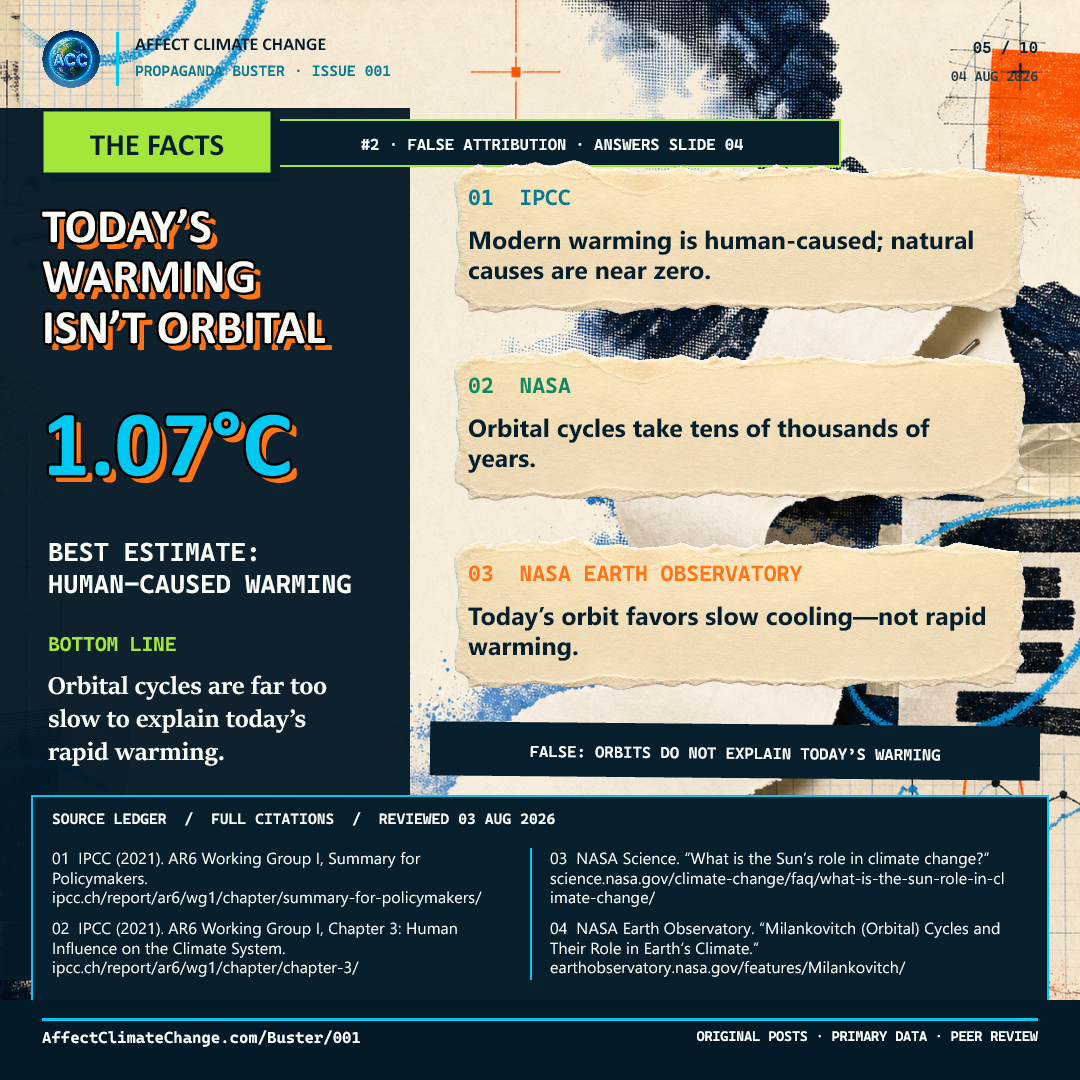
NASA did not make this admission. Orbital cycles explain long-term glacial pacing, but not the rapid modern warming trend.
- NASA states that current orbital conditions would favor very slow cooling rather than the rapid warming now observed.
- The IPCC assessed human-induced warming at about 1.07°C for 2010–2019 relative to 1850–1900, while natural forcings contributed approximately −0.1°C to +0.1°C.
- The original headline supplies no NASA statement supporting its claimed 'admission.'
Evidence chain
Each source is dated and paired with the finding it supports. The original post establishes what was claimed; it does not decide the scientific verdict.
Why Milankovitch (Orbital) Cycles Can't Explain Earth's Current Warming
Published / source period:
NASA Science · Orbital cycles act over tens to hundreds of thousands of years; current orbital positions would favor slow cooling without human influence.
Accessed August 8, 2026
AR6 WGI Chapter 3: Human Influence on the Climate System
Published / source period:
Intergovernmental Panel on Climate Change · Best estimate of human-induced warming in 2010–2019 versus 1850–1900 is 1.07 C; natural forcings contributed only -0.1 C to +0.1 C.
Accessed August 8, 2026
Global Warming: Is Current Warming Natural?
Published / source period:
NASA Earth Observatory · Natural causes remain active but are too small or too slow to explain recent rapid warming; the observed vertical temperature pattern matches greenhouse forcing.
Accessed August 8, 2026
What is true
Changes in Earth's orbit affect the distribution of sunlight and help pace glacial cycles over very long periods. They remain an important part of paleoclimate science, but they do not explain the direction or speed of current warming.
Where the claim fails
The headline reverses NASA's published explanation. Milankovitch cycles operate over tens to hundreds of thousands of years, while the present warming has unfolded rapidly and carries the observed fingerprint of increased greenhouse gases.
Limits and uncertainty
This legacy case predates ACC's separate limitations field. Its original verdict, scope, sources, and revision record are preserved without adding a retroactive certainty estimate.
Assessment after the evidence
NASA did not make this admission. Orbital cycles explain long-term glacial pacing, but not the rapid modern warming trend.
How the framing works
How scientists know
Researchers compare measured temperature, ocean heat, atmospheric composition, solar output, volcanic activity and orbital forcing with physical climate models. Only the simulations that include human greenhouse-gas forcing reproduce the modern warming pattern and magnitude.
Editorial boundaries
ACC evaluates the claim. It does not infer intent, coordination, or funding without direct evidence specific to that attribution.
The source presentation and reuse decision are documented here: Approved for publication as a recreated attributed text treatment with direct original-source and archive links.
Corrections and revision record
Corrections status: No change to the scientific verdict has been recorded.
0.1 · August 3, 2026
Initial evidence review and source-preservation record.
0.2 · August 5, 2026
Integrated the attributed headline treatment and reconciled the direct NASA source; verdict unchanged.
1.0 · August 8, 2026
Rechecked the NASA and IPCC sources and published a text-only attributed headline treatment; verdict unchanged.