Precise proposition checked
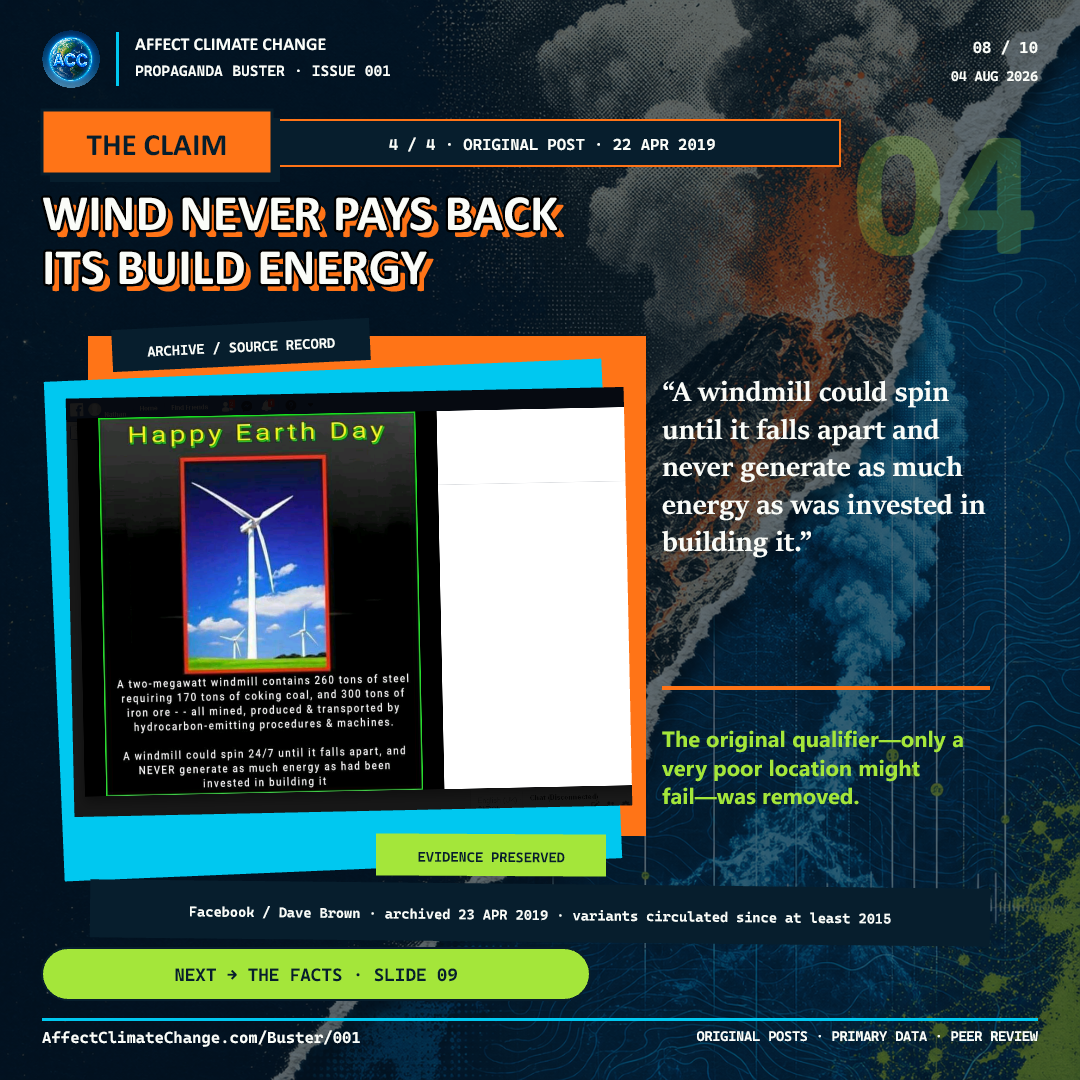
A wind turbine can spin until it falls apart and never generate as much energy as was invested in building it.
Full post context: A wind turbine can spin until it falls apart and never generate as much energy as was invested in building it.
Scope of this check: This legacy case evaluates only the specific factual proposition shown above. It does not infer intent, coordination, funding, or deception.
What the evidence shows
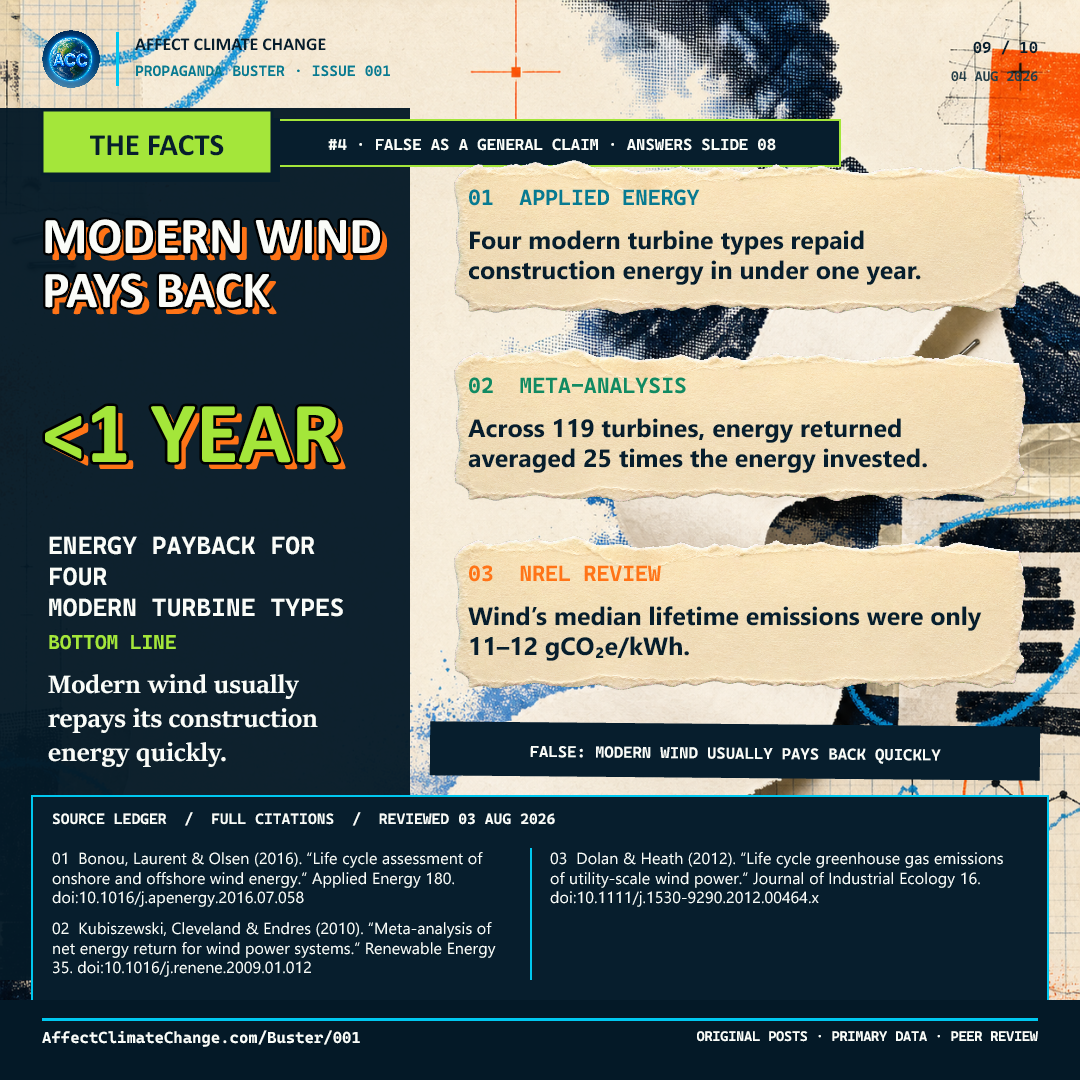
The viral meme removes the original quote's site-specific condition. Meta-analyses and lifecycle studies find modern wind turbines normally repay construction energy many times over.
- A meta-analysis covering 119 turbines from 50 studies reported an average energy return on investment of 25.2.
- A lifecycle study of four modern onshore and offshore technologies found energy payback periods below one year.
- A systematic review found median lifecycle greenhouse-gas emissions near 11–12 gCO2e/kWh for utility-scale wind power.
Evidence chain
Each source is dated and paired with the finding it supports. The original post establishes what was claimed; it does not decide the scientific verdict.
Meta-Analysis of Net Energy Return for Wind Power Systems
Published / source period:
Renewable Energy · Across 119 turbines from 50 analyses, average energy return on investment was 25.2; operational studies averaged 19.8.
Accessed August 8, 2026
Life cycle assessment of onshore and offshore wind energy — from theory to application
Published / source period:
Applied Energy · Energy payback time was less than one year for all four modern wind technologies studied.
Accessed August 8, 2026
Life Cycle Greenhouse Gas Emissions of Utility-Scale Wind Power: Systematic Review and Harmonization
Published / source period:
Journal of Industrial Ecology / NREL / DOE OSTI · Reviewing roughly 240 LCAs, 72 met quality thresholds; median lifecycle emissions were about 11–12 gCO2e/kWh.
Accessed August 8, 2026
What is true
A poorly sited turbine can perform badly, and turbine construction requires energy and materials. Those real considerations are why project-specific capacity factors and lifecycle assessments matter; they do not justify the claim that wind turbines generally fail to repay their construction energy.
Where the claim fails
The meme turns a conditional statement about unusually poor siting into a universal claim about wind turbines. Published lifecycle studies include raw materials, manufacturing, transport, construction, maintenance and decommissioning and still find positive lifetime energy returns for modern projects.
Limits and uncertainty
This legacy case predates ACC's separate limitations field. Its original verdict, scope, sources, and revision record are preserved without adding a retroactive certainty estimate.
Assessment after the evidence
The viral meme removes the original quote's site-specific condition. Meta-analyses and lifecycle studies find modern wind turbines normally repay construction energy many times over.
How the framing works
How scientists know
Lifecycle assessments inventory energy and emissions across a turbine's full life and compare them with measured or expected electricity production. Meta-analyses combine many turbine designs and sites to test whether an isolated result is representative.
Editorial boundaries
ACC evaluates the claim. It does not infer intent, coordination, or funding without direct evidence specific to that attribution.
The source presentation and reuse decision are documented here: Approved for publication as a recreated attributed text treatment with direct original-source and archive links.
Corrections and revision record
Corrections status: No change to the scientific verdict has been recorded.
0.1 · August 3, 2026
Initial evidence review and source-preservation record.
0.2 · August 5, 2026
Integrated the attributed meme treatment and retained the site-specific limitation in the evidence record; verdict unchanged.
1.0 · August 8, 2026
Rechecked the lifecycle and energy-return sources, replaced the unstable NREL record link with the DOE OSTI record, and published a text-only attributed treatment; verdict unchanged.