Precise proposition checked
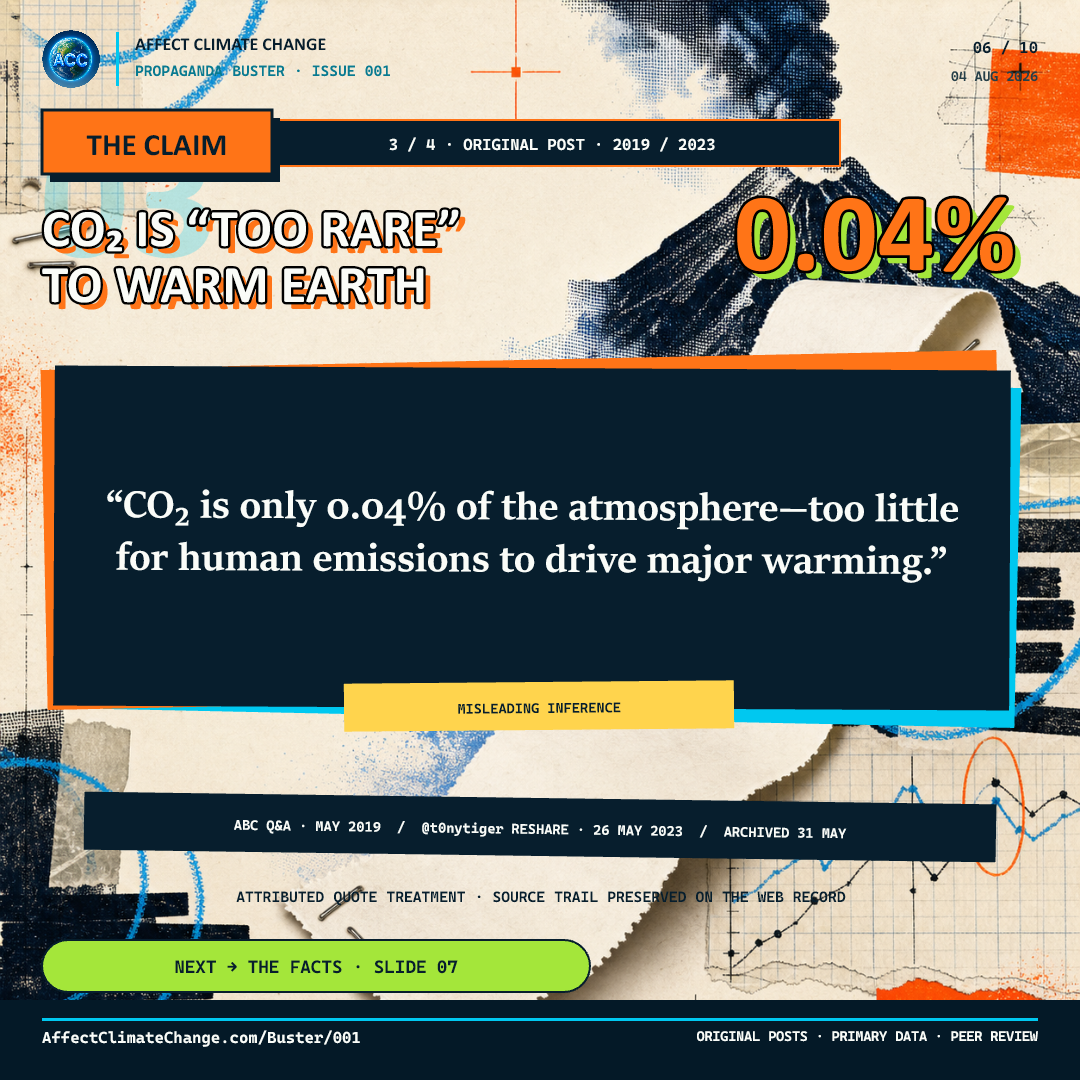
CO2 is only 0.04% of the atmosphere, so human CO2 is too small to cause substantial global warming.
Full post context: CO2 is only 0.04% of the atmosphere, so human CO2 is too small to cause substantial global warming.
Scope of this check: This legacy case evaluates only the specific factual proposition shown above. It does not infer intent, coordination, funding, or deception.
What the evidence shows
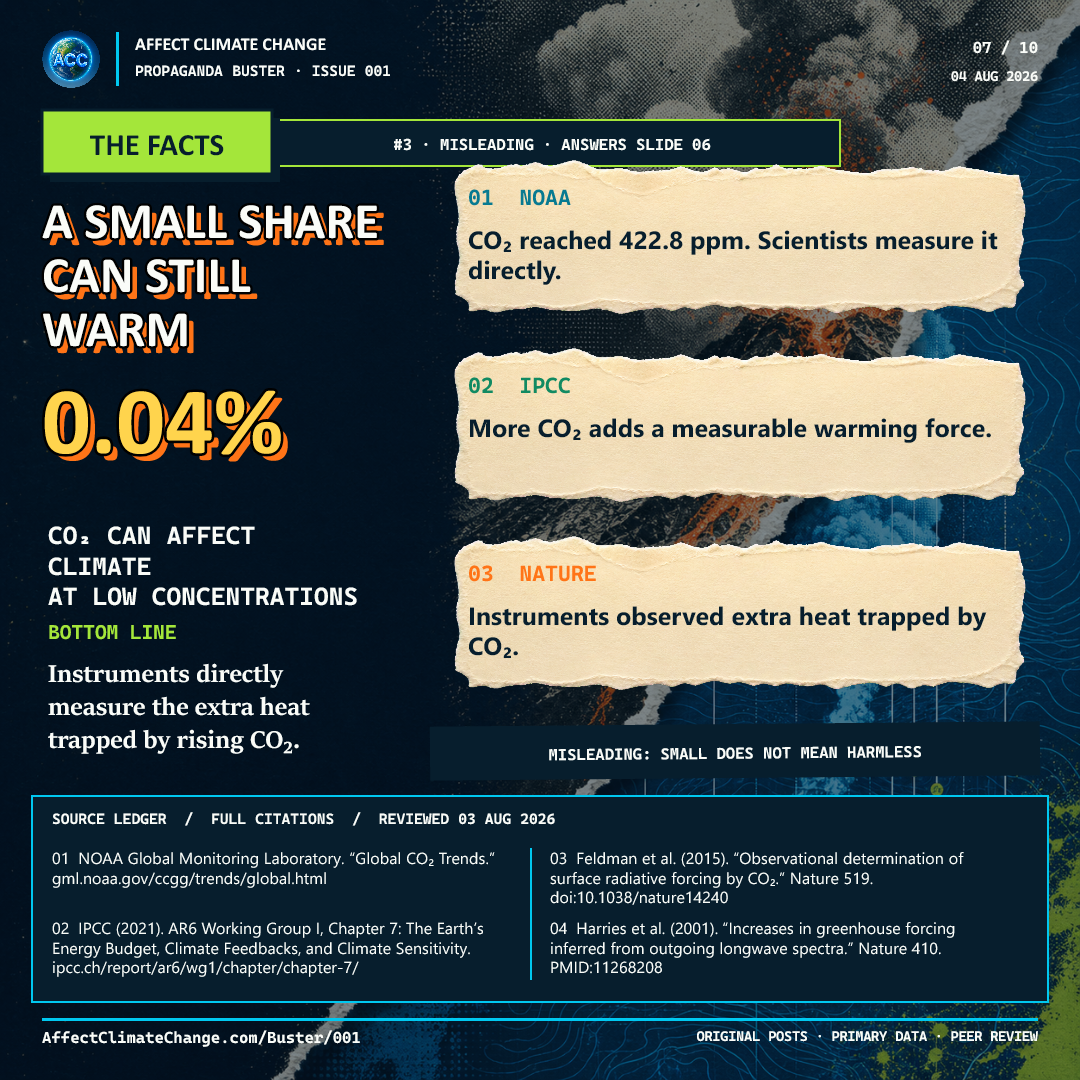
A gas's climatic effect depends on its infrared absorption and change in concentration, not on whether its atmospheric percentage looks small.
- A Nature study directly measured increased surface radiative forcing associated with a 22 ppm carbon dioxide rise from 2000 to 2010.
- Satellite spectra comparing 1970 and 1997 supplied direct observational evidence of increased greenhouse forcing.
- The IPCC assessed carbon dioxide effective radiative forcing in 2019 at 2.16 W/m² relative to 1750.
Evidence chain
Each source is dated and paired with the finding it supports. The original post establishes what was claimed; it does not decide the scientific verdict.
Observational determination of surface radiative forcing by CO2 from 2000 to 2010
Published / source period:
Nature · A 22 ppm CO2 increase produced a directly observed rise in surface radiative forcing at two sites, consistent with radiative-transfer calculations.
Accessed August 8, 2026
Increases in greenhouse forcing inferred from the outgoing longwave radiation spectra of the Earth in 1970 and 1997
Published / source period:
Nature / PubMed record · Satellite spectra provide direct experimental evidence of an increased greenhouse effect consistent with rising greenhouse gases. Nature published an erratum on April 26, 2001.
Accessed August 8, 2026
Annual Greenhouse Gas Index
Published / source period:
NOAA Global Monitoring Laboratory · Global CO2 reached 422.80 +/- 0.10 ppm in 2024 and was the largest contributor to effective radiative forcing from long-lived greenhouse gases.
Accessed August 8, 2026
AR6 WGI Chapter 7: The Earth's Energy Budget, Climate Feedbacks, and Climate Sensitivity
Published / source period:
Intergovernmental Panel on Climate Change · CO2 effective radiative forcing in 2019 relative to 1750 was assessed at 2.16 [1.90 to 2.41] W/m2.
Accessed August 8, 2026
What is true
Carbon dioxide is a trace gas, currently a little above four hundred parts per million. Its concentration has nevertheless increased by roughly half since the preindustrial era, and its molecular absorption properties give that change a measurable warming effect.
Where the claim fails
The approximate percentage is real, but atmospheric abundance alone does not determine climatic influence. Carbon dioxide absorbs infrared radiation at specific wavelengths, and both surface instruments and satellites directly detect the resulting change in Earth's energy flow.
Limits and uncertainty
This legacy case predates ACC's separate limitations field. Its original verdict, scope, sources, and revision record are preserved without adding a retroactive certainty estimate.
Assessment after the evidence
A gas's climatic effect depends on its infrared absorption and change in concentration, not on whether its atmospheric percentage looks small.
How the framing works
How scientists know
Laboratory spectroscopy establishes how carbon dioxide absorbs infrared energy. Surface instruments and satellites then observe the predicted spectral changes in the real atmosphere, while global monitoring networks measure the concentration increase.
Editorial boundaries
ACC evaluates the claim. It does not infer intent, coordination, or funding without direct evidence specific to that attribution.
The source presentation and reuse decision are documented here: Approved for publication as a recreated attributed text treatment with direct original-source and archive links.
Corrections and revision record
Corrections status: No change to the scientific verdict has been recorded.
0.1 · August 3, 2026
Initial evidence review and source-preservation record.
0.2 · August 5, 2026
Corrected the Harries et al. PubMed identifier to 11268208, added DOI 10.1038/35066553 and the official erratum, and integrated the attributed quote treatment; verdict unchanged.
1.0 · August 8, 2026
Rechecked the direct-observation, NOAA, and IPCC sources and published a text-only attributed quote treatment; verdict unchanged.