
Precise proposition checked
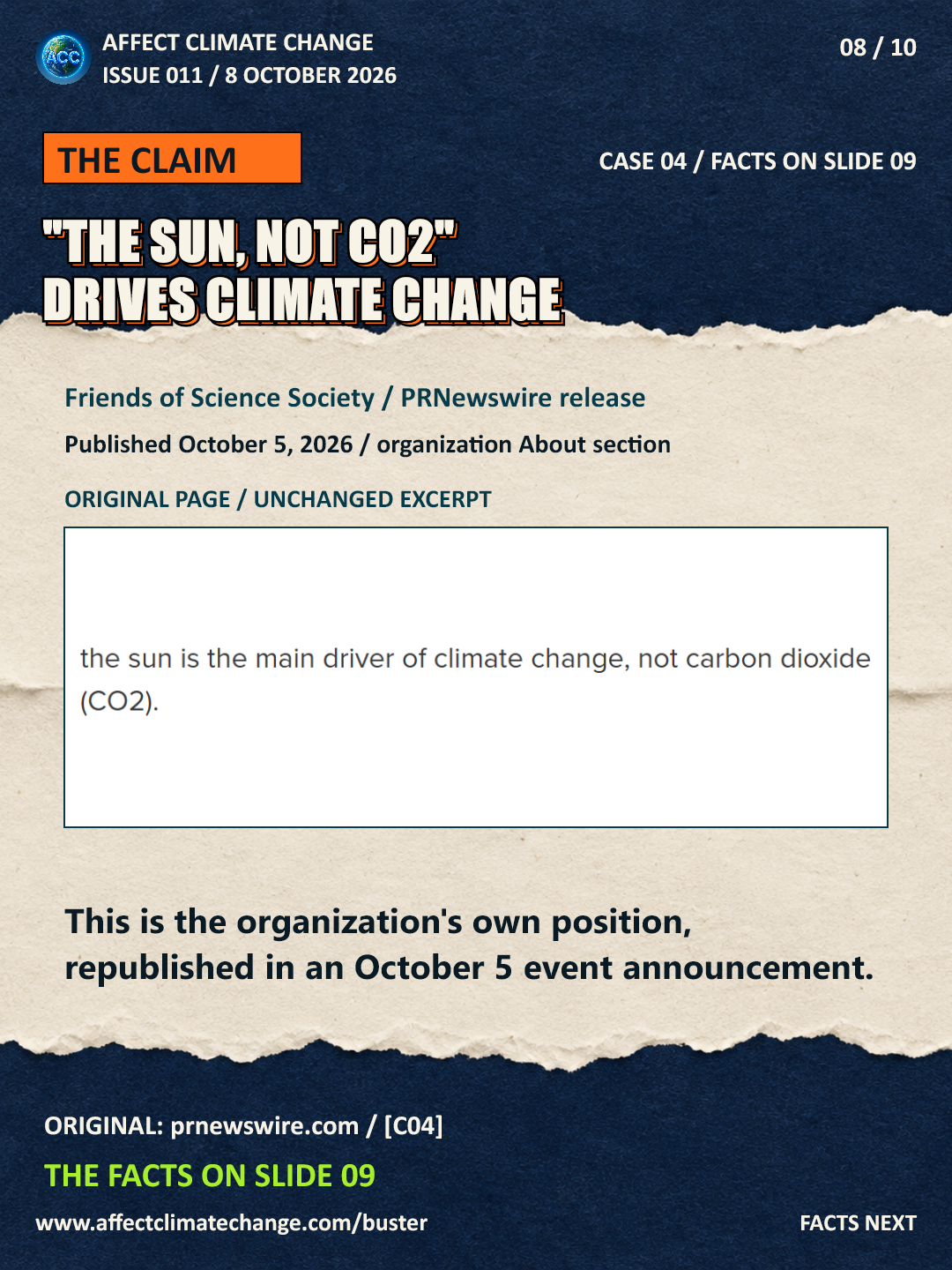
The Sun, rather than human greenhouse-gas emissions, is the main driver of recent global warming. This check does not concern every historical change in climate.
Full post context: The original statement is the organization's own position in the About section of its October 5 press release. It is not attributed to the advertised speaker and does not report a new study. Our verdict concerns its use as an explanation for recent global warming, not the Sun's basic role in climate or every historical climate change.
Scope of this check: Verdict scope is recent global warming. Multiple human and natural influences exist. IPCC attribution ranges and baselines are retained in the full record.
What the evidence shows
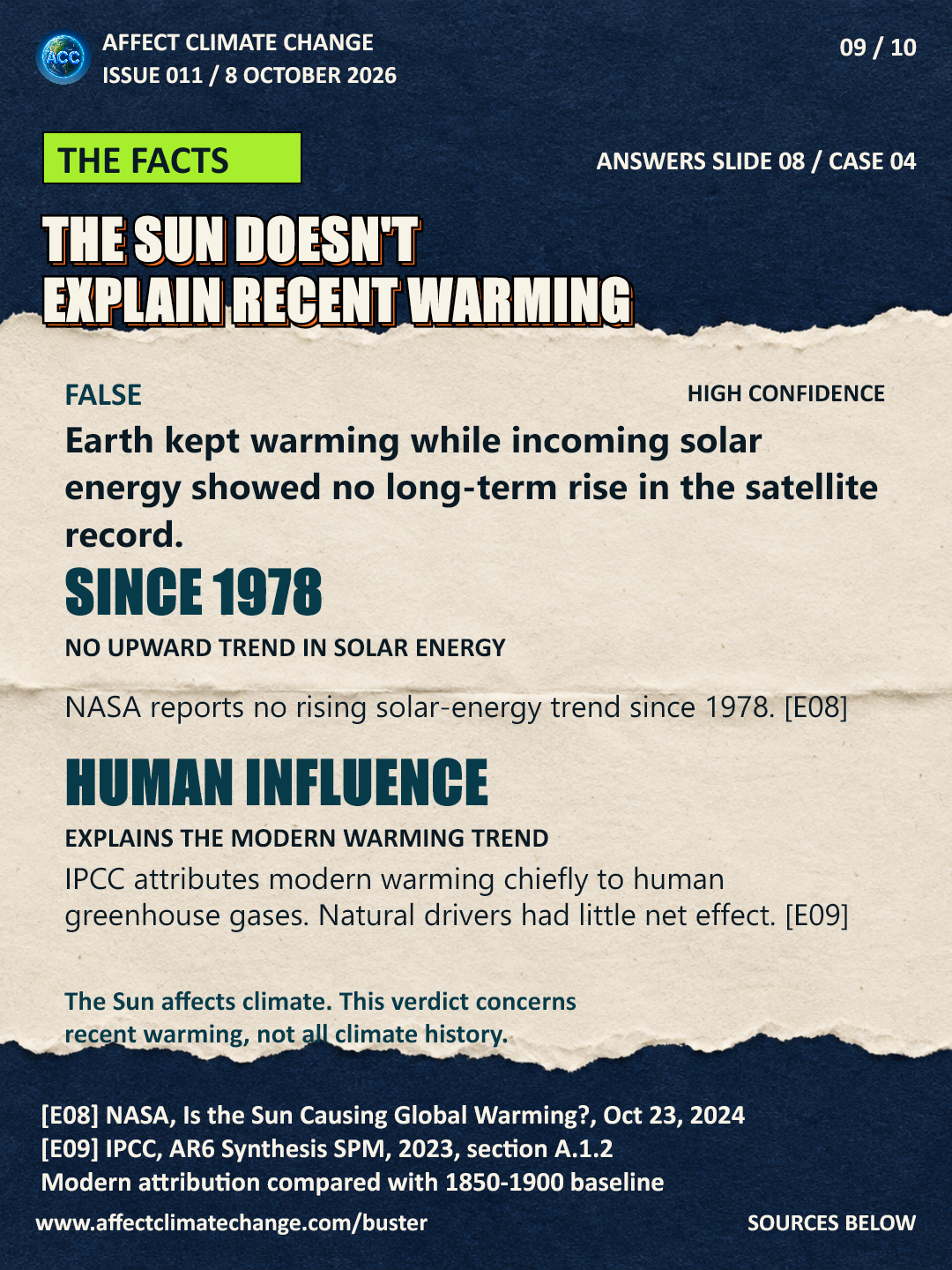
The original statement is the organization's own position in the About section of its October 5 press release. It is not attributed to the advertised speaker and does not report a new study. Our verdict concerns its use as an explanation for recent global warming, not the Sun's basic role in climate or every historical climate change. NASA reports no net increase in incoming solar energy since the 1950s and no upward trend in the satellite measurements beginning in 1978, despite rising global temperatures. NASA also explains that warming near the surface with cooling in the stratosphere matches the greenhouse-gas pattern rather than an increase in solar output. The IPCC's 2023 synthesis estimates human-caused warming for 2010-2019 relative to 1850-1900 at 0.8-1.3 degrees C, with a best estimate of 1.07 degrees C. Natural solar and volcanic drivers contributed between -0.1 and +0.1 degrees C. Greenhouse gases caused warming, partly offset by other human influences, especially aerosols. This does not mean CO2 is the only driver or that uncertainty is absent. The Sun and orbital cycles do affect climate over various timescales. That true general statement cannot explain the observed modern warming trend without the needed increase in solar forcing.
- SINCE 1978 — NO UPWARD TREND IN SOLAR ENERGY. NASA reports no rising solar-energy trend since 1978. [E08]
- HUMAN INFLUENCE — EXPLAINS THE MODERN WARMING TREND. IPCC attributes modern warming chiefly to human greenhouse gases. Natural drivers had little net effect. [E09]
- Verdict scope is recent global warming. Multiple human and natural influences exist. IPCC attribution ranges and baselines are retained in the full record.
Evidence chain
Each source is dated and paired with the finding it supports. The original post establishes what was claimed; it does not decide the scientific verdict.
Is the Sun Causing Global Warming?
Published / source period: 2024-10-23 (page last updated)
NASA · No net incoming-solar-energy increase since the 1950s and no upward trend in the satellite record beginning in 1978, despite rising temperatures.
Accessed October 11, 2026
AR6 Synthesis Report, Summary for Policymakers
Published / source period: 2023
Intergovernmental Panel on Climate Change · 2010-2019 versus 1850-1900 human warming 0.8-1.3 C, best 1.07 C. Natural solar/volcanic contribution -0.1 to +0.1 C. Greenhouse-gas warming partly offset by other human influences.
Accessed October 11, 2026
What is true
The Sun and orbital cycles affect climate on other timescales. Modern warming also reflects non-CO₂ greenhouse gases, aerosols and natural influences; CO₂ is not the only factor.
Where the claim fails
The original statement is the organization's own position in the About section of its October 5 press release. It is not attributed to the advertised speaker and does not report a new study. Our verdict concerns its use as an explanation for recent global warming, not the Sun's basic role in climate or every historical climate change. NASA reports no net increase in incoming solar energy since the 1950s and no upward trend in the satellite measurements beginning in 1978, despite rising global temperatures. NASA also explains that warming near the surface with cooling in the stratosphere matches the greenhouse-gas pattern rather than an increase in solar output. The IPCC's 2023 synthesis estimates human-caused warming for 2010-2019 relative to 1850-1900 at 0.8-1.3 degrees C, with a best estimate of 1.07 degrees C. Natural solar and volcanic drivers contributed between -0.1 and +0.1 degrees C. Greenhouse gases caused warming, partly offset by other human influences, especially aerosols. This does not mean CO2 is the only driver or that uncertainty is absent. The Sun and orbital cycles do affect climate over various timescales. That true general statement cannot explain the observed modern warming trend without the needed increase in solar forcing.
Limits and uncertainty
Verdict scope is recent global warming. Multiple human and natural influences exist. IPCC attribution ranges and baselines are retained in the full record. The Sun affects climate. This verdict concerns recent warming, not all climate history.
Assessment after the evidence
False as an explanation of recent global warming.
How the framing works
A true general role for the Sun substituted for modern attribution
How scientists know
NASA compares incoming solar-energy trends and atmospheric warming patterns. IPCC attribution combines observations and climate-model experiments to estimate human and natural contributions with uncertainty ranges.
Editorial boundaries
ACC evaluates the claim. It does not infer intent, coordination, funding, deception, or control without direct evidence specific to that attribution.
The source presentation and reuse decision are documented here: Bounded native excerpt used for identification and criticism with attribution and a direct source link. No license or endorsement implied.
Corrections and revision record
Corrections status: No change to the scientific verdict has been recorded.
web-1 · October 11, 2026
First website edition authorized by Jesse on October 11, 2026. Original issue, claim and evidence dates preserved; original provenance, evidence, limitations and verdict appear in that order.