ACC News Brief
Clean Energy Switzerland
Evaporation-powered lab device reaches 1 volt and 0.25 watts per square meter
What happened
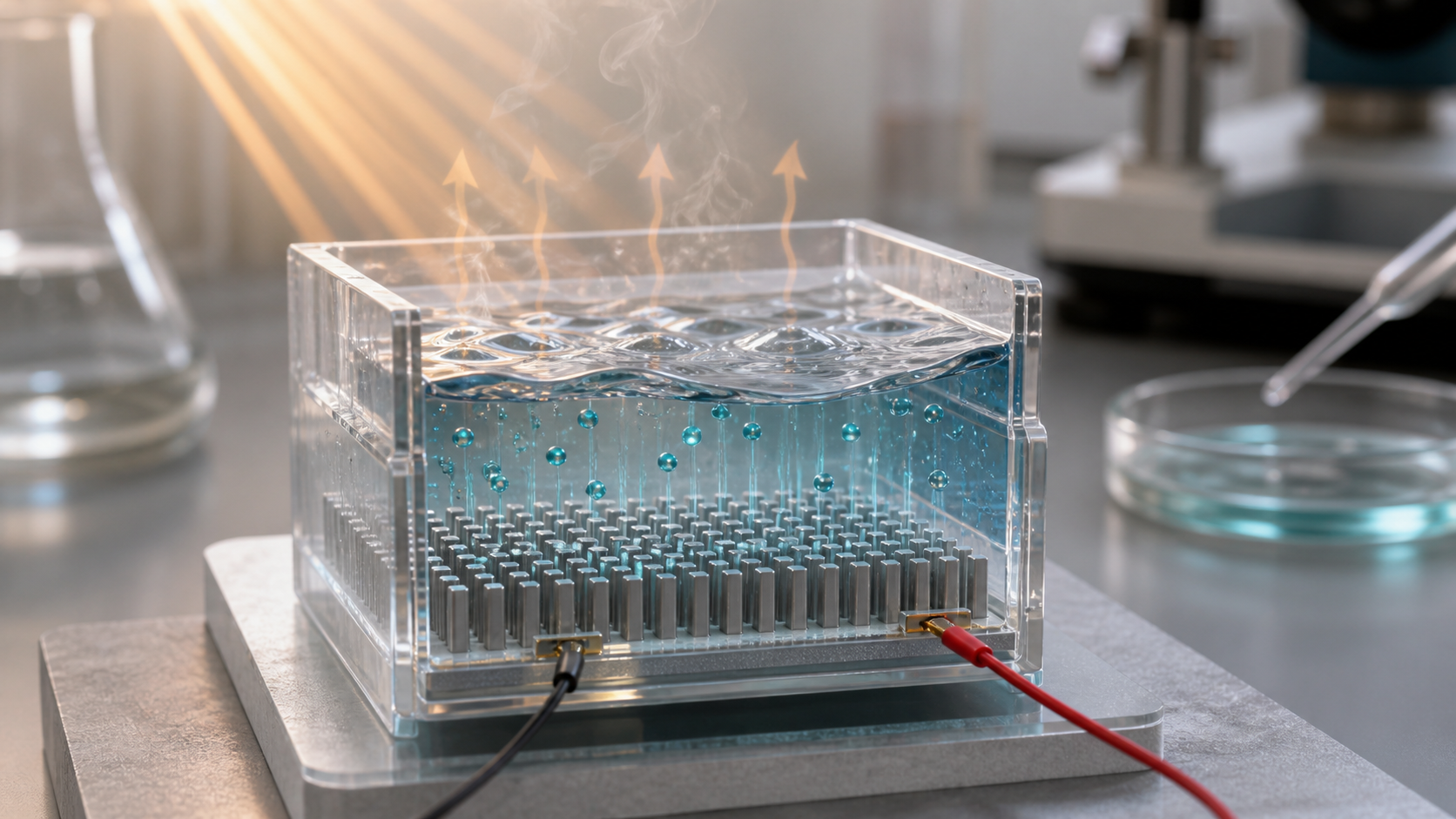
An EPFL team built a one-square-centimeter laboratory device that separates an evaporating top surface from a silicon-dielectric nanopillar electrode with an ion-conducting liquid layer. Under optimized heat, light, and salt conditions, the device reached 1 volt open-circuit voltage and 0.25 watts per square meter of power density, while a stability test maintained steady voltage for more than 50 hours. The experiment clarifies how light, heat, surface chemistry, and ion movement interact; it does not demonstrate a field-ready generator or commercial power system.
Why it matters
Evaporation-driven devices might eventually power very low-energy sensors or recover small amounts of low-grade heat where batteries or wiring are impractical. The reported output is still a laboratory result at tiny area, so durability, net energy, manufacturing cost, water chemistry, fouling, and performance outdoors remain unresolved.
What to watch
- Independent replication and larger-area modules that preserve voltage, power density, and stable operation.
- Full energy-balance tests under realistic light, temperature, humidity, salinity, and evaporation conditions.
- Material use, fabrication yield, electrode durability, salt buildup, maintenance, lifecycle impacts, and practical sensor demonstrations.
Sources & evidence
- Enhancing hydrovoltaic power generation through coupled heat and light-driven surface charge dynamicsPeer-reviewed open-access Article in Nature Communications, published January 9, 2026. It reports a one-square-centimeter experimental device, a predictive equivalent-circuit model, 1 V open-circuit voltage, 0.25 W/m2 peak power density under optimized conditions, and more than 50 hours of steady-voltage testing; it is not an operating commercial generator.
- Source data for the hydrovoltaic device studyZenodo source-data record linked by the paper for the experimental measurements and figures.
Continue learning with ACC
Explore ACC's renewable electricity and grid guide