ACC News Brief
Solar China
Flexible tandem solar cell reaches 27.3% by controlling crystallization
What happened
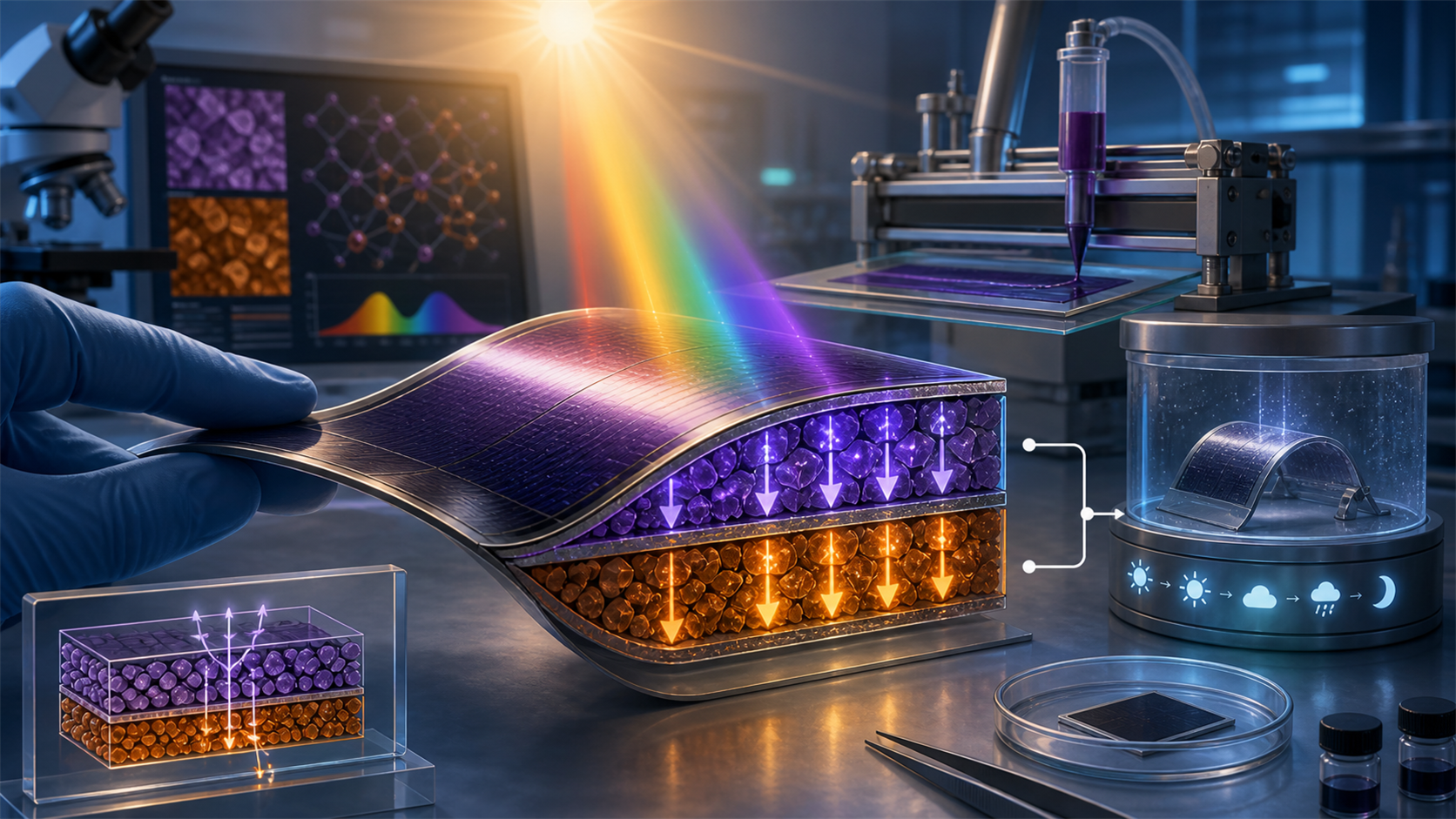
Researchers reported a flexible perovskite–CIGS tandem solar cell with 27.3% power-conversion efficiency after using 2-pyrrolidinone to suppress unwanted crystallization during ambient blade coating. The laboratory device showed minimal efficiency loss during 500 hours of operation, an encouraging result that does not yet establish commercial-scale durability.
Why it matters
Lightweight, flexible solar cells could serve roofs and other surfaces that cannot support conventional modules. Reaching that potential will require independently verified performance, larger-area manufacturing, long outdoor lifetimes, and responsible management of lead and other materials.
What to watch
- Independent efficiency certification and results from larger modules made with scalable production methods.
- Outdoor, damp-heat, thermal-cycle, and mechanical-flex testing over much longer periods.
- Manufacturing yield, material supply, encapsulation, and end-of-life recovery.
Sources & evidence
- Crystallization suppression of mixed-halide intermediates for perovskite/Cu(In,Ga)Se2 tandem solar cells with improved efficiencyPeer-reviewed Article in Nature Energy, published January 29, 2026. It reports a 27.3% flexible monolithic two-terminal tandem device and 500-hour operational testing; these are laboratory results, not evidence of a commercial module or operating solar project.
Continue learning with ACC
Explore ACC's renewable electricity and grid guide