ACC News Brief
Climate Solutions Laboratory research
A selective membrane helped an electrochemical cell capture carbon dioxide from air
What happened
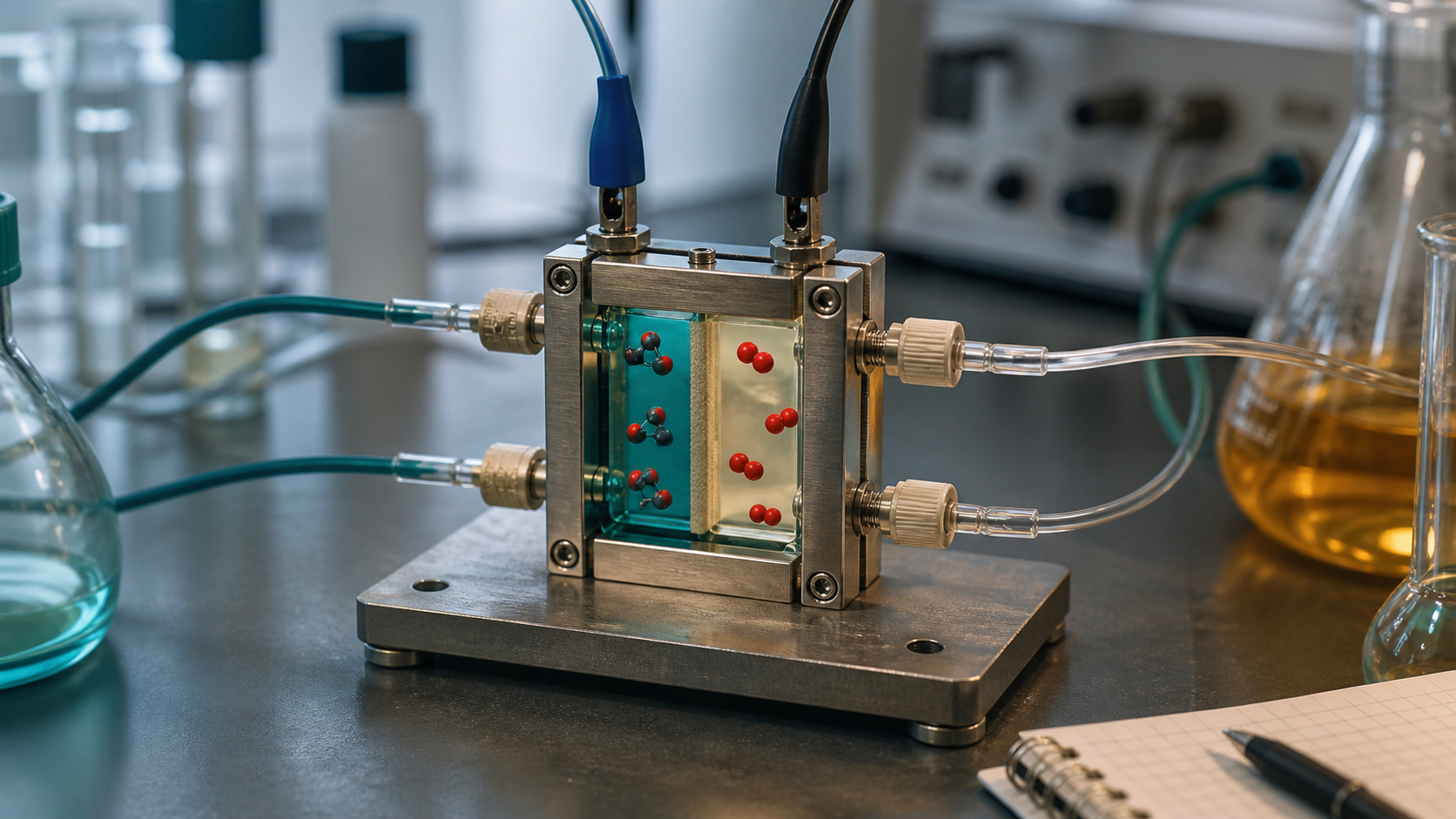
A peer-reviewed laboratory study paired a redox carrier with a gas-selective membrane in a two-by-two-centimetre electrochemical cell. The membrane suppressed oxygen side reactions while the device cycled direct-air capture under both dry and humid conditions.
Why it matters
Oxygen and humidity are persistent challenges for electrochemical direct-air capture, so addressing one bottleneck is useful progress. The experiment was a small, low-loading cell and did not demonstrate a scaled air contactor, full-system energy use, carbon-dioxide compression, geological storage, lifecycle emissions, or durable net removal.
What to watch
- Thousands of cycles, larger electrodes, realistic airflow, humid-air durability, and complete energy requirements.
- Verified carbon-dioxide compression and storage plus lifecycle accounting before any net-removal claim.
Sources & evidence
- High-efficiency electrochemical air capture enabled by thiadiazole redox carrier with tunable gas-selective channelsPeer-reviewed Article, Nature Communications 17 (2026), published March 7, 2026. The small cell completed 48 dry-air and 46 humid-air cycles with reported Faradaic efficiencies near 80 and 78 percent; it was not a scaled removal system.
Continue learning with ACC
Explore ACC's climate solutions pathways