ACC News Brief
Climate Solutions Global
Where forests return can matter as much as how much land is restored
What happened
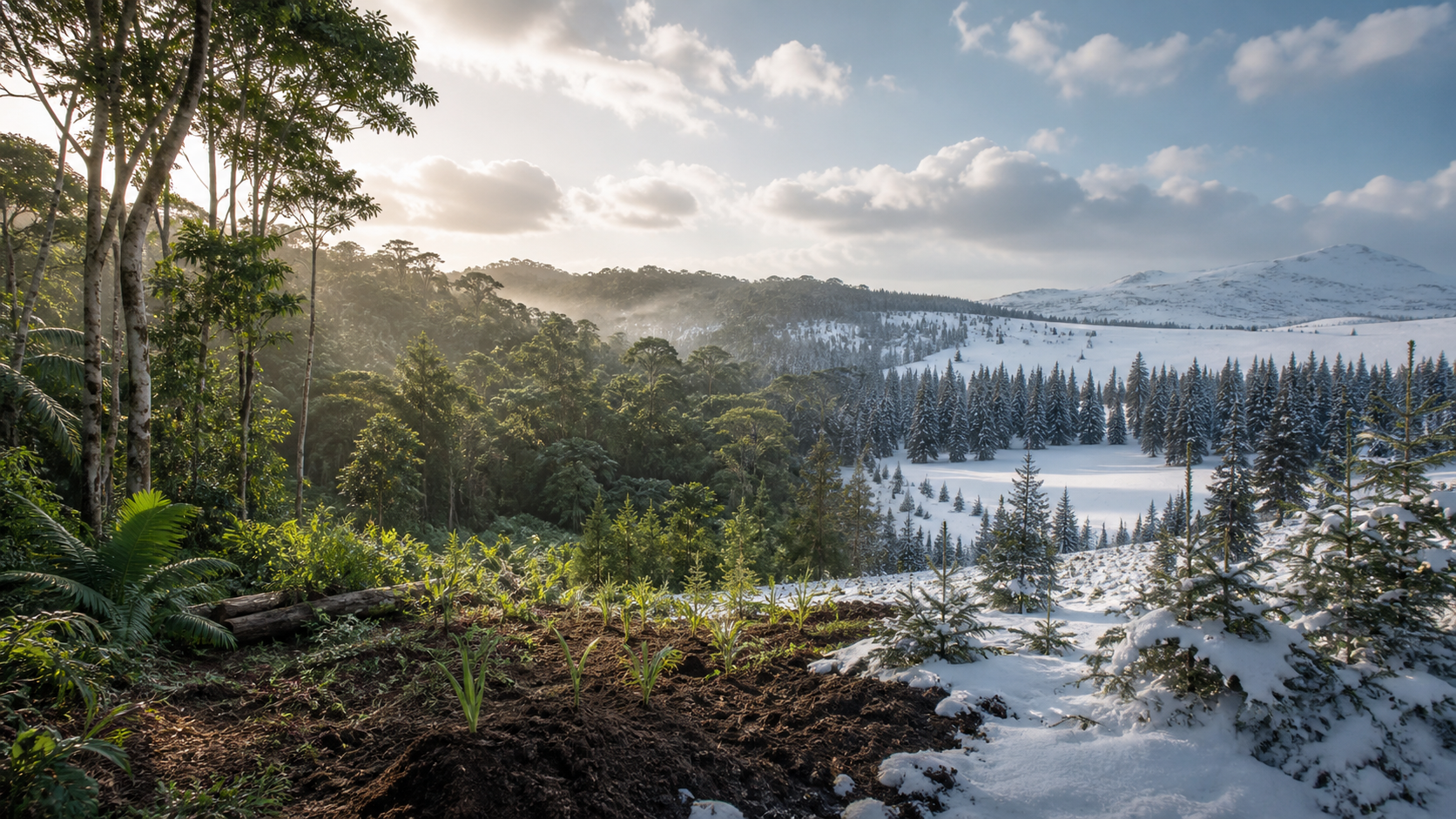
In a peer-reviewed Earth-system modeling study, three reforestation scenarios produced estimated end-century global cooling of 0.13 to 0.25 degrees Celsius. A strategically located scenario used about 450 million fewer hectares while achieving cooling comparable to a much larger scenario, because carbon, evapotranspiration, albedo, and circulation effects varied by place.
Why it matters
Climate-smart restoration requires more than maximizing tree counts: tropical planting generally cooled locally in the model, while some high-latitude planting could offset benefits by darkening snowy surfaces. These are modeled scenarios, not proof of available land, durable carbon, biodiversity gains, community consent, or observed temperature change.
What to watch
- Field feasibility, land rights, food competition, biodiversity, fire and drought risk, and long-term carbon permanence.
- Whether other Earth-system models reproduce the regional tradeoffs and remote atmospheric and ocean feedbacks.
Sources & evidence
- Reforestation scenarios shape global and regional temperature outcomesPeer-reviewed Article, Communications Earth & Environment 7 (2026), from ETH Zurich, Ghent University, NCAR, and the Potsdam Institute for Climate Impact Research. Published March 11, 2026. Five-member CESM2 scenario ensembles under SSP2-4.5; projected rather than observed outcomes.
- Reforestation modeling code archiveCode archive associated with the Earth-system modeling study.
Continue learning with ACC
Explore ACC's ecosystems guide