ACC News Brief
Clean Energy Chabahar Bay, Oman Sea
A coastal blowhole study tests a low-impact route to wave energy
What happened
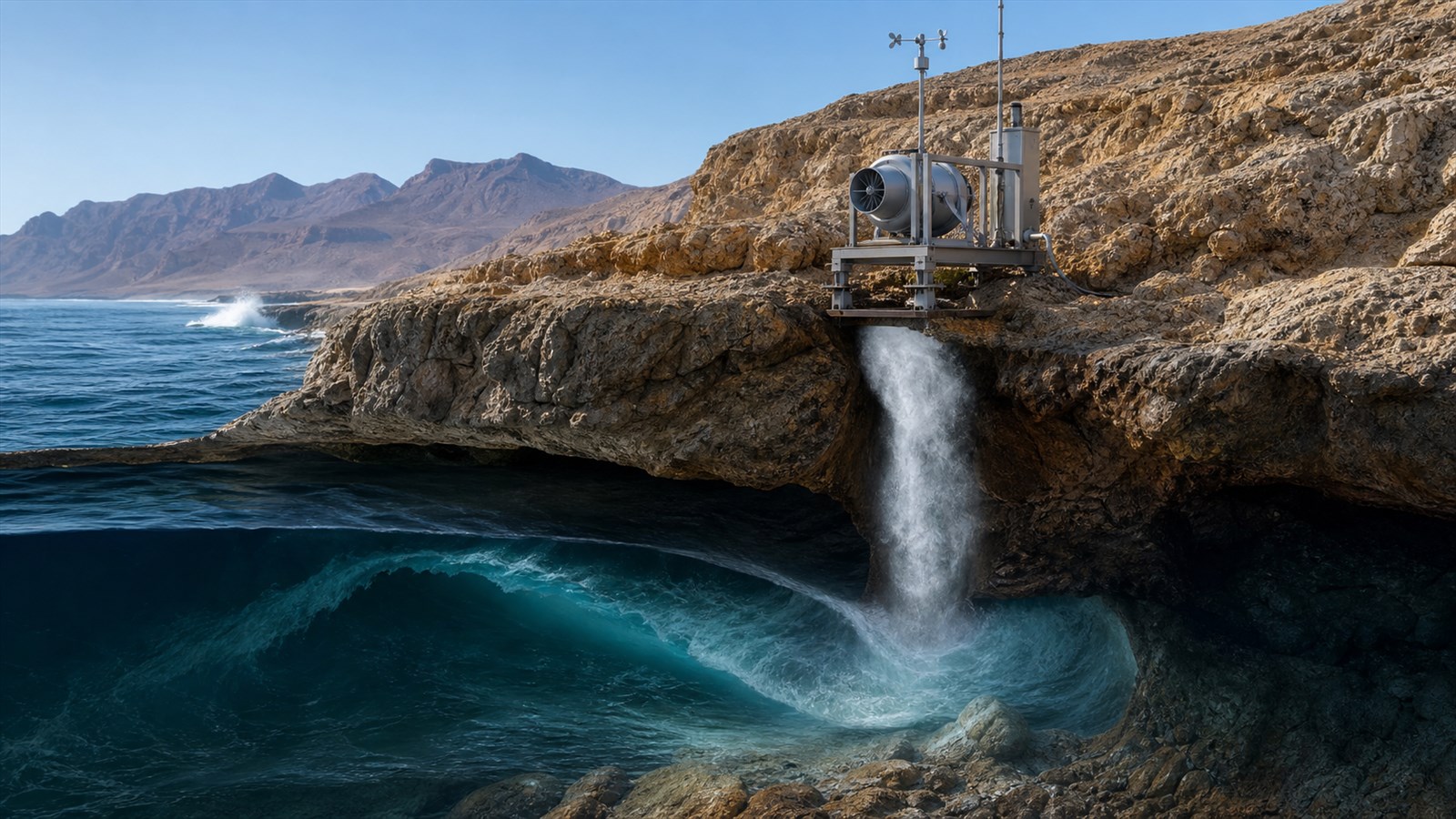
A Scientific Reports study treated a natural coastal blowhole as an analogue of an oscillating water column. Laboratory airflow measurements validated a computational fluid-dynamics model that was extended to a Chabahar Bay field geometry. The model estimated about 3 kilowatts of pneumatic kinetic power per vent, while 5,000 Monte Carlo realizations produced a mean regional wave-power flux of 8.7 kilowatts per meter. Those are modeled mechanical and wave-resource values, not electrical output from an installed generator or proof of commercial viability.
Why it matters
Using existing coastal geometry could reduce some civil works associated with wave energy, but a promising airflow resource is only the start. Turbine efficiency, ecology, corrosion, safety, maintenance, permitting, and seasonal reliability still determine whether the concept is useful.
What to watch
- A real field prototype measuring net electricity, efficiency, noise, wildlife effects, saltwater corrosion, storm survival, and maintenance rather than modeled airflow alone.
- Site screening that protects culturally important coastlines and sensitive habitats and avoids treating rare natural blowholes as automatically available infrastructure.
Sources & evidence
- A natural coastal blowhole as a novel wave energy extraction mechanism; experimental, CFD, and probabilistic evaluationOpen-access Scientific Reports study published May 7, 2026, DOI 10.1038/s41598-026-50798-3. It combines laboratory measurements, CFD, and probabilistic wave-resource modeling; it does not report electricity from an operating field turbine.
Continue learning with ACC
Explore ACC's renewable energy and grid guide