Precise proposition checked
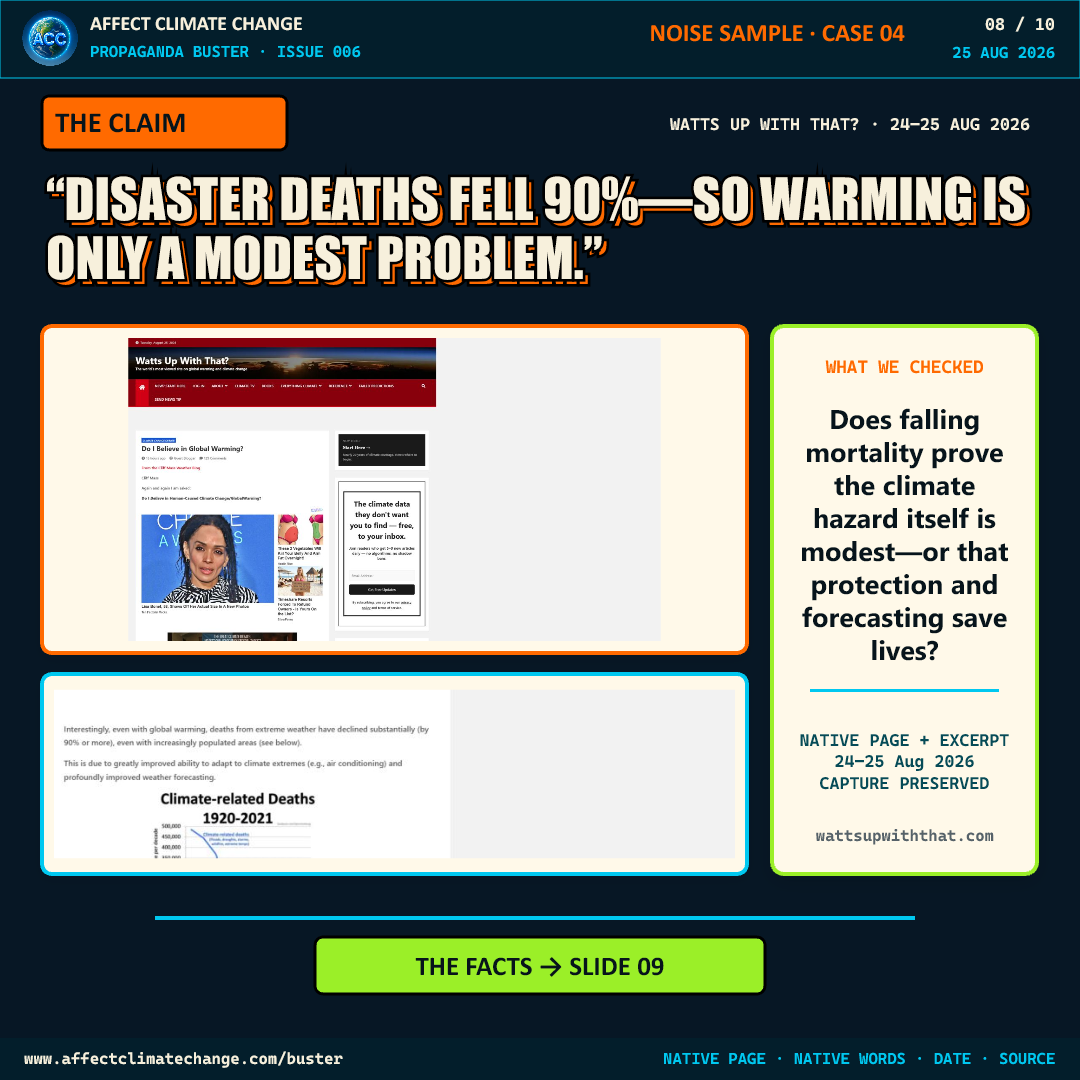
The decline in weather-related disaster mortality is a sufficient measure of total climate risk and demonstrates that human-caused warming creates only modest harm.
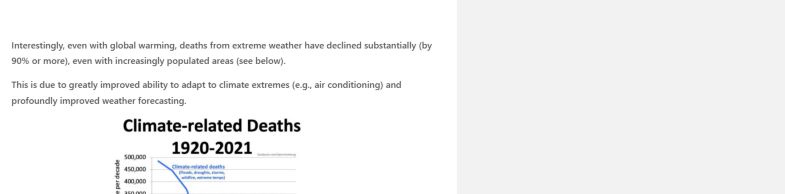
Full post context: A Watts Up With That? article dated August 24 in its URL and August 25 in page metadata used a large decline in weather-disaster mortality to characterize human-caused warming as only a modest problem.
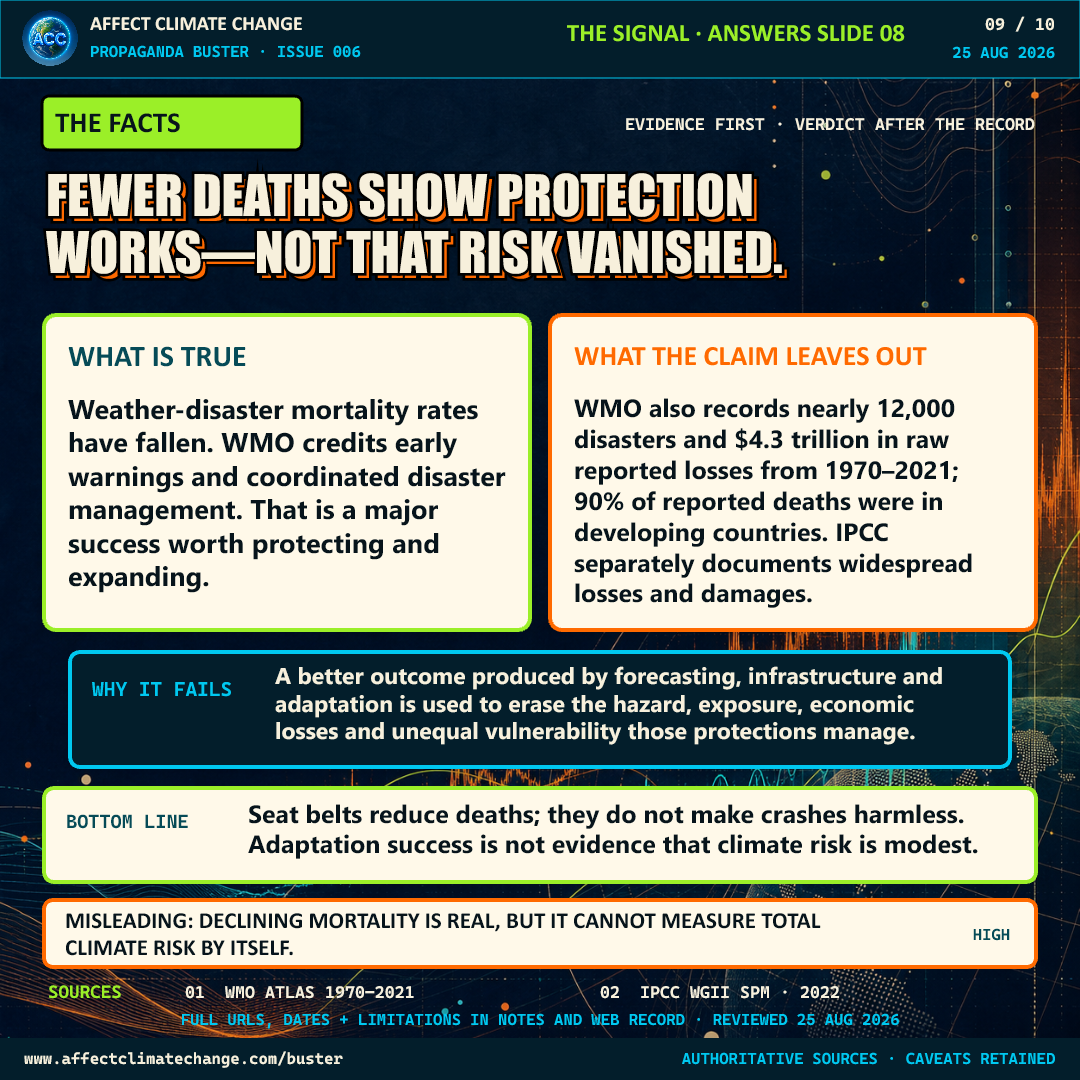
Scope of this check: The check recognizes the mortality decline and the lifesaving effects of early warning, preparedness, infrastructure, and disaster management.
What the evidence shows
WMO credits early warnings and coordinated disaster management with lower mortality rates. It also records nearly 12,000 weather-, climate-, and water-related disasters and about $4.3 trillion in raw reported losses from 1970–2021; IPCC separately documents widespread adverse climate impacts and losses and damages.
- WMO reports large declines in mortality rates and credits early warnings and disaster management.
- WMO records nearly 12,000 disasters and about $4.3 trillion in raw reported losses from 1970–2021.
- Ninety percent of reported deaths in the WMO record occurred in developing countries.
- IPCC documents widespread adverse impacts and losses and damages beyond mortality alone.
Evidence chain
Each source is dated and paired with the finding it supports. The original post establishes what was claimed; it does not decide the scientific verdict.
Atlas of Mortality and Economic Losses from Weather Climate and Water-related Hazards 1970-2021
Published / source period: 2023-05-22
World Meteorological Organization · Reports falling mortality rates linked to early warnings and disaster management, alongside nearly 12,000 recorded disasters, about $4.3 trillion in raw reported losses, and strong geographic inequality from 1970–2021.
Accessed August 25, 2026
IPCC AR6 WGII Summary for Policymakers
Published / source period: 2022
Intergovernmental Panel on Climate Change · Human-caused climate change has caused widespread adverse impacts and losses and damages beyond natural variability.
Accessed August 25, 2026
What is true
Weather-disaster mortality rates have fallen substantially, and that is a major achievement. Early warning systems, forecasting, safer infrastructure, public health, and emergency management save lives.
Where the claim fails
The argument substitutes one outcome that is strongly shaped by preparedness for the full risk picture. Successful adaptation can reduce deaths even while hazards, exposure, economic losses, displacement, and ecosystem damage remain serious.
Limits and uncertainty
WMO's $4.3 trillion is raw reported weather-, climate-, and water-related loss, not an exposure- or inflation-normalized climate-attribution series. Disaster databases change over time, and no single metric captures total climate risk.
Assessment after the evidence
Falling mortality shows that protection works; it does not measure total hazard, exposure, economic loss, displacement, ecosystem damage, or unequal vulnerability.
How the framing works
Outcome substitution: success in reducing one consequence is used to erase the broader risk being managed.
How scientists know
Risk assessments separate hazard, exposure, vulnerability, and outcomes, then compare mortality with economic losses, displacement, infrastructure damage, ecosystem impacts, and geographic inequality.
Editorial boundaries
ACC evaluates the claim. It does not infer intent, coordination, funding, deception, or control without direct evidence specific to that attribution.
The source presentation and reuse decision are documented here: Approved bounded native-source crop for criticism and fact-checking, shown with attribution and a direct source link; unrelated page content is excluded.
Corrections and revision record
Corrections status: No change to the scientific verdict has been recorded.
v1.0 · August 25, 2026
Initial evidence review. Verdict: MISLEADING, high confidence; adaptation success and total risk remain separate.
v1.1 · August 28, 2026
Canonical website record integrated from the verified R1 handoff.