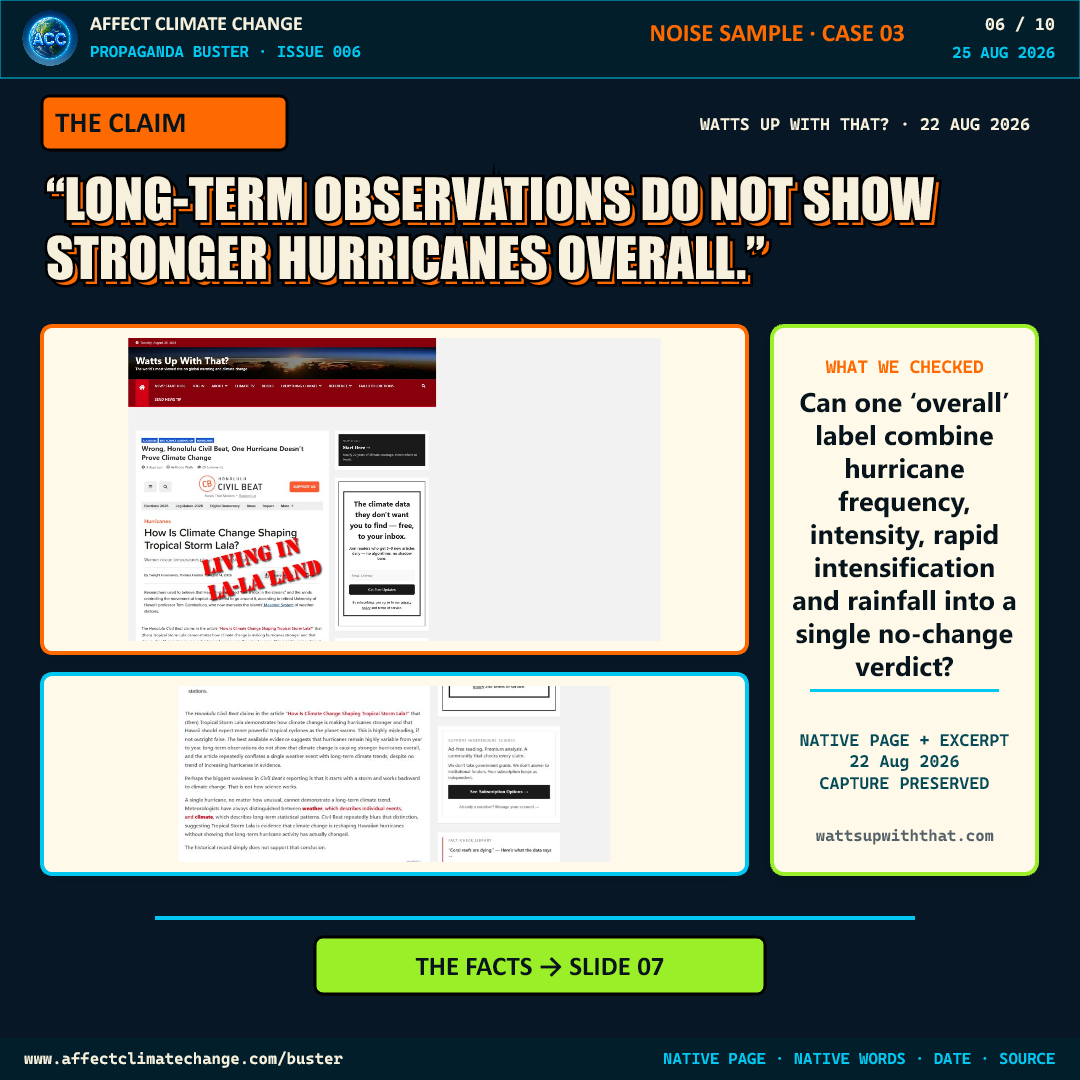
Precise proposition checked
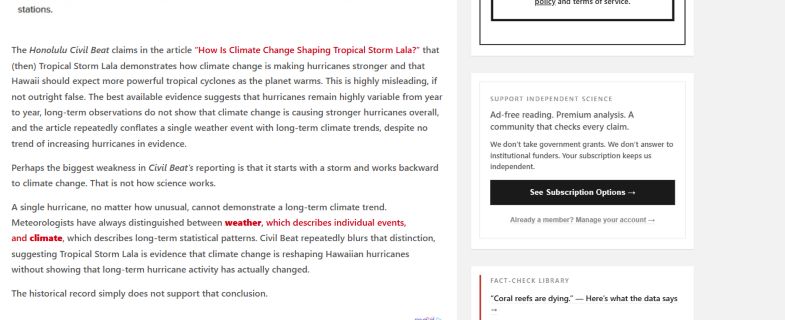
Long-term evidence shows no strengthening climate-change signal for tropical cyclones when frequency, intensity, rapid intensification, and rainfall are considered together.
Full post context: An August 22, 2026 Watts Up With That? article used one broad ‘overall’ label while discussing hurricane frequency, intensity, rapid intensification, and rainfall.
Scope of this check: The check agrees that one hurricane cannot establish a climate trend and that a clear global increase in total tropical-cyclone counts has not been established.
What the evidence shows
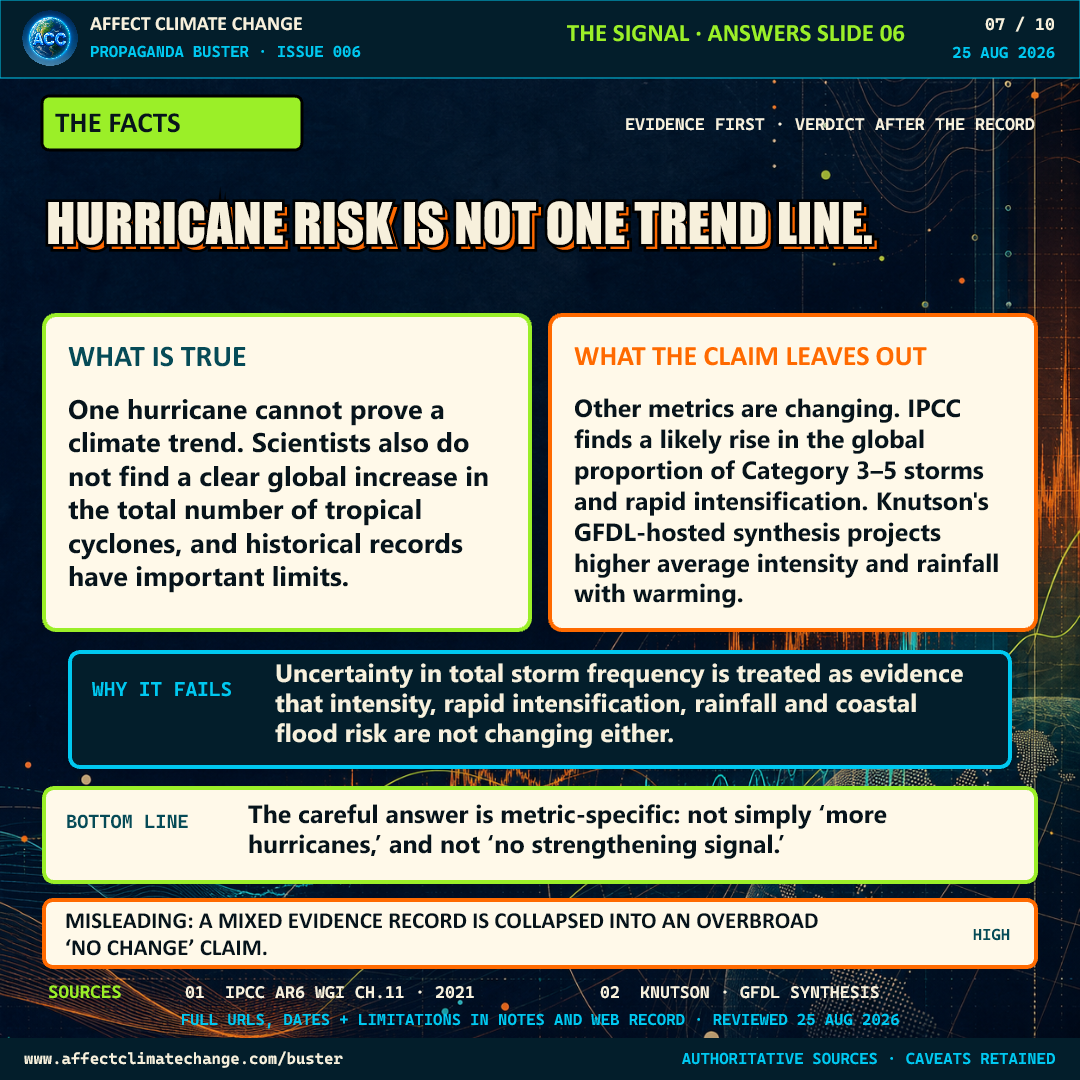
IPCC finds likely increases in the global proportion of Category 3–5 tropical cyclones and rapid-intensification events. Tom Knutson's scientist-maintained NOAA/GFDL-hosted synthesis projects higher average intensity and rainfall with warming, while total frequency may decrease or remain similar; the page is not an official agency position.
- A clear global increase in total tropical-cyclone numbers has not been established.
- IPCC finds likely increases in the global proportion of Category 3–5 storms.
- IPCC assesses likely increases in rapid-intensification events.
- Knutson's NOAA/GFDL-hosted scientist synthesis projects higher average intensity and rainfall while total frequency may decrease or stay similar, and it explicitly disclaims official agency-position status.
Evidence chain
Each source is dated and paired with the finding it supports. The original post establishes what was claimed; it does not decide the scientific verdict.
IPCC AR6 WGI Chapter 11
Published / source period: 2021
Intergovernmental Panel on Climate Change · Likely increases in the global proportion of Category 3-5 storms and rapid-intensification events; evidence differs by metric and basin.
Accessed August 25, 2026
Global Warming and Hurricanes
Published / source period: 2024-11-20
Tom Knutson / NOAA GFDL-hosted scientist synthesis · The scientist-maintained synthesis projects higher tropical-cyclone intensity and rainfall and a larger proportion of very intense storms, while total frequency may decrease or remain similar.
Accessed August 25, 2026
Tropical Cyclones and Climate Change Assessment Part II
Published / source period: 2020
Knutson et al. / Bulletin of the American Meteorological Society · Assessment finds rising tropical-cyclone risk for some metrics under anthropogenic warming.
Accessed August 25, 2026
What is true
Scientists have not established a clear global increase in the total number of tropical cyclones, and one event cannot prove a climate trend. Observational quality and attribution confidence vary by basin and metric.
Where the claim fails
The claim collapses distinct physical quantities into one vague ‘overall’ measure. Uncertainty or no clear trend in total frequency does not erase assessed signals in the intensity distribution, rapid intensification, or rainfall.
Limits and uncertainty
Historical observing systems changed, and regional signals differ. Projections and attribution are metric-specific; the record does not support the simplistic claim that every hurricane measure is increasing everywhere.
Assessment after the evidence
Total storm counts, intensity, Category 3–5 share, rapid intensification, and rainfall are different metrics with different assessed trends.
How the framing works
Metric collapse: several distinct hurricane indicators are combined into one broad no-change conclusion.
How scientists know
Researchers analyze homogenized storm records, satellite-era observations, physical theory, event metrics, and climate-model experiments separately for frequency, intensity, rainfall, and intensification.
Editorial boundaries
ACC evaluates the claim. It does not infer intent, coordination, funding, deception, or control without direct evidence specific to that attribution.
The source presentation and reuse decision are documented here: Approved bounded native-source crop for criticism and fact-checking, shown with attribution and a direct source link; unrelated page content is excluded.
Corrections and revision record
Corrections status: No change to the scientific verdict has been recorded.
v1.0 · August 25, 2026
Initial evidence review. Verdict: MISLEADING, high confidence; frequency and intensity remain separated.
v1.1 · August 28, 2026
Canonical website record integrated from the verified R1 handoff.