Precise proposition checked
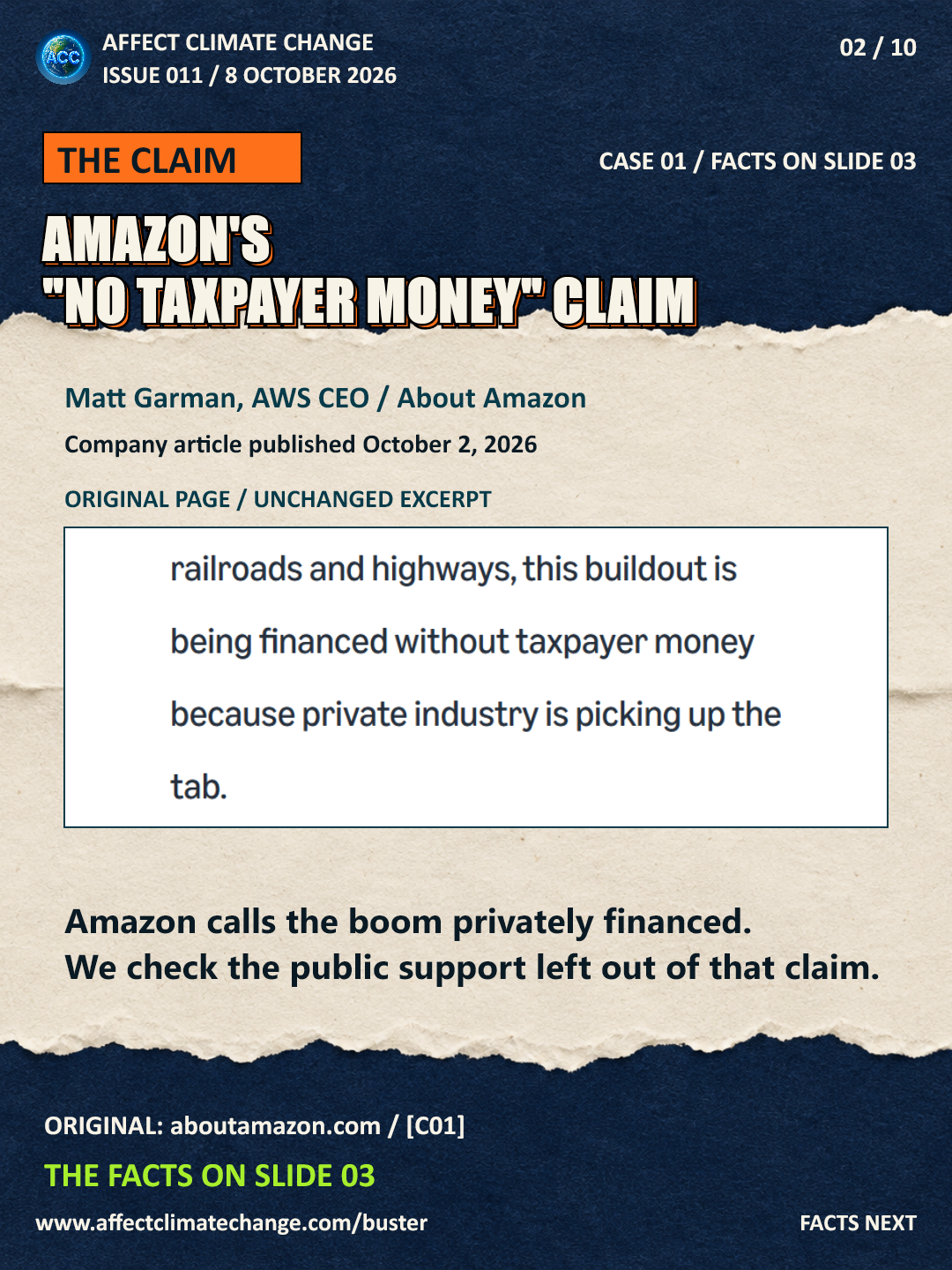
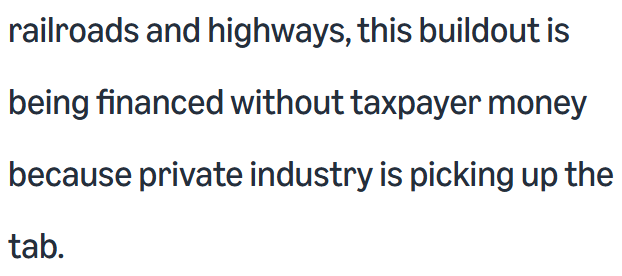
The buildout described by Amazon is financed without taxpayer money, presented as an absence of public support for the expansion.
Full post context: The checked article says the buildout is financed without taxpayer money. The strongest reasonable reading is that private companies finance their own buildings and equipment. That distinction does not eliminate public support enabling the expansion. The verdict addresses the broad public-support impression, not whether the state pays every construction bill.
Scope of this check: Authorized funding and reported tax benefits are different measures. Disbursement, Amazon's specific Virginia benefit and net fiscal effects were not established.
What the evidence shows
The checked article says the buildout is financed without taxpayer money. The strongest reasonable reading is that private companies finance their own buildings and equipment. That distinction does not eliminate public support enabling the expansion. The verdict addresses the broad public-support impression, not whether the state pays every construction bill. Mississippi HB 1, Second Extraordinary Session of 2024, section 2, directs a $44 million transfer from the State Capital Expense Fund to the Project Atlas Fund. HB 2, section 1, appropriates $44 million from that fund to the Mississippi Development Authority for the specified data-processing project. Official governor records identify Project Atlas with AWS's Madison County investment. These are approved state funds, not proof that all funds were disbursed or paid directly to Amazon. Virginia's RD40 report, published January 2, 2026, reports $1,941,390,000 in FY2025 tax benefits for 56 data-center operators. The report says the data were supplied by the operators and were not independently validated. The figure covers the industry, not Amazon alone. It represents tax exemption benefits, not a cash appropriation. It is not a calculation of the state's net fiscal loss, and it must not be added to the Mississippi amount as a common total. Companies should disclose public support alongside private investment. These records establish public support without proving dishonest intent, a net fiscal loss, or the merits of every project. The Virginia report also estimates positive net tax revenue from the incentive under its fiscal-model assumptions (Tables 2–3). Those modeled returns deserve consideration, but they do not show that no public support exists. This fact check does not independently establish the incentive's net benefit or decide whether a particular project merits approval.
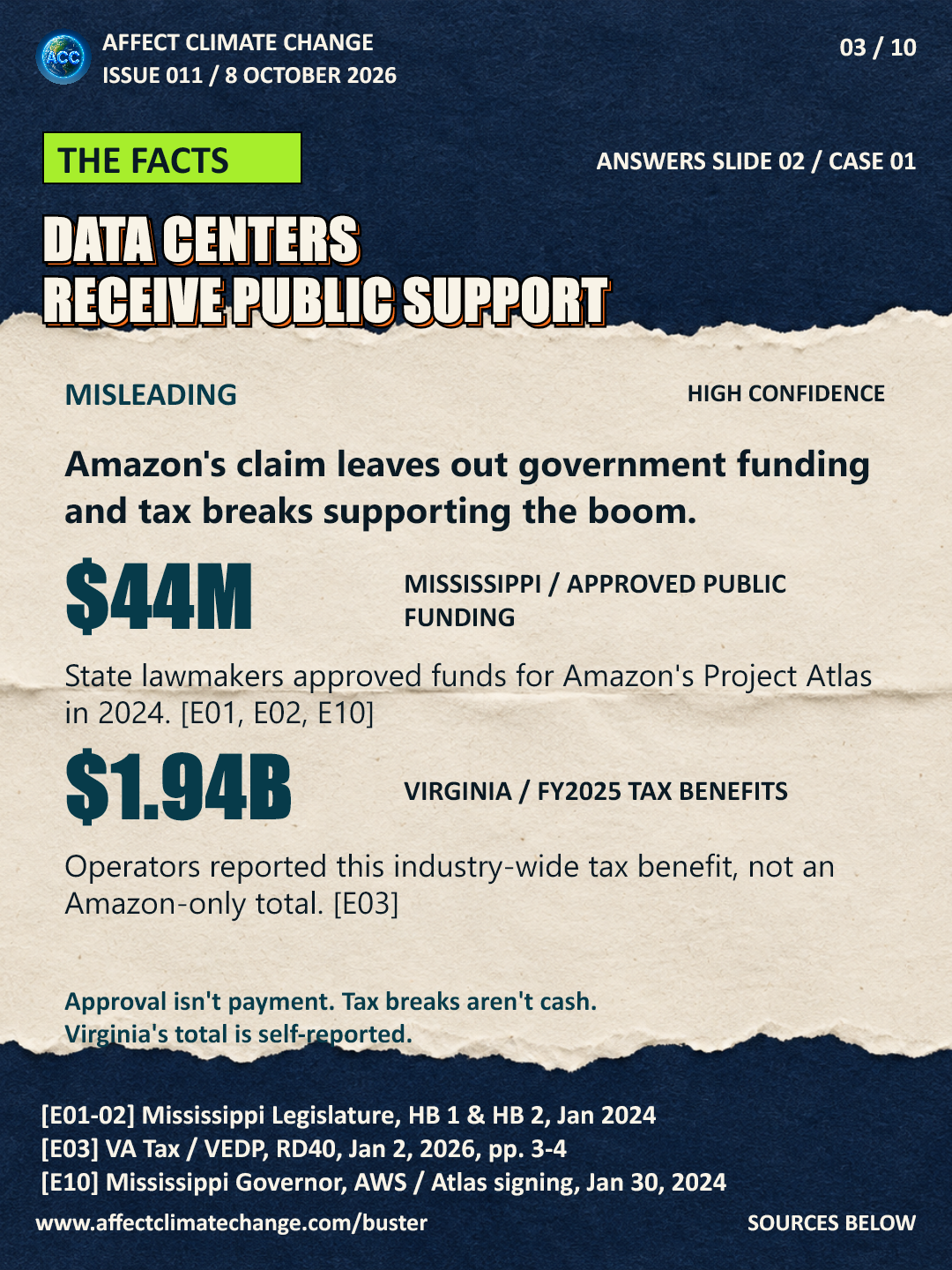
- $44M — MISSISSIPPI / APPROVED PUBLIC FUNDING. State lawmakers approved funds for Amazon's Project Atlas in 2024. [E01, E02, E10]
- $1.94B — VIRGINIA / FY2025 TAX BENEFITS. Operators reported this industry-wide tax benefit, not an Amazon-only total. [E03]
- Authorized funding and reported tax benefits are different measures. Disbursement, Amazon's specific Virginia benefit and net fiscal effects were not established.
Evidence chain
Each source is dated and paired with the finding it supports. The original post establishes what was claimed; it does not decide the scientific verdict.
House Bill 2, Second Extraordinary Session 2024
Published / source period: 2024-01-30
Mississippi Legislature · Appropriates $44 million from Project Atlas Fund to Mississippi Development Authority for the specified data-processing project. Approval is not disbursement.
Accessed October 11, 2026
House Bill 1, Second Extraordinary Session 2024
Published / source period: 2024-01-30
Mississippi Legislature · Transfers $44 million from the State Capital Expense Fund to the Project Atlas Fund. It is the same funding stream as E01, not an additional $44 million.
Accessed October 11, 2026
Data Center Sales and Use Tax Exemption Report, RD40
Published / source period: 2026-01-02
Virginia Department of Taxation / Virginia Economic Development Partnership · FY2025 reported tax benefits: $1,941,390,000 for 56 operators. Industry-wide, operator-reported, not independently validated and not a cash-grant total.
Accessed October 11, 2026
Governor Tate Reeves signs Project Atlas legislation for AWS
Published / source period: 2024-01-30
Governor of Mississippi · Official governor announcement identifies the Project Atlas legislation with AWS and its Madison County investment. Not proof of individual disbursements.
Accessed October 11, 2026
What is true
Private companies finance their own equipment and buildings. Virginia’s report also models positive net state tax revenue under its assumptions; this check does not independently establish the incentive’s net fiscal benefit.
Where the claim fails
The checked article says the buildout is financed without taxpayer money. The strongest reasonable reading is that private companies finance their own buildings and equipment. That distinction does not eliminate public support enabling the expansion. The verdict addresses the broad public-support impression, not whether the state pays every construction bill. Mississippi HB 1, Second Extraordinary Session of 2024, section 2, directs a $44 million transfer from the State Capital Expense Fund to the Project Atlas Fund. HB 2, section 1, appropriates $44 million from that fund to the Mississippi Development Authority for the specified data-processing project. Official governor records identify Project Atlas with AWS's Madison County investment. These are approved state funds, not proof that all funds were disbursed or paid directly to Amazon. Virginia's RD40 report, published January 2, 2026, reports $1,941,390,000 in FY2025 tax benefits for 56 data-center operators. The report says the data were supplied by the operators and were not independently validated. The figure covers the industry, not Amazon alone. It represents tax exemption benefits, not a cash appropriation. It is not a calculation of the state's net fiscal loss, and it must not be added to the Mississippi amount as a common total. Companies should disclose public support alongside private investment. These records establish public support without proving dishonest intent, a net fiscal loss, or the merits of every project. The Virginia report also estimates positive net tax revenue from the incentive under its fiscal-model assumptions (Tables 2–3). Those modeled returns deserve consideration, but they do not show that no public support exists. This fact check does not independently establish the incentive's net benefit or decide whether a particular project merits approval.
Limits and uncertainty
Authorized funding and reported tax benefits are different measures. Disbursement, Amazon's specific Virginia benefit and net fiscal effects were not established. Approval isn't payment. Tax breaks aren't cash. Virginia's total is self-reported.
Assessment after the evidence
Private financing does not erase public support.
How the framing works
Omitted public-support context in a private-financing frame
How scientists know
We read the enacted Mississippi appropriation and fund-transfer laws and the governor’s identification of Project Atlas, then separately checked Virginia’s operator-reported tax-benefit tables and fiscal-model limits.
Editorial boundaries
ACC evaluates the claim. It does not infer intent, coordination, funding, deception, or control without direct evidence specific to that attribution.
The source presentation and reuse decision are documented here: Bounded native excerpt used for identification and criticism with attribution and a direct source link. No license or endorsement implied.
Corrections and revision record
Corrections status: No change to the scientific verdict has been recorded.
web-1 · October 11, 2026
First website edition authorized by Jesse on October 11, 2026. Original issue, claim and evidence dates preserved; original provenance, evidence, limitations and verdict appear in that order.