Precise proposition checked
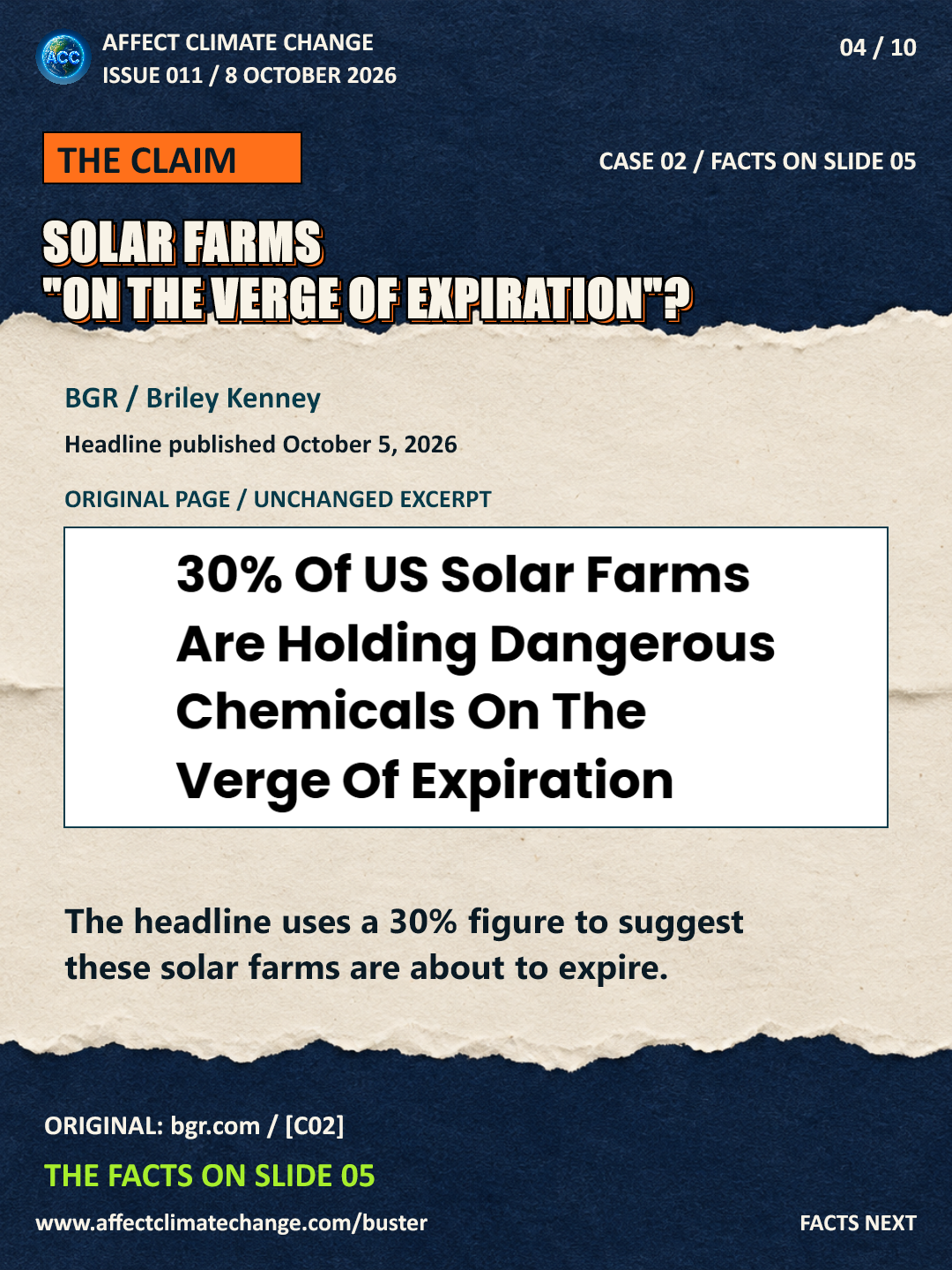
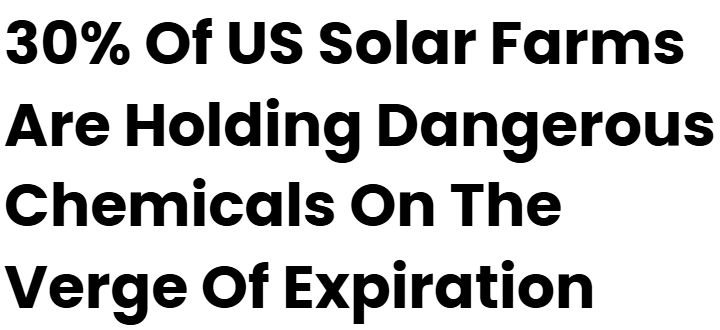
The cited percentage establishes that 30% of existing U.S. solar farms hold dangerous chemicals and are nearing the end of their useful lives.
Full post context: This check addresses the numerical and age claim in BGR's headline, not whether cadmium can be hazardous. The DOE source reports a 34% share of the 2022 U.S. utility-scale photovoltaic module market for cadmium-telluride technology. A module-market share is not a count of existing solar farms and gives no distribution of their ages or remaining lifetimes.
Scope of this check: This check does not establish a national inventory of retiring farms or claim that all discarded panels are harmless. BGR does not link to the DOE paper; DOE is ACC’s comparison evidence, not an identified citation in BGR. An earlier visual panel’s “cited” wording should be read with this clarification.
What the evidence shows
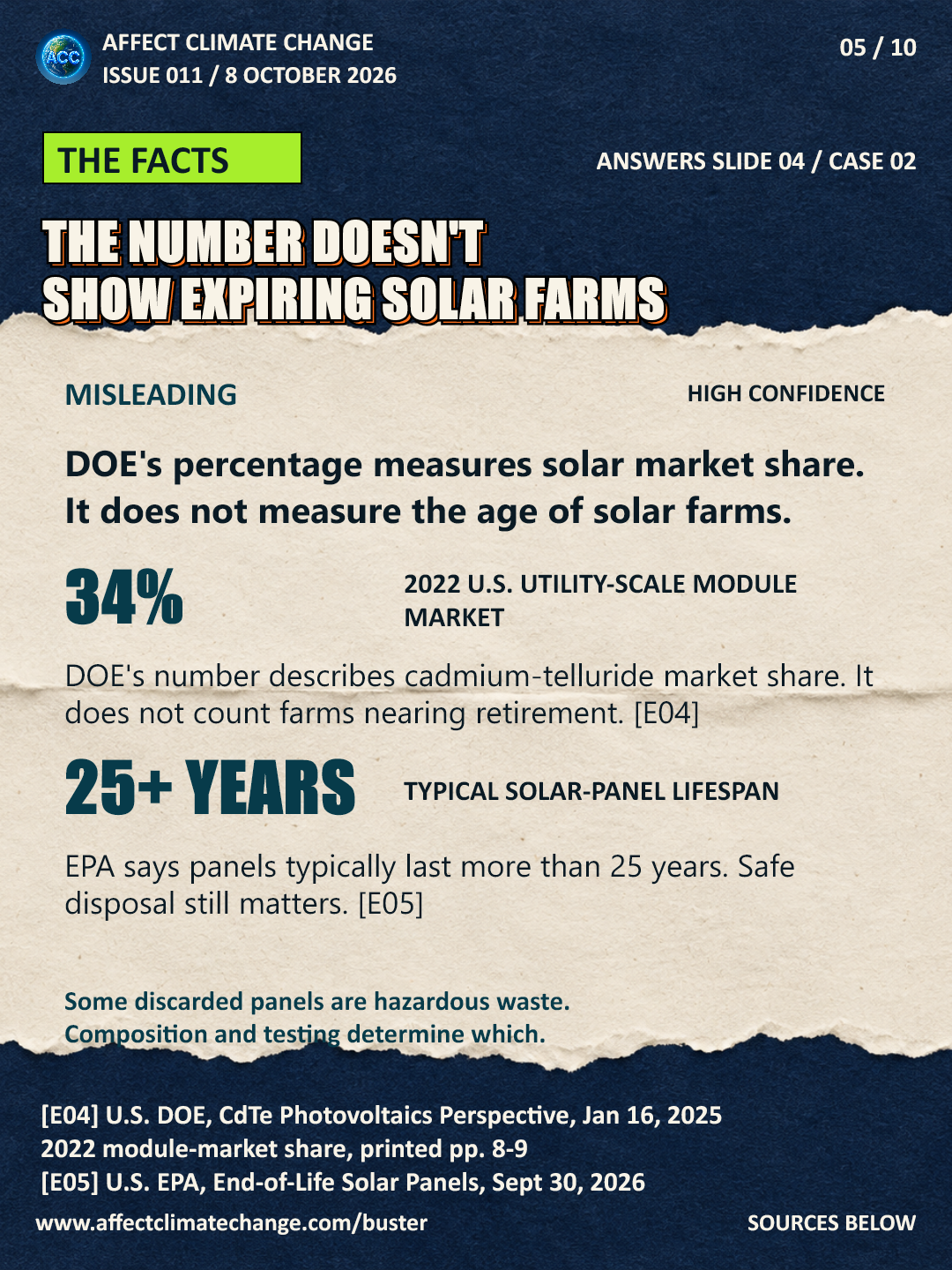
This check addresses the numerical and age claim in BGR's headline, not whether cadmium can be hazardous. The DOE source reports a 34% share of the 2022 U.S. utility-scale photovoltaic module market for cadmium-telluride technology. A module-market share is not a count of existing solar farms and gives no distribution of their ages or remaining lifetimes. EPA says solar panels typically last more than 25 years. Age, condition and installation date matter when assessing retirement. The headline does not provide an age inventory establishing that 30% of U.S. farms are on the verge of expiration. The article itself acknowledges that newer installations will retire later. EPA also says some discarded panels qualify as hazardous waste while others do not. Panel composition and regulatory testing matter. Responsible end-of-life management and recycling remain real obligations. The verdict is MISLEADING for the headline's comparison, with the numerical near-expiry assertion unsupported by the cited evidence.
- 34% — 2022 U.S. UTILITY-SCALE MODULE MARKET. DOE's number describes cadmium-telluride market share. It does not count farms nearing retirement. [E04]
- 25+ YEARS — TYPICAL SOLAR-PANEL LIFESPAN. EPA says panels typically last more than 25 years. Safe disposal still matters. [E05]
- This check does not establish a national inventory of retiring farms or claim that all discarded panels are harmless. BGR does not link to the DOE paper; DOE is ACC’s comparison evidence, not an identified citation in BGR. An earlier visual panel’s “cited” wording should be read with this clarification.
Evidence chain
Each source is dated and paired with the finding it supports. The original post establishes what was claimed; it does not decide the scientific verdict.
Cadmium Telluride Photovoltaics Perspective Paper
Published / source period: 2025-01-16
U.S. Department of Energy · 34% is cadmium-telluride share of the 2022 U.S. utility-scale PV module market. It does not measure existing-farm count, ages or near-retirement share.
Accessed October 11, 2026
End-of-Life Solar Panels: Regulations and Management
Published / source period: 2026-09-30 (page last updated)
U.S. Environmental Protection Agency · Panels typically last more than 25 years. Some discarded panels are hazardous waste while others are not, depending on composition and classification testing.
Accessed October 11, 2026
What is true
Cadmium can be hazardous, and some discarded panels qualify as hazardous waste. EPA’s testing and composition criteria matter. The article itself acknowledges that newer installations will retire later.
Where the claim fails
This check addresses the numerical and age claim in BGR's headline, not whether cadmium can be hazardous. The DOE source reports a 34% share of the 2022 U.S. utility-scale photovoltaic module market for cadmium-telluride technology. A module-market share is not a count of existing solar farms and gives no distribution of their ages or remaining lifetimes. EPA says solar panels typically last more than 25 years. Age, condition and installation date matter when assessing retirement. The headline does not provide an age inventory establishing that 30% of U.S. farms are on the verge of expiration. The article itself acknowledges that newer installations will retire later. EPA also says some discarded panels qualify as hazardous waste while others do not. Panel composition and regulatory testing matter. Responsible end-of-life management and recycling remain real obligations. The verdict is MISLEADING for the headline's comparison, with the numerical near-expiry assertion unsupported by the cited evidence.
Limits and uncertainty
This check does not establish a national inventory of retiring farms or claim that all discarded panels are harmless. BGR does not link to the DOE paper; DOE is ACC’s comparison evidence, not an identified citation in BGR. An earlier visual panel’s “cited” wording should be read with this clarification. Some discarded panels are hazardous waste. Composition and testing determine which.
Assessment after the evidence
The cited percentage does not support the age claim.
How the framing works
A market-share statistic repurposed as an age statistic
How scientists know
We checked the DOE paper’s year, denominator and module-market definition against EPA’s panel-lifespan and hazardous-waste guidance. Neither source supplies a national inventory of farm ages.
Editorial boundaries
ACC evaluates the claim. It does not infer intent, coordination, funding, deception, or control without direct evidence specific to that attribution.
The source presentation and reuse decision are documented here: Bounded native excerpt used for identification and criticism with attribution and a direct source link. No license or endorsement implied.
Corrections and revision record
Corrections status: No change to the scientific verdict has been recorded.
web-1 · October 11, 2026
First website edition authorized by Jesse on October 11, 2026. Original issue, claim and evidence dates preserved; original provenance, evidence, limitations and verdict appear in that order.