ACC News Brief
Cryosphere Svalbard, Norwegian Arctic
VERIFIED FIELD OBSERVATION / MODELED UPSCALING - rough regional estimate, not a global methane-budget total
Svalbard glacier rivers reveal a geology-controlled methane pathway
What happened
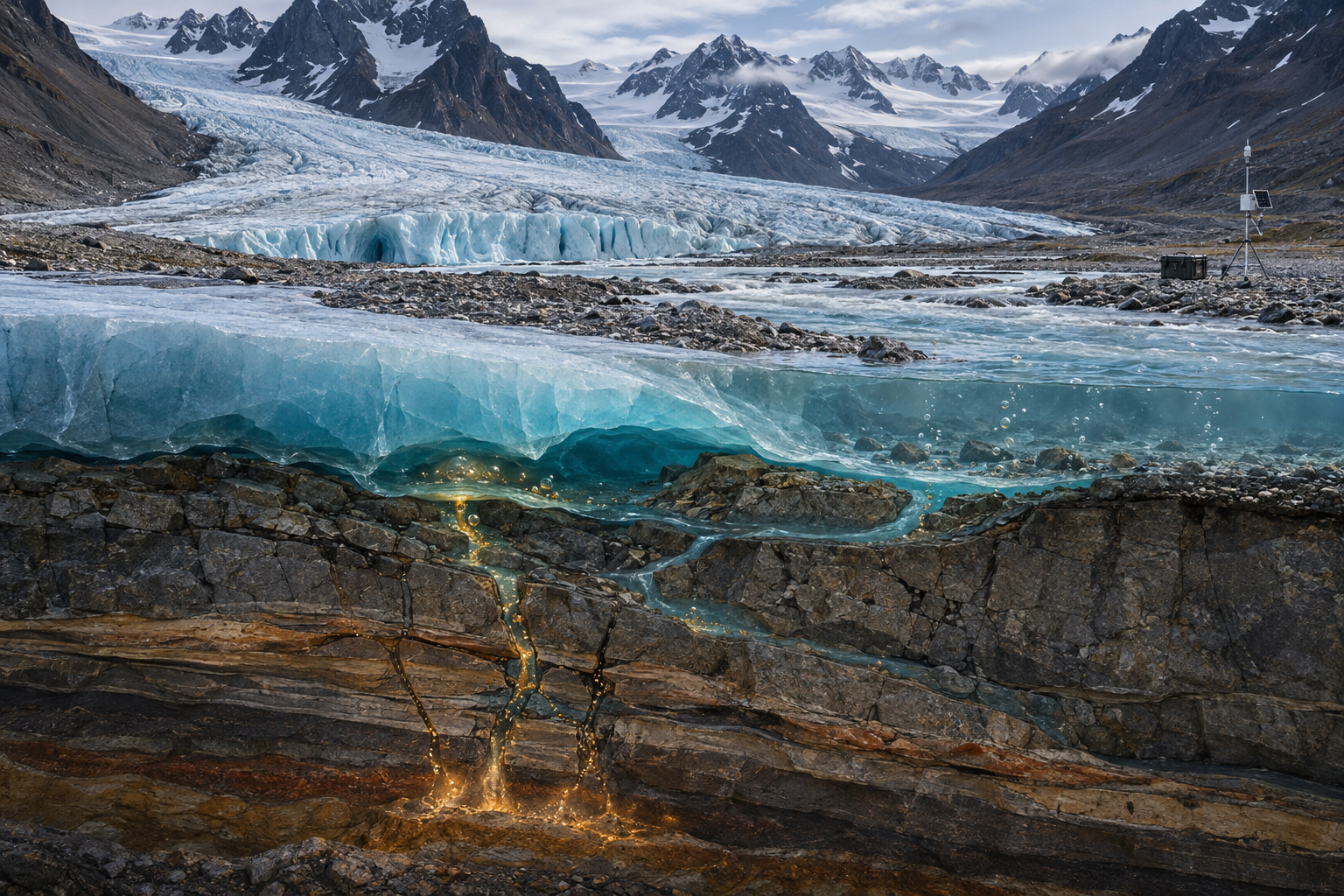
Researchers analyzed 148 river samples from 19 valley glaciers across central Svalbard and found every sampled meltwater system supersaturated with methane, with peaks up to 425 times atmospheric equilibrium. Carbon isotopes plus ethane and propane indicated largely ancient, thermogenic gas from underlying geology. Organic-rich shale and thawed, hydrologically active glacier beds together explained much of the concentration variation.
ACC context
Supersaturation shows that methane can leave the water, but is not a measured atmospheric emission total. Rough Svalbard-wide estimates range from 182-368 tonnes for 2023 and 219-364 tonnes for 2024; some methane may be oxidized, and the trajectory may decline as glacier beds freeze.
Why it matters
The study identifies where glacier meltwater is most likely to mobilize geologic methane: glaciers over carbon-rich rock with water-connected beds. That mechanism can guide measurements in other glaciated hydrocarbon provinces.
What to watch
- Year-round and early-melt measurements that capture pulses missed by summer sampling.
- Direct measurements of how much transported methane outgasses versus being oxidized.
- Whether emissions rise and later fall as thinning glaciers develop frozen beds.
Sources & evidence
- Subglacial geology and thermal conditions regulate methane emissions from Svalbard glaciersNature Communications Version of Record published September 8, 2026; 148 river samples from 19 central Svalbard glaciers, with rough archipelago-scale estimates.
Continue learning with ACC
See how warming can interact with natural carbon feedbacks