Precise proposition checked
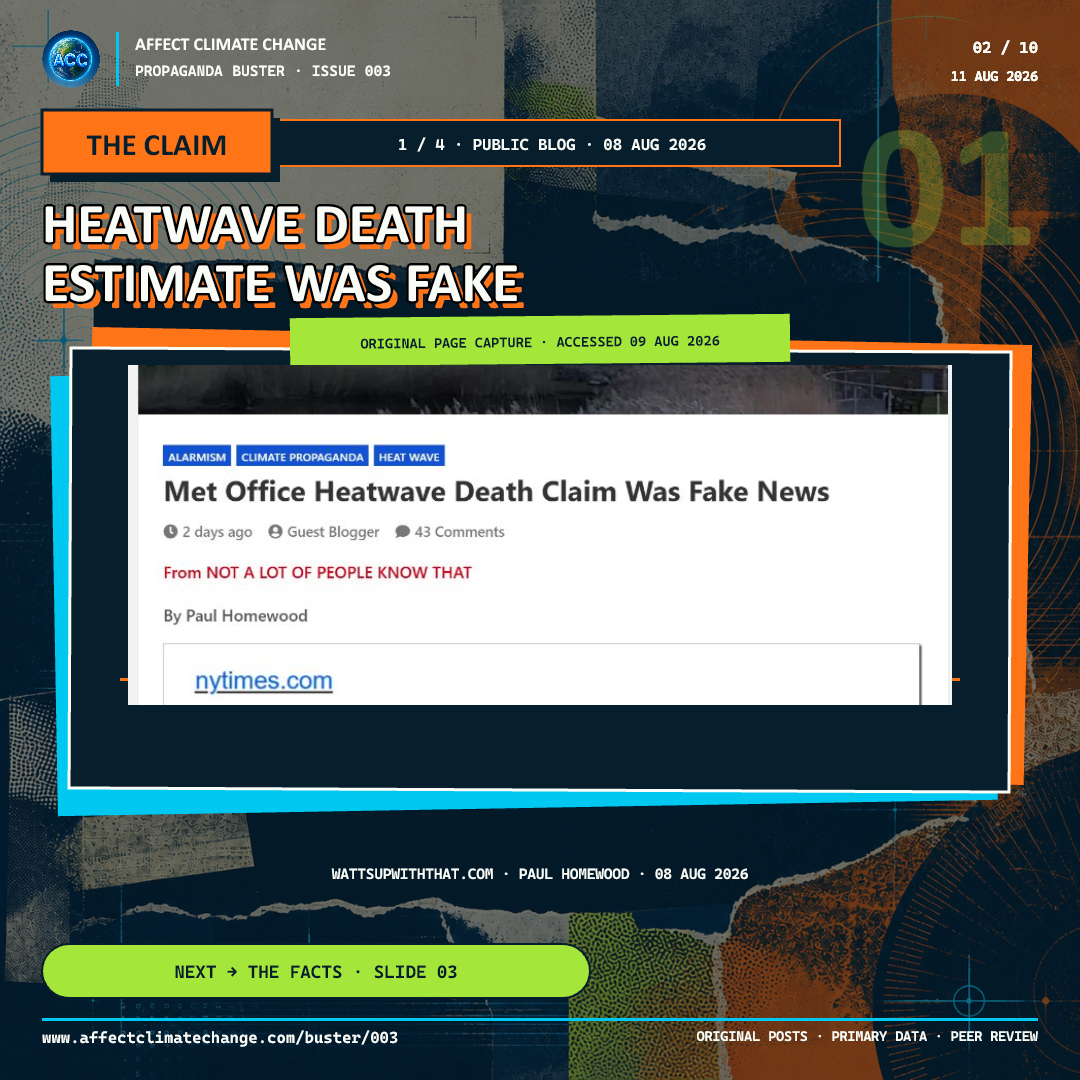
A flat cumulative death-registration total shows the 2026 heatwave-death estimate was fake.
Full post context: The public article titled ‘Met Office Heatwave Death Claim Was Fake News’ compares broad cumulative weekly registrations with a rapid estimate for deaths during two specific hot periods and concludes: ‘The claim was fake.’
Scope of this check: This verdict evaluates whether cumulative registrations disprove the time-localized mortality estimate. It does not evaluate or infer the author's motive, funding, or intent.
What the evidence shows
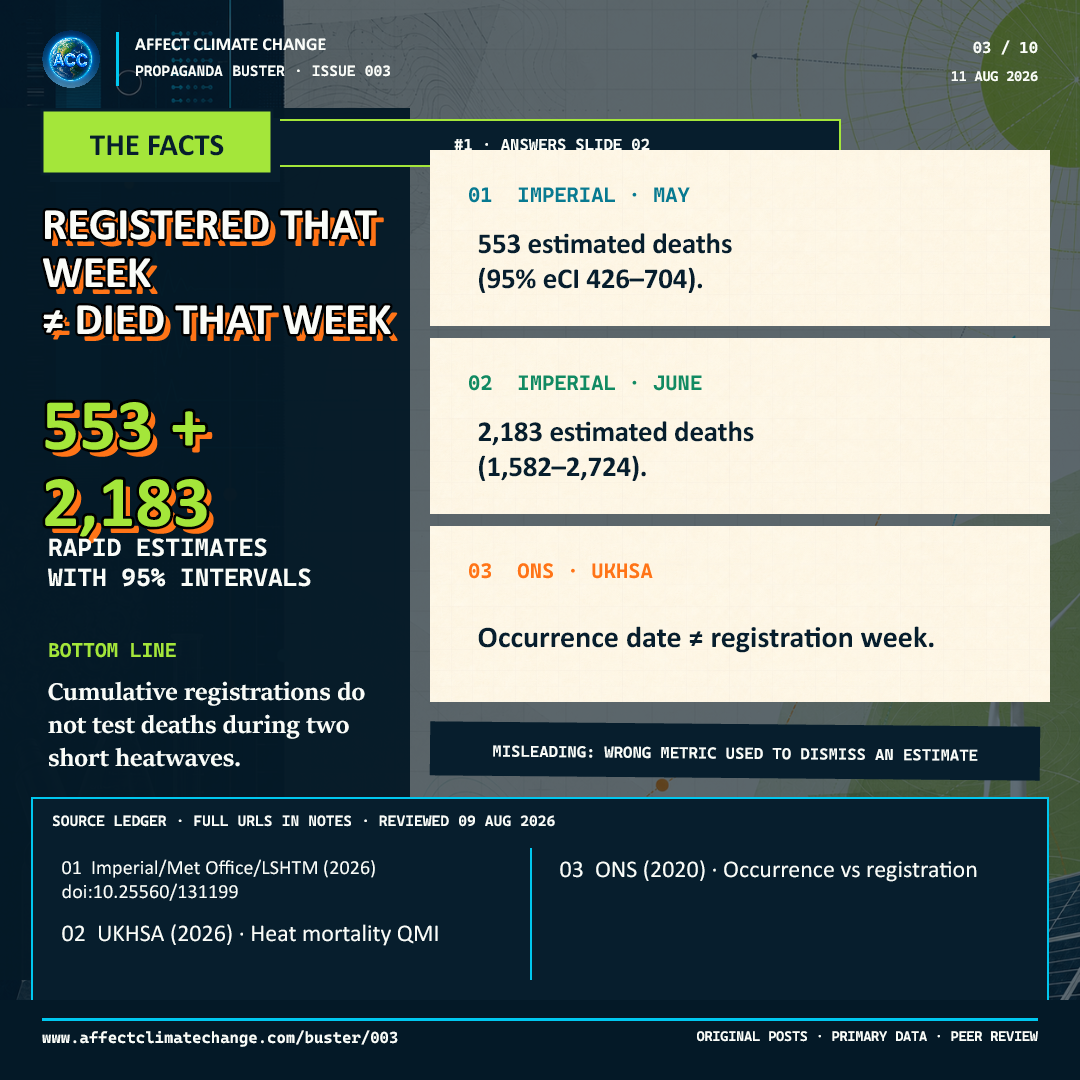
Cumulative registration totals do not test deaths during two short heatwaves. The 2,736 total is a rapid modelled estimate with uncertainty, not a final death-certificate count, but the registration comparison does not show it was fabricated.
- The scientific report estimates 553 deaths during May 21–29, with a 95% empirical confidence interval of 426–704.
- It estimates 2,183 deaths during June 18–28, with a 95% empirical confidence interval of 1,582–2,724.
- ONS explains that occurrence date and registration week are different measures and that registration delays matter for time-specific surveillance.
Evidence chain
Each source is dated and paired with the finding it supports. The original post establishes what was claimed; it does not decide the scientific verdict.
Climate change increases heat-health risks in England and Wales: May and June 2026
Published / source period: 2026-07-13
Imperial College London, Grantham Institute, Met Office, and LSHTM · Reports 553 estimated deaths for May 21–29 and 2,183 for June 18–28, with 95% empirical confidence intervals and explicit model limitations.
Accessed August 9, 2026
Quality and methodology information: Heat mortality monitoring reports
Published / source period: 2026-04-02
UK Health Security Agency · Explains comparison of deaths during heat episodes with nearby non-heat baselines and the reporting of uncertainty.
Accessed August 9, 2026
Predicting total weekly death occurrences in England and Wales methodology
Published / source period: 2020-05-29
Office for National Statistics · Explains why registration counts differ from occurrence dates and why occurrence data are more useful for rare time-specific events.
Accessed August 9, 2026
What is true
The estimate is provisional and model-based rather than a final official count. It assumes a historical relationship between temperature and mortality, reports uncertainty ranges, and may not fully capture changes in vulnerability or adaptation. Those limitations should be stated without treating a different metric as a disproof.
Where the claim fails
The comparison substitutes a broad registration total for deaths occurring during defined heat episodes. Registrations can occur days or weeks after death and include deaths from many dates, so a flat cumulative period can conceal a short-lived mortality increase and cannot directly falsify the modelled estimate.
Limits and uncertainty
The rapid report estimates 553 deaths for May 21–29 and 2,183 for June 18–28, with 95% empirical confidence intervals. Final validated figures are expected in 2027, and there is no single definitive measure of heat mortality.
Assessment after the evidence
Cumulative registration totals do not test deaths during two short heatwaves. The 2,736 total is a rapid modelled estimate with uncertainty, not a final death-certificate count, but the registration comparison does not show it was fabricated.
How the framing works
Wrong metric and context collapse: cumulative registrations are used to reject a time-localized modelled estimate.
How scientists know
Researchers compare mortality during specified heat periods with an expected non-heat baseline, report uncertainty, and distinguish occurrence dates from later registration dates. The full Imperial report, UKHSA methodology, and ONS registration guidance make those definitions and limits explicit.
Editorial boundaries
ACC evaluates the claim. It does not infer intent, coordination, funding, deception, or control without direct evidence specific to that attribution.
The source presentation and reuse decision are documented here: Final limited-use review approved the recreated attributed-text treatment and the limited excerpt crop embedded in ACC's ten-slide edition; the complete native capture remains private research material.
Corrections and revision record
Corrections status: No change to the scientific verdict has been recorded.
0.1 · August 9, 2026
Initial editor-review candidate created from four native public claims, primary and peer-reviewed sources, explicit uncertainty, and a complete ten-slide social preview. No publication approval recorded.
0.2-r6 · August 11, 2026
Replaced the Arctic-ratio case with the wind-and-solar lifecycle-emissions claim, preserved the exact ‘no sharp acceleration’ wording, qualified the UNECE-derived 80–99% illustrative range, added the AR6 Working Group I Summary for Policymakers source, and integrated the final R6 slide renders. No publication approval recorded.
1.0 · August 11, 2026
Recorded final owner approval for the public website record and corrected larger-type R6 social edition after independent source, calculation, accessibility, limited-use, and editorial review. This local package does not itself deploy or post the issue.
1.1-r7 · August 11, 2026
Replaced the Issue 003 visual skin with owner-approved established ACC navy, orange, cyan, and lime R7 artwork while preserving the claims, evidence, verdicts, citations, and accessibility copy. This local package does not itself deploy the website or post the issue.