Precise proposition checked
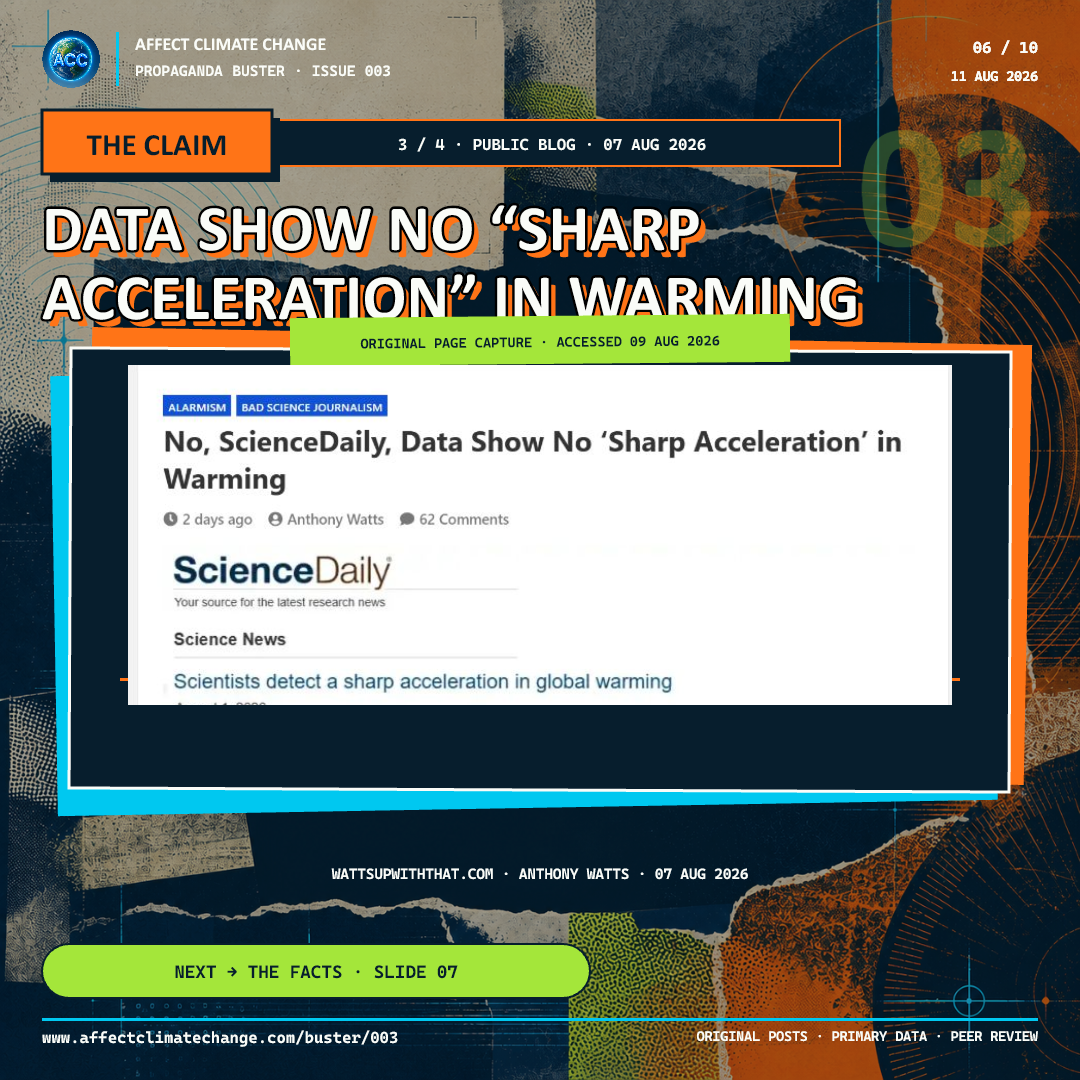
Data show no ‘sharp acceleration’ in warming.
Full post context: The public article's categorical headline says data show no sharp acceleration. Its body acknowledges the study's adjusted result of roughly 0.35°C per decade and greater-than-98-percent finding, while arguing that the raw series and adjustment method do not justify ScienceDaily's wording.
Scope of this check: This verdict preserves the article's legitimate method caveat. It evaluates whether the categorical headline fairly represents the full evidence, not whether every statistical method produces the same rate.
What the evidence shows
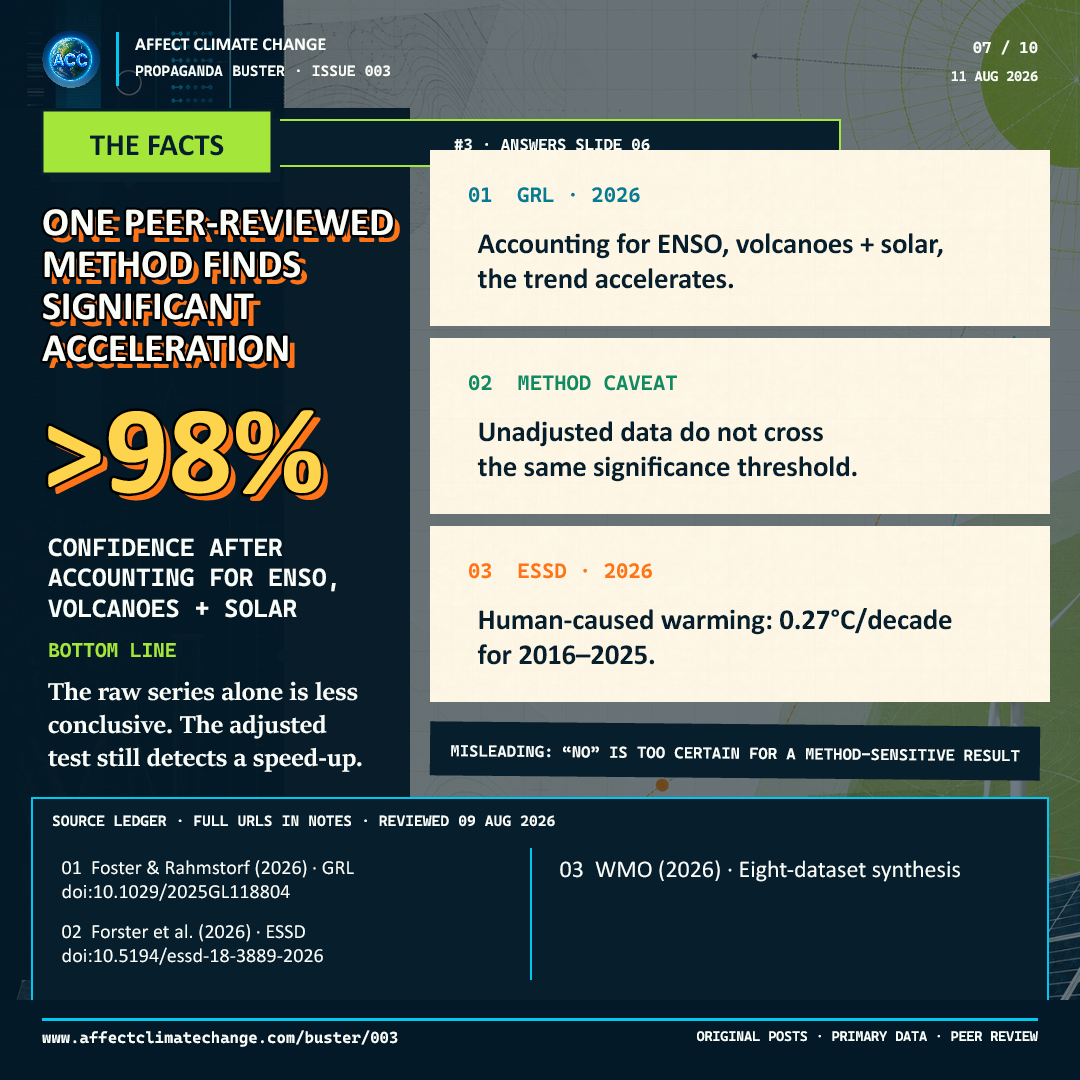
The adjusted analysis finds acceleration above 98% confidence after accounting for natural influences. The unadjusted series is noisier and does not reach the same threshold—a real caveat—but the categorical headline omits the published adjusted result.
- Foster and Rahmstorf find statistically significant acceleration above 98% confidence after accounting for El Niño, volcanoes, and solar variation.
- The study reports faster warming over the most recent ten-plus years than in any previous decade, while the raw series remains noisier.
- Forster and colleagues report human-induced warming of 0.27°C per decade for 2016–2025 and observed warming of 0.30°C per decade over the same period.
Evidence chain
Each source is dated and paired with the finding it supports. The original post establishes what was claimed; it does not decide the scientific verdict.
Global Warming Has Accelerated Significantly
Published / source period: 2026-03-06
Geophysical Research Letters · Finds warming acceleration above 98% confidence after adjusting five global-temperature datasets for major natural-variability factors.
Accessed August 9, 2026
Indicators of Global Climate Change 2025
Published / source period: 2026-06-11
Earth System Science Data · Reports human-induced warming of 0.27°C per decade and observed warming of 0.30°C per decade for 2016–2025, with stated uncertainty and variability caveats.
Accessed August 9, 2026
WMO confirms 2025 was one of warmest years on record
Published / source period: 2026-01-14
World Meteorological Organization · Synthesizes eight datasets and reports that 2023–2025 were the three warmest years and 2015–2025 the eleven warmest.
Accessed August 9, 2026
What is true
Acceleration detection is sensitive to the selected interval, datasets, and treatment of natural variability. The word ‘sharp’ is subjective, the raw record is noisy, and no single paper fixes an exact future rate. Those caveats narrow the conclusion but do not erase the affirmative adjusted finding.
Where the claim fails
The headline treats a real method caveat as proof of the opposite result. The unadjusted series does not cross the same statistical threshold, but the adjusted five-dataset analysis does find acceleration, so the categorical claim that data show no ‘sharp acceleration’ does not fairly represent the complete finding.
Limits and uncertainty
The acceleration result depends on the paper's adjustment method and interval. ACC does not claim every method detects an identical change or that short-term rates can be extrapolated unchanged into the future.
Assessment after the evidence
The adjusted analysis finds acceleration above 98% confidence after accounting for natural influences. The unadjusted series is noisier and does not reach the same threshold—a real caveat—but the categorical headline omits the published adjusted result.
How the framing works
Certainty reversal and omitted method: a real methodological caveat is presented as though the data categorically demonstrate the opposite of the published adjusted result.
How scientists know
Researchers compare multiple global-temperature datasets, quantify El Niño, volcanic, and solar influences, test trend changes statistically, and report confidence. Independent annual indicators distinguish observed and human-induced rates and provide a second line of evidence about recent warming.
Editorial boundaries
ACC evaluates the claim. It does not infer intent, coordination, funding, deception, or control without direct evidence specific to that attribution.
The source presentation and reuse decision are documented here: Final limited-use review approved the recreated attributed-text treatment and the limited excerpt crop embedded in ACC's ten-slide edition; the complete native capture remains private research material.
Corrections and revision record
Corrections status: No change to the scientific verdict has been recorded.
0.1 · August 9, 2026
Initial editor-review candidate created from four native public claims, primary and peer-reviewed sources, explicit uncertainty, and a complete ten-slide social preview. No publication approval recorded.
0.2-r6 · August 11, 2026
Replaced the Arctic-ratio case with the wind-and-solar lifecycle-emissions claim, preserved the exact ‘no sharp acceleration’ wording, qualified the UNECE-derived 80–99% illustrative range, added the AR6 Working Group I Summary for Policymakers source, and integrated the final R6 slide renders. No publication approval recorded.
1.0 · August 11, 2026
Recorded final owner approval for the public website record and corrected larger-type R6 social edition after independent source, calculation, accessibility, limited-use, and editorial review. This local package does not itself deploy or post the issue.
1.1-r7 · August 11, 2026
Replaced the Issue 003 visual skin with owner-approved established ACC navy, orange, cyan, and lime R7 artwork while preserving the claims, evidence, verdicts, citations, and accessibility copy. This local package does not itself deploy the website or post the issue.