Precise proposition checked
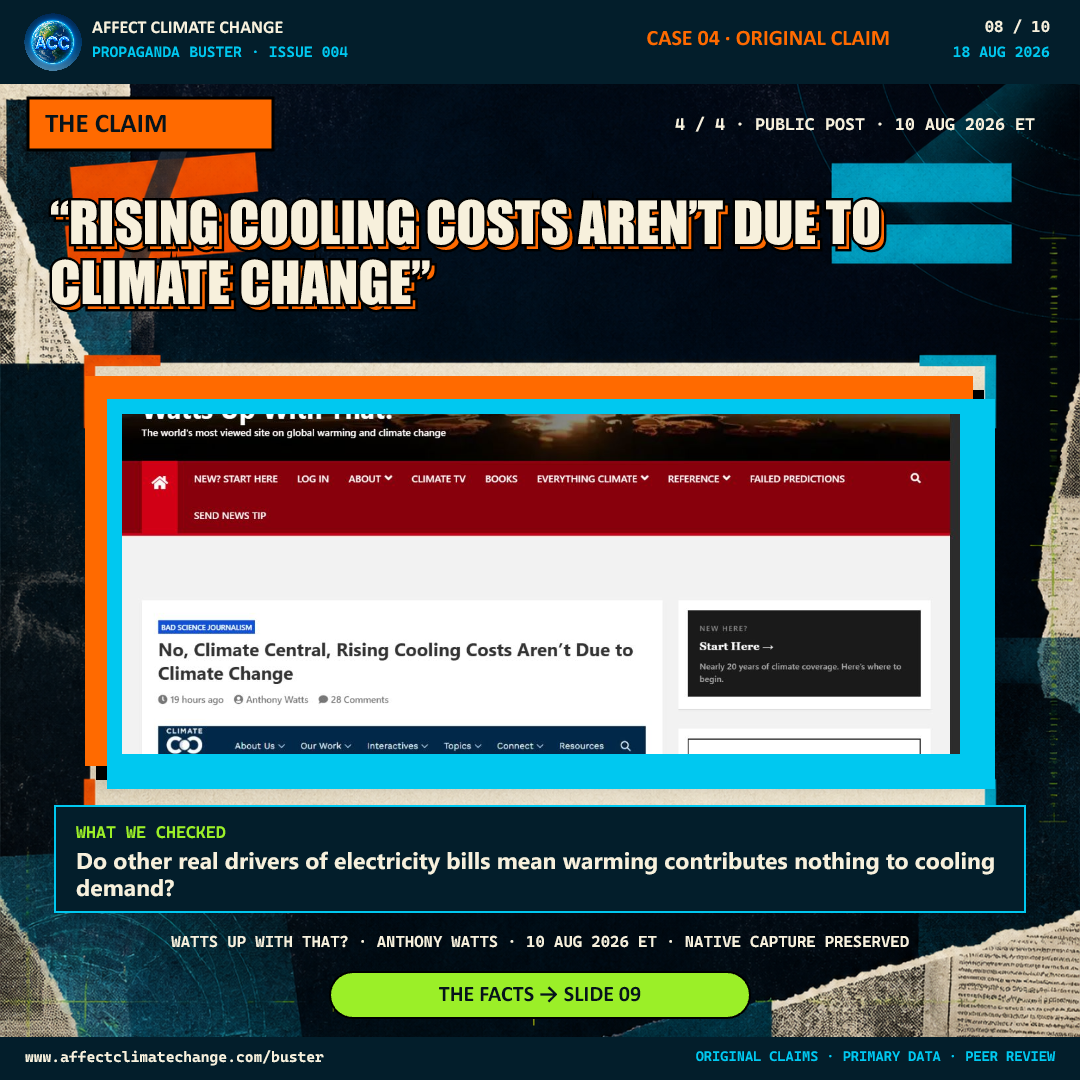
Rising cooling costs are not due to climate change.
Full post context: The August 10 article headline says rising cooling costs are not due to climate change. Its body correctly identifies other contributors but reframes the source analysis as though it claimed greenhouse gases alone determine household bills.
Scope of this check: The verdict does not assign a precise climate share to any household bill. It evaluates whether real non-climate drivers justify the categorical conclusion that warming contributes nothing to cooling demand or costs.
What the evidence shows
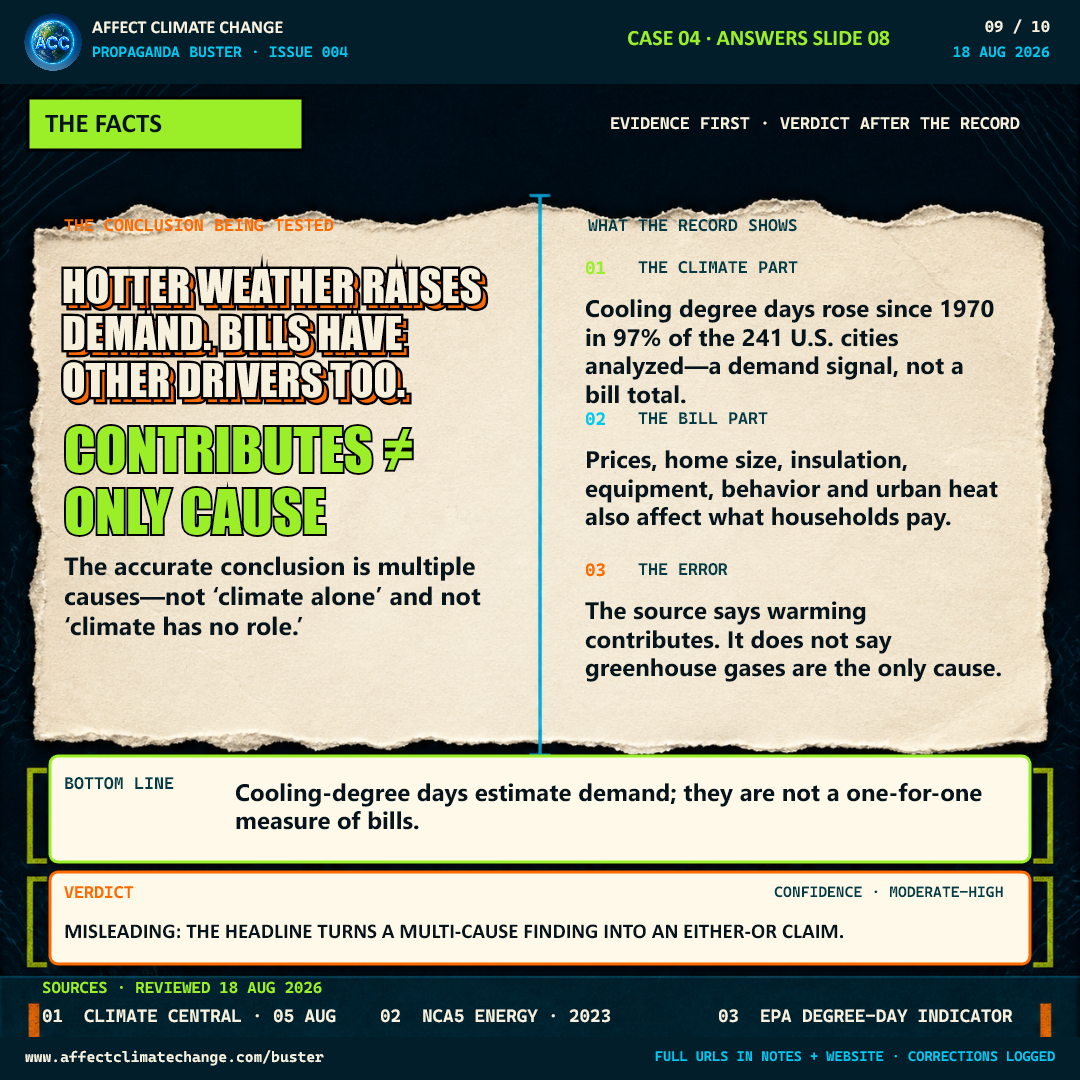
Hotter weather raises cooling demand, while electricity prices, buildings, equipment, behavior, urban heat, and other factors also shape bills. Multiple causes do not support a categorical claim that climate has no role.
- Cooling degree days increased since 1970 in 97% of the 241 U.S. cities analyzed by Climate Central.
- Electricity rates, home size, insulation, equipment, behavior, and urban heat also affect household cooling costs.
- EPA describes degree days as a rough energy-demand indicator rather than a one-for-one measure of actual use or bills.
Evidence chain
Each source is dated and paired with the finding it supports. The original post establishes what was claimed; it does not decide the scientific verdict.
Warming U.S. Cities Face Higher Cooling Demand and Energy Bills
Published / source period: 2026-08-05
Climate Central · Finds cooling degree days increased since 1970 in 97% of 241 analyzed cities and presents warming alongside other demand and bill factors.
Accessed August 14, 2026
Fifth National Climate Assessment: Energy Supply, Delivery, and Demand
Published / source period: 2023-11-14
U.S. Global Change Research Program · Assesses how increasing temperatures affect seasonal energy demand and system stress while preserving regional and infrastructure context.
Accessed August 14, 2026
Climate Change Indicators: Heating and Cooling Degree Days
Published / source period: 2024-06
U.S. Environmental Protection Agency · Uses NOAA temperature records and describes degree days as a rough surrogate for heating or cooling energy demand rather than actual billed use.
Accessed August 14, 2026
Heating and Cooling Degree Days technical documentation
Published / source period: 2024-06
U.S. Environmental Protection Agency · Defines the indicator, data sources, population weighting, and limitations through the 2023 data period.
Accessed August 14, 2026
What is true
Cooling degree days are only a proxy, and electricity bills depend on rates, home size, insulation, equipment efficiency, behavior, urban heat, and local conditions. Exact driver shares are not established by the cited city analysis.
Where the claim fails
The article turns a multi-cause problem into an either-or choice. The source analysis explicitly discusses prices, urban heat, and other factors while using cooling degree days as a temperature-linked demand indicator, not as a complete household-bill decomposition.
Limits and uncertainty
The 97% statistic applies to 241 analyzed U.S. cities and does not mean every city's trend is identical. Cooling degree days are not actual billed consumption, and the analysis does not fully decompose every household cost driver.
Assessment after the evidence
Hotter weather raises cooling demand, while electricity prices, buildings, equipment, behavior, urban heat, and other factors also shape bills. Multiple causes do not support a categorical claim that climate has no role.
How the framing works
False dichotomy and straw man: other genuine contributors are presented as an alternative to warming rather than simultaneous influences.
How scientists know
Scientists calculate cooling degree days from temperature records to estimate weather-related cooling demand, then distinguish that signal from actual energy use and bills. Government indicators and national assessments preserve those limitations.
Editorial boundaries
ACC evaluates the claim. It does not infer intent, coordination, funding, deception, or control without direct evidence specific to that attribution.
The source presentation and reuse decision are documented here: Approved recreated attributed-text treatment. A limited native-page excerpt appears only inside ACC's fact-checking social slide; complete captures remain private research material.
Corrections and revision record
Corrections status: No change to the scientific verdict has been recorded.
R3 · August 18, 2026
Retained the moderate-high-confidence multi-cause verdict and explicit bill-attribution limits.