Precise proposition checked
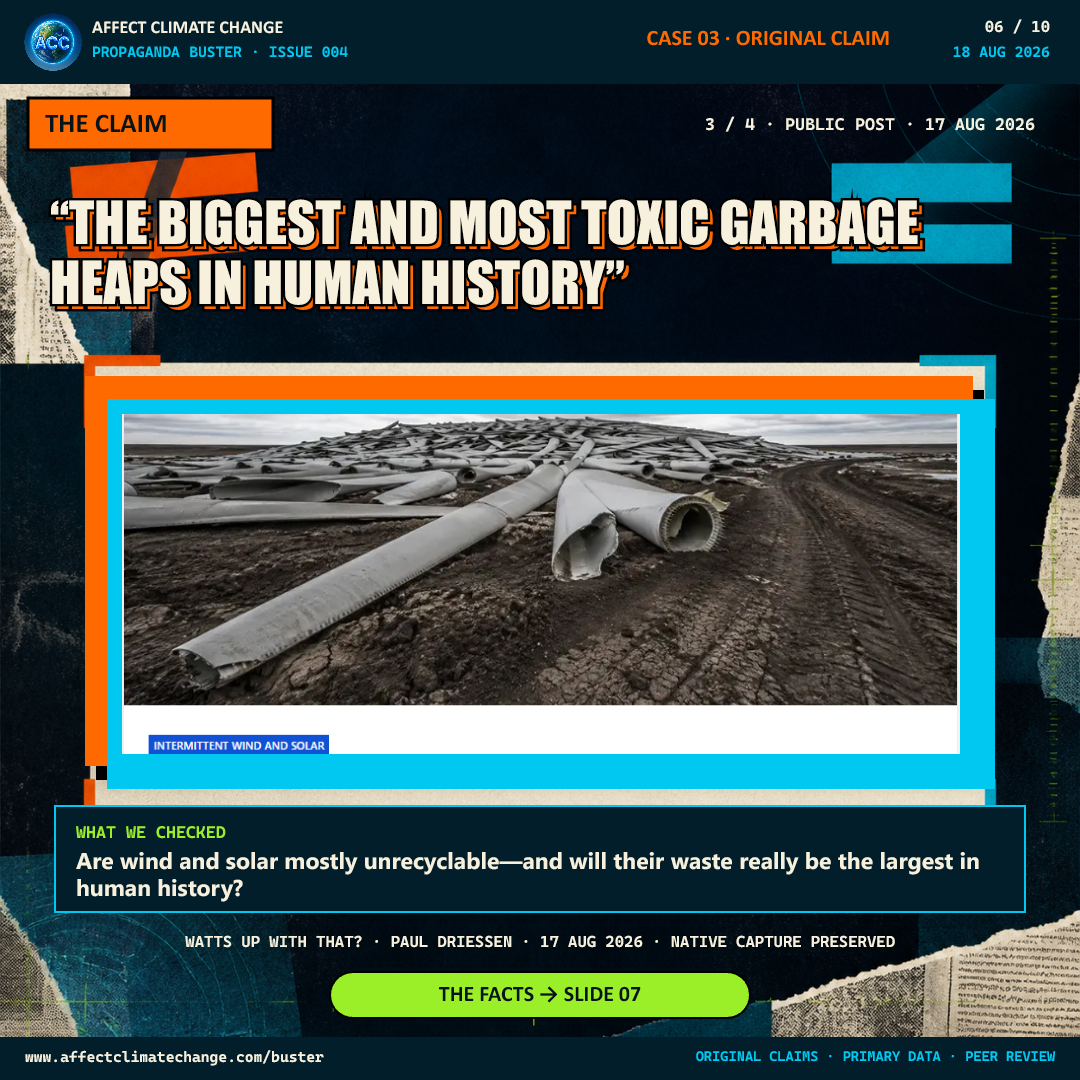
Wind, solar, and battery systems will create the biggest and most toxic garbage heaps in human history.
Full post context: The August 17 article calls wind, solar, and battery waste the biggest and most toxic garbage heaps in human history and describes their components as enormous, non-recyclable trash. ACC evaluates the bounded wind-and-solar waste proposition.
Scope of this check: The verdict does not say renewable-energy waste is harmless, fully recycled, or automatically well managed. It evaluates the post's claims about overall recyclability, toxicity, and historical scale.
What the evidence shows
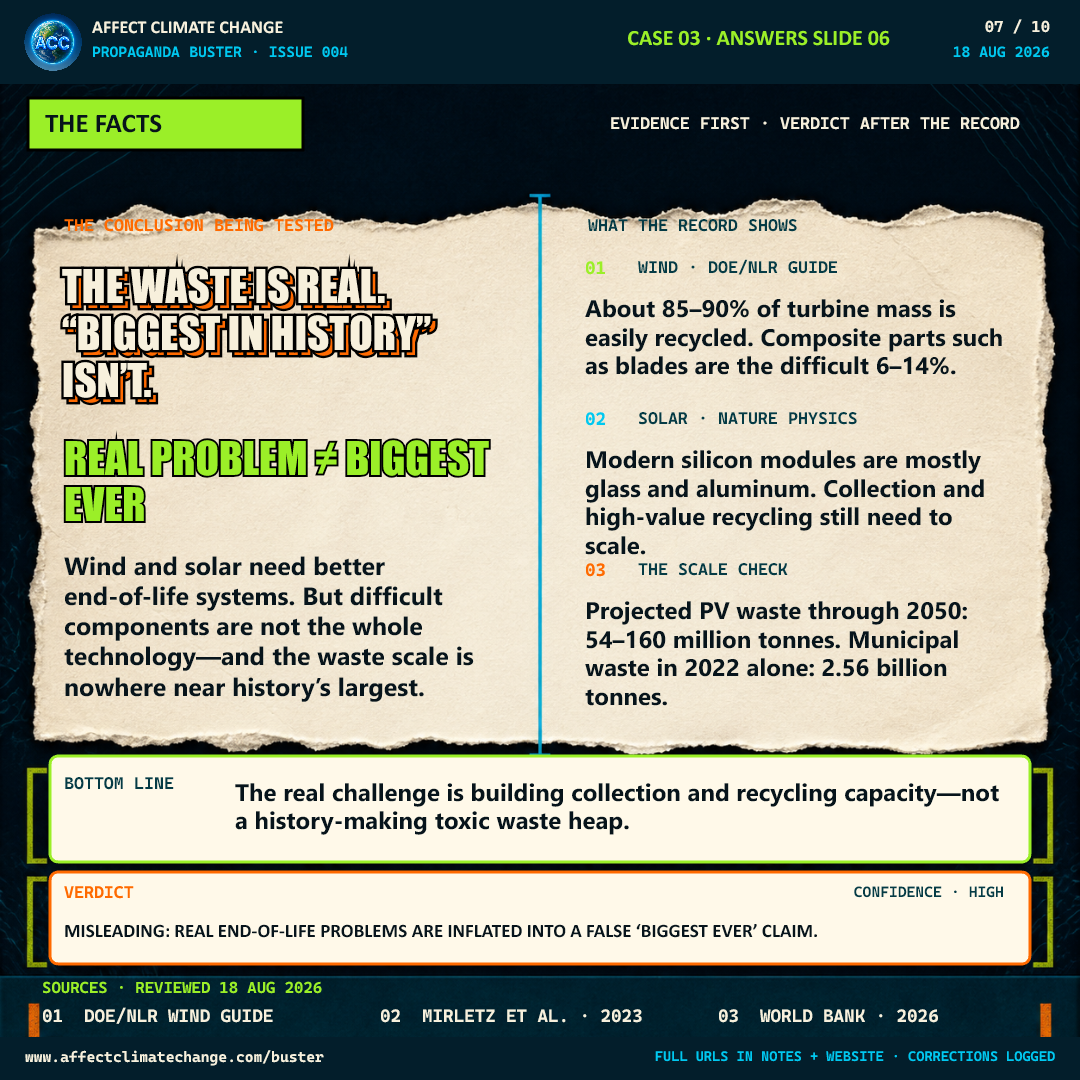
Renewable-energy equipment creates real end-of-life waste, but most turbine mass and most solar-module mass consist of recyclable materials. Difficult components and weak collection systems do not make this history's largest toxic waste stream.
- DOE's end-of-service guide reports that about 85–90% of turbine mass is readily recyclable, while composite parts such as blades comprise about 6–14% and remain harder to process.
- A peer-reviewed analysis projects 54–160 million tonnes of cumulative photovoltaic-module waste through 2050 and describes modern silicon modules as mostly glass and aluminum by mass.
- The World Bank reports 2.56 billion tonnes of municipal solid waste generated worldwide in 2022 alone.
- Collection, transport, economics, high-value material recovery, and end-of-life infrastructure still need substantial improvement.
Evidence chain
Each source is dated and paired with the finding it supports. The original post establishes what was claimed; it does not decide the scientific verdict.
Wind Energy End-of-Service Guide
Published / source period: Accessed 2026-08-18
U.S. Department of Energy / National Laboratory of the Rockies · Reports that about 85–90% of turbine mass is readily recyclable and that composite components such as blades are the difficult 6–14%.
Accessed August 18, 2026
Unfounded Concerns About Photovoltaic Module Toxicity and Waste Are Slowing Decarbonization
Published / source period: 2023
Mirletz et al. / Nature Physics · Projects 54–160 million tonnes of cumulative photovoltaic-module waste through 2050 and compares it with much larger existing waste streams.
Accessed August 18, 2026
Unfounded Concerns About Photovoltaic Module Toxicity and Waste Are Slowing Decarbonization
Published / source period: 2023
U.S. Department of Energy OSTI · Provides accessible composition data showing modern crystalline-silicon modules are predominantly glass and aluminum by mass.
Accessed August 18, 2026
What a Waste 3.0
Published / source period: 2026
World Bank · Reports 2.56 billion tonnes of municipal solid waste in 2022 and a business-as-usual projection of 3.86 billion tonnes annually by 2050.
Accessed August 18, 2026
What is true
Composite blades remain difficult and often uneconomic to recycle, solar collection systems and high-value recovery need to scale, foundations and cables have separate retirement issues, and poor disposal can create local risks. Those real challenges require planning and policy.
Where the claim fails
The article generalizes from hard-to-recycle blades and present recycling gaps to the full technologies, then describes decades of projected waste as history's largest. Authoritative material inventories and global waste data contradict that overall scale and composition framing.
Limits and uncertainty
Wind-turbine percentages exclude foundations, underground wiring, and related infrastructure. Photovoltaic waste projections vary by deployment, lifetime, damage, reuse, and collection assumptions. Municipal waste is used only as a scale comparison; different waste categories have different hazards.
Assessment after the evidence
Renewable-energy equipment creates real end-of-life waste, but most turbine mass and most solar-module mass consist of recyclable materials. Difficult components and weak collection systems do not make this history's largest toxic waste stream.
How the framing works
Scale inflation and whole-from-part reasoning: difficult components and future system gaps are presented as if the entire technologies were unrecyclable and historically unprecedented.
How scientists know
End-of-service guides measure the material composition and treatment options for turbines. Peer-reviewed photovoltaic studies estimate cumulative waste under deployment and lifetime scenarios, inventory modern module materials, and compare projected quantities with major existing waste streams.
Editorial boundaries
ACC evaluates the claim. It does not infer intent, coordination, funding, deception, or control without direct evidence specific to that attribution.
The source presentation and reuse decision are documented here: Approved recreated attributed-text treatment. A limited native-page excerpt appears only inside ACC's fact-checking social slide; complete captures remain private research material.
Corrections and revision record
Corrections status: No change to the scientific verdict has been recorded.
R3 · August 18, 2026
Replaced the earlier reef candidate with the user-selected wind-and-solar waste claim and added current provenance, sources, limitations, slides, caption, and accessibility copy.