Precise proposition checked
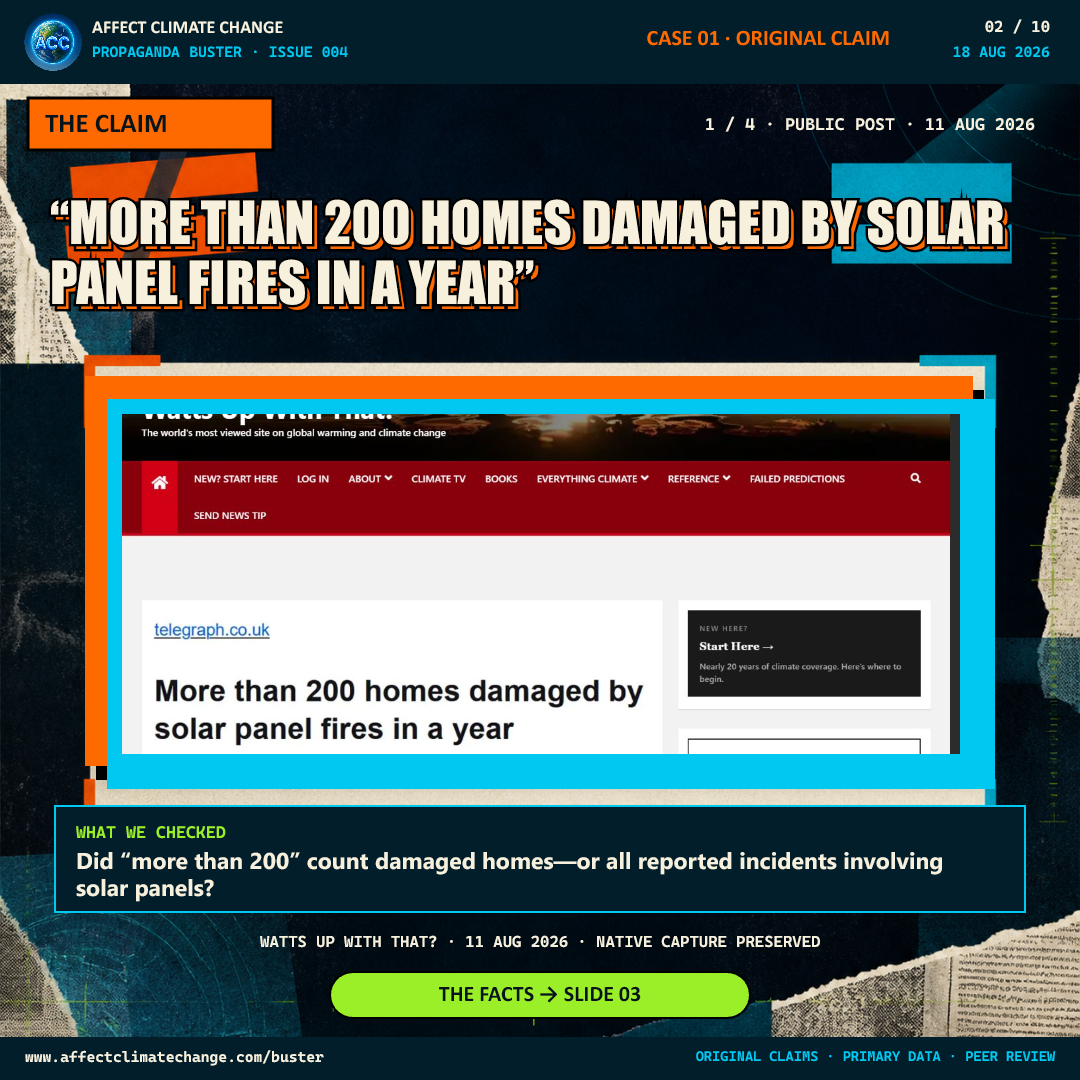
More than 200 homes were damaged by solar-panel fires in one year.
Full post context: The August 11 headline says more than 200 homes were damaged, while the article body says the underlying release identified 212 incidents involving solar panels across property types and 102 residential-property incidents.
Scope of this check: This verdict evaluates the headline's number and category. It does not claim that photovoltaic systems have no fire risk or that every incident was caused by a defective panel.
What the evidence shows
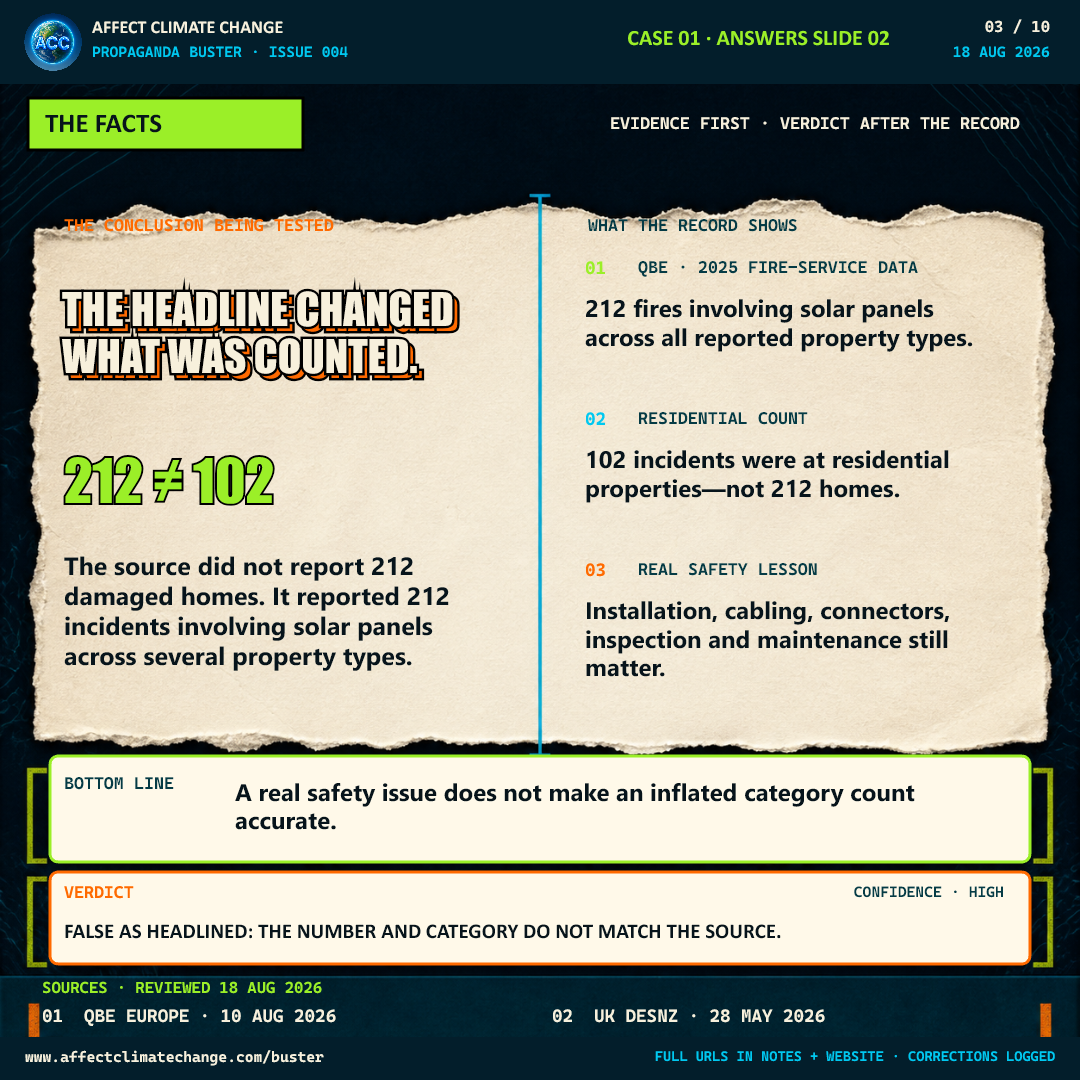
The source reported 212 incidents involving solar panels across multiple property types, not 212 damaged homes. It identified 102 residential incidents, while leaving causation and denominators unresolved.
- QBE reported 212 incidents involving solar panels across the property types represented in its fire-service responses.
- The same release reported 102 incidents at residential properties, not 212 damaged homes.
- Official statistics caution that a free-text mention of solar panels does not by itself establish ignition source or causation.
Evidence chain
Each source is dated and paired with the finding it supports. The original post establishes what was claimed; it does not decide the scientific verdict.
Solar panel fires increasing at more than double the rate of installations
Published / source period: 2026-08-10
QBE Europe · Reports 212 incidents involving solar panels across property types and 102 residential-property incidents.
Accessed August 14, 2026
Number of fires in England with solar panel or photovoltaic panel mentioned in additional-information free text
Published / source period: 2026-01-29
UK Ministry of Housing, Communities and Local Government · Explains that the statistics use free-text mentions, which do not independently establish ignition source or causation.
Accessed August 14, 2026
Fire safety: Thermal exposure to roofs from fires involving photovoltaic panels
Published / source period: 2026-02-13
UK Building Safety Regulator · Documents genuine rooftop photovoltaic fire-safety considerations without validating the altered headline count.
Accessed August 14, 2026
What is true
Solar installations can be involved in real fires, and installation quality, connectors, cabling, inspection, maintenance, and emergency response matter. Those safety concerns do not make the altered headline count accurate.
Where the claim fails
The headline substitutes homes for all reported incidents involving solar panels. That changes both the property category and the meaning of the number, and the underlying reporting language does not establish that a solar-panel defect caused every incident.
Limits and uncertainty
The QBE total combines information obtained from fire services and does not provide a complete national causal rate. A residential-property incident is not necessarily a destroyed home, and a panel mention is not necessarily proof of panel causation.
Assessment after the evidence
The source reported 212 incidents involving solar panels across multiple property types, not 212 damaged homes. It identified 102 residential incidents, while leaving causation and denominators unresolved.
How the framing works
Category inflation: a broader incident total is relabeled as damaged homes, making the event appear more common and severe.
How scientists know
The primary release separates the all-property total from the residential subset. Government statistics also explain that solar-panel mentions in incident free text do not by themselves identify the ignition source or causal equipment failure.
Editorial boundaries
ACC evaluates the claim. It does not infer intent, coordination, funding, deception, or control without direct evidence specific to that attribution.
The source presentation and reuse decision are documented here: Approved recreated attributed-text treatment. A limited native-page excerpt appears only inside ACC's fact-checking social slide; complete captures remain private research material.
Corrections and revision record
Corrections status: No change to the scientific verdict has been recorded.
R3 · August 18, 2026
Retained the previously reviewed verdict and updated the issue date for the final four-claim edition.