Precise proposition checked
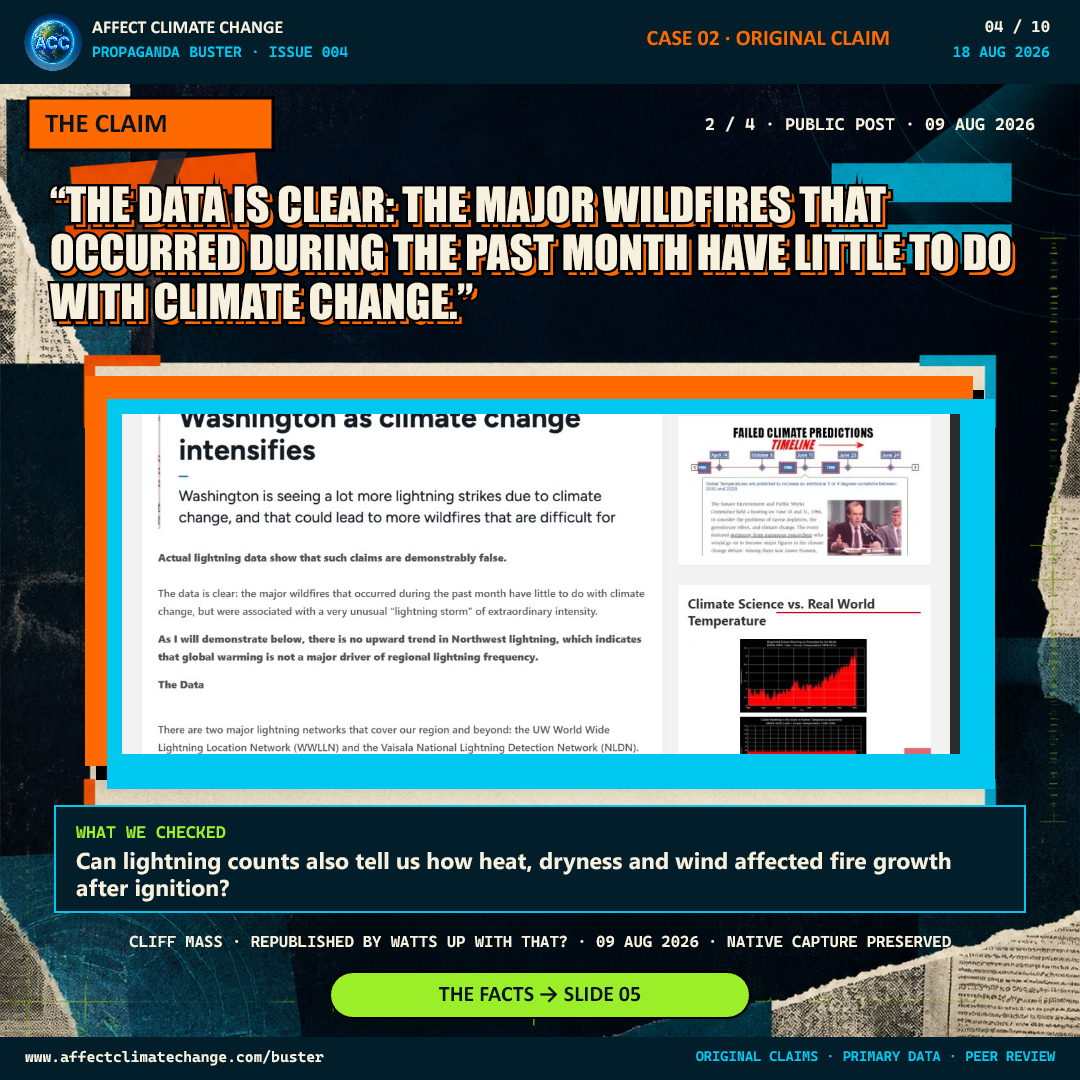
A flat Northwest lightning trend shows recent major wildfires had little to do with climate change.
Full post context: The August 9 post says the major wildfires of the previous month had little to do with climate change and uses a flat or declining regional lightning trend as the central test.
Scope of this check: ACC accepts that regional lightning counts may be flat. This verdict addresses only whether ignition counts can rule out climate influence on fuel dryness, fire weather, spread, intensity, or burned area.
What the evidence shows
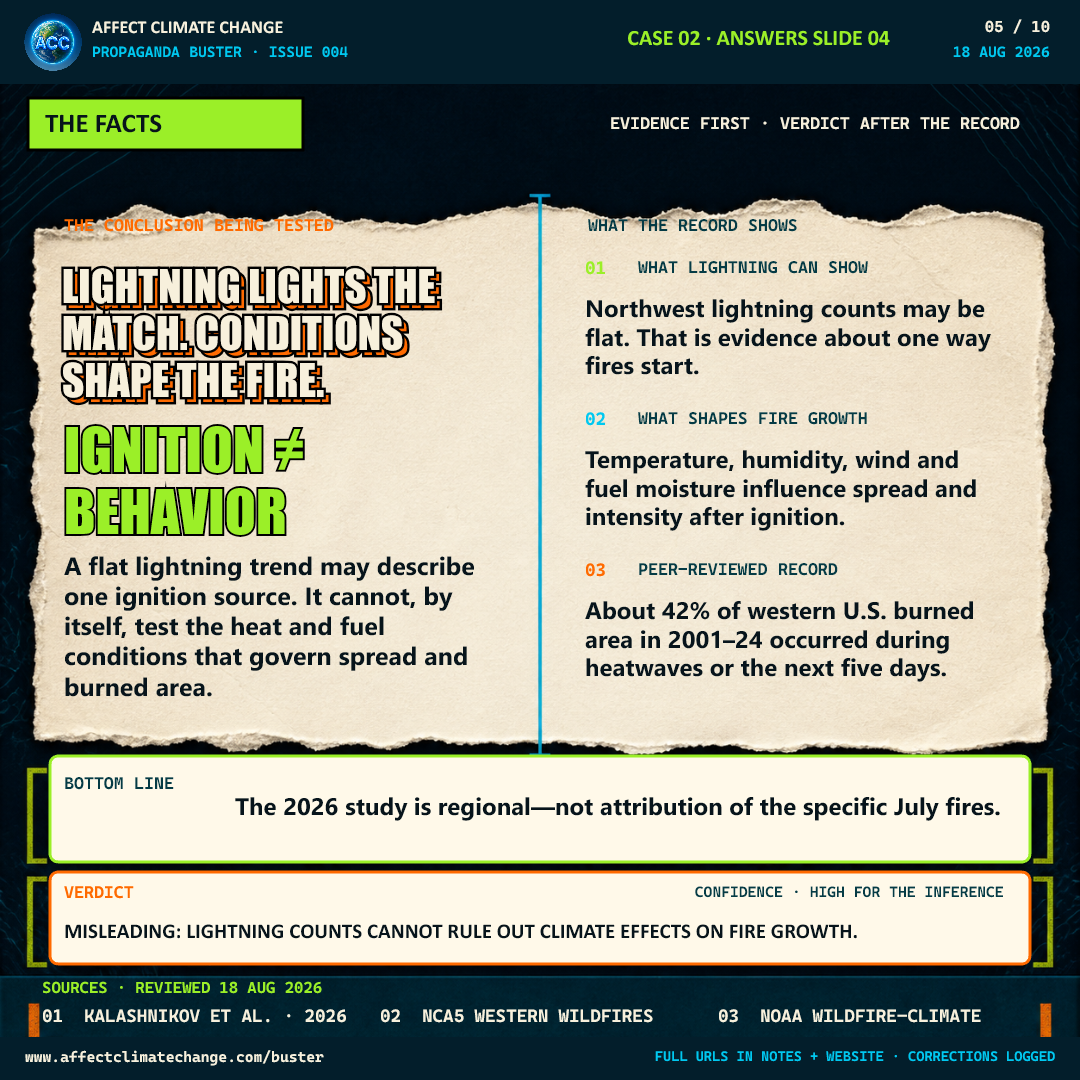
Lightning counts describe one ignition pathway. They cannot, by themselves, establish how heat, humidity, wind, and fuel moisture affected growth after ignition or prove that climate had little role in burned area.
- Northwest lightning counts may be flat, which is evidence about one ignition source.
- Temperature, humidity, wind, and fuel moisture influence fire spread and intensity after ignition.
- About 42% of western U.S. burned area during 2001–2024 occurred during heatwaves or the following five days.
Evidence chain
Each source is dated and paired with the finding it supports. The original post establishes what was claimed; it does not decide the scientific verdict.
Heatwaves enable wildfire activity in the western United States
Published / source period: 2026-06-17
Kalashnikov et al. / Science Advances · Finds that heatwave and five-day post-heatwave periods contained about 42% of western U.S. burned area during 2001–2024.
Accessed August 14, 2026
Fifth National Climate Assessment: Western Wildfires
Published / source period: 2023-11-14
U.S. Global Change Research Program · Synthesizes evidence that warming and drying conditions influence western wildfire behavior and burned area.
Accessed August 14, 2026
Wildfire–Climate Connection
Published / source period: Accessed 2026-08-14
NOAA · Explains how fuel moisture, temperature, humidity, and wind affect wildfire risk and behavior after ignition.
Accessed August 14, 2026
What is true
Lightning is an important natural ignition source, and the post's regional lightning trend may be accurate. No evidence used here attributes the specific July 2026 fires or assigns them a climate-change percentage.
Where the claim fails
The argument treats the number of lightning ignitions as though it also measures the conditions governing fire behavior. A stable ignition trend can coexist with hotter or drier conditions that allow some fires to spread farther or burn more intensely.
Limits and uncertainty
The peer-reviewed result covers the western United States from 2001 through 2024 and is not an event-attribution analysis of the July 2026 Northwest fires.
Assessment after the evidence
Lightning counts describe one ignition pathway. They cannot, by themselves, establish how heat, humidity, wind, and fuel moisture affected growth after ignition or prove that climate had little role in burned area.
How the framing works
Single-cause framing: evidence about how fires begin is used to dismiss evidence about the conditions that shape what happens afterward.
How scientists know
Researchers separately measure ignition, temperature, humidity, wind, fuel moisture, fire weather, burned area, and severity. A 2026 regional study found that a disproportionate share of western U.S. burned area occurred during or just after heatwaves.
Editorial boundaries
ACC evaluates the claim. It does not infer intent, coordination, funding, deception, or control without direct evidence specific to that attribution.
The source presentation and reuse decision are documented here: Approved recreated attributed-text treatment. A limited native-page excerpt appears only inside ACC's fact-checking social slide; complete captures remain private research material.
Corrections and revision record
Corrections status: No change to the scientific verdict has been recorded.
R3 · August 18, 2026
Retained the previously reviewed ignition-versus-behavior verdict and the explicit event-attribution limitation.