Precise proposition checked
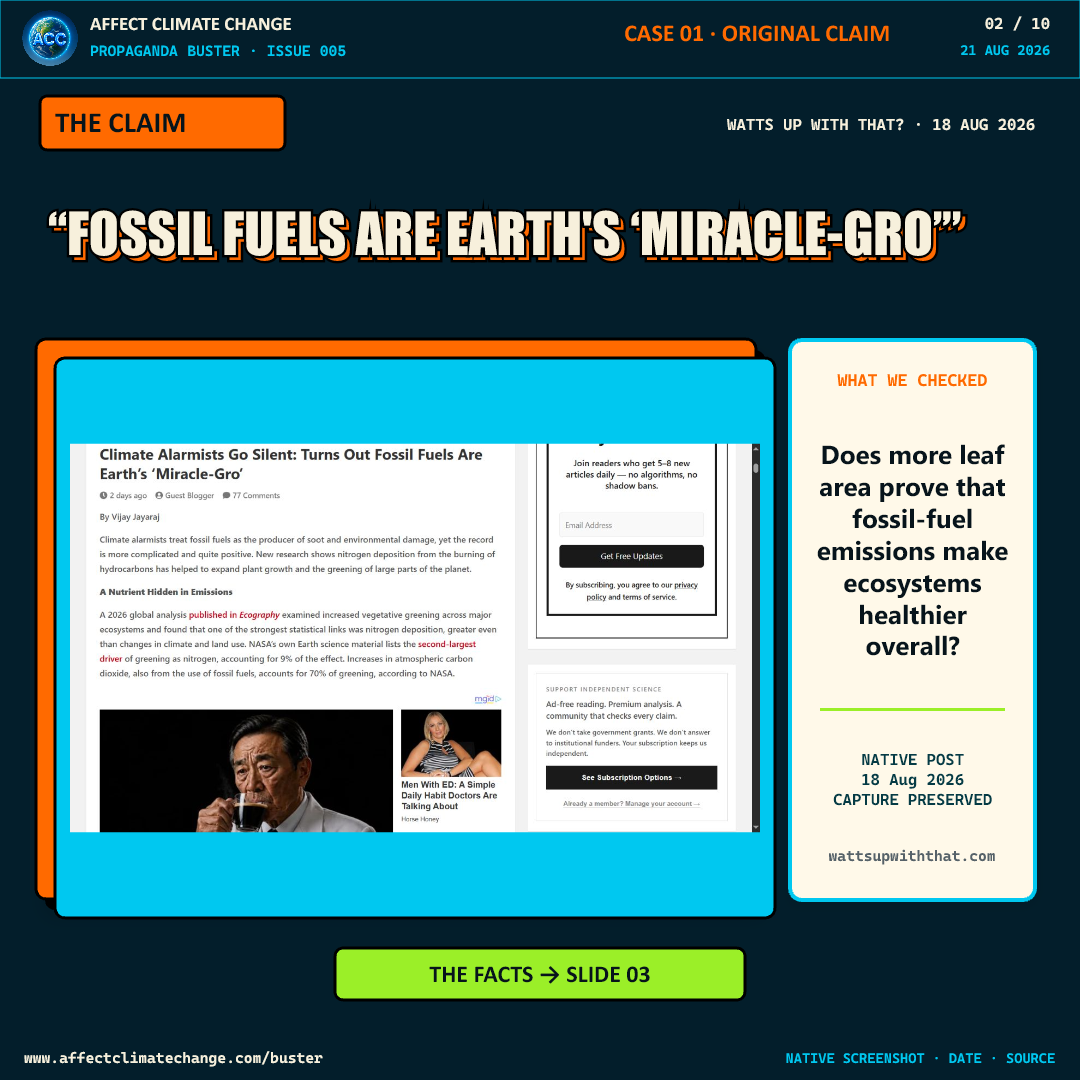
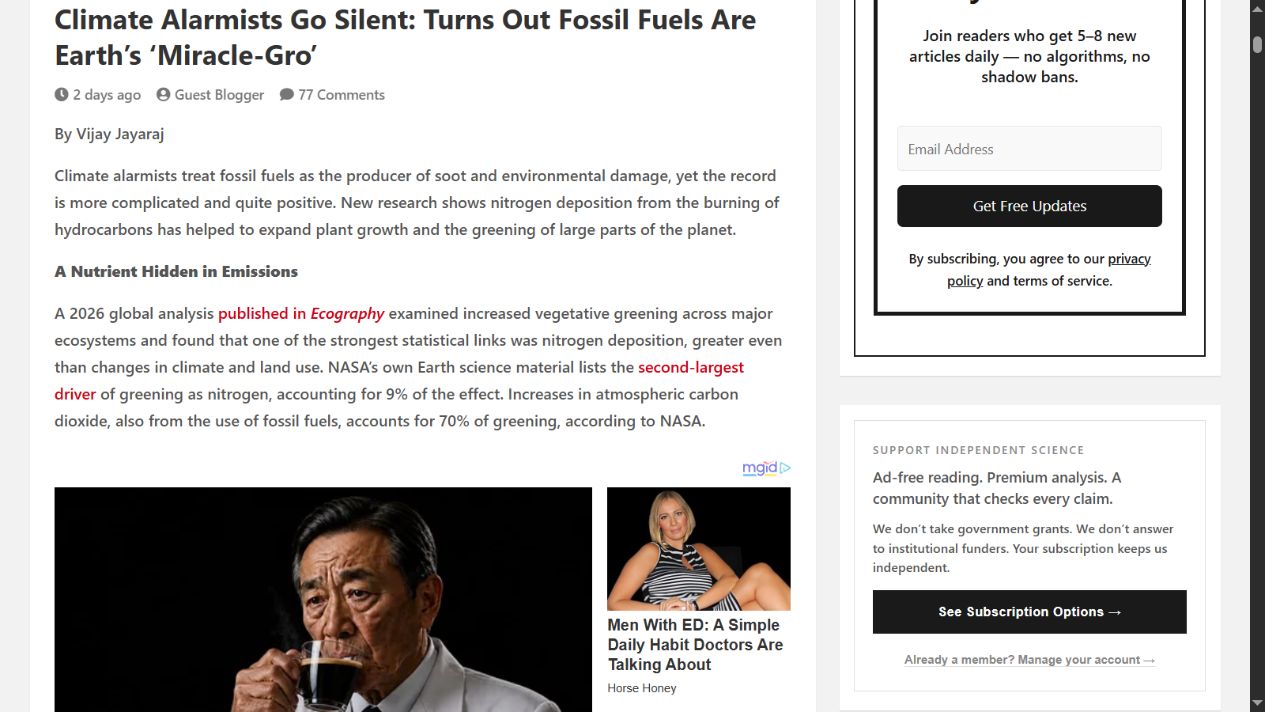
Observed increases in global leaf area establish that fossil-fuel emissions improve ecosystems overall and outweigh the broader harms from rising greenhouse gases.
Full post context: An August 18, 2026 Watts Up With That? article used documented satellite greening to argue that fossil fuels are environmentally beneficial overall.
Scope of this check: The check accepts that carbon dioxide fertilization and other drivers have increased leaf area in many regions; it tests the broader claim about total ecosystem and climate benefit.
What the evidence shows
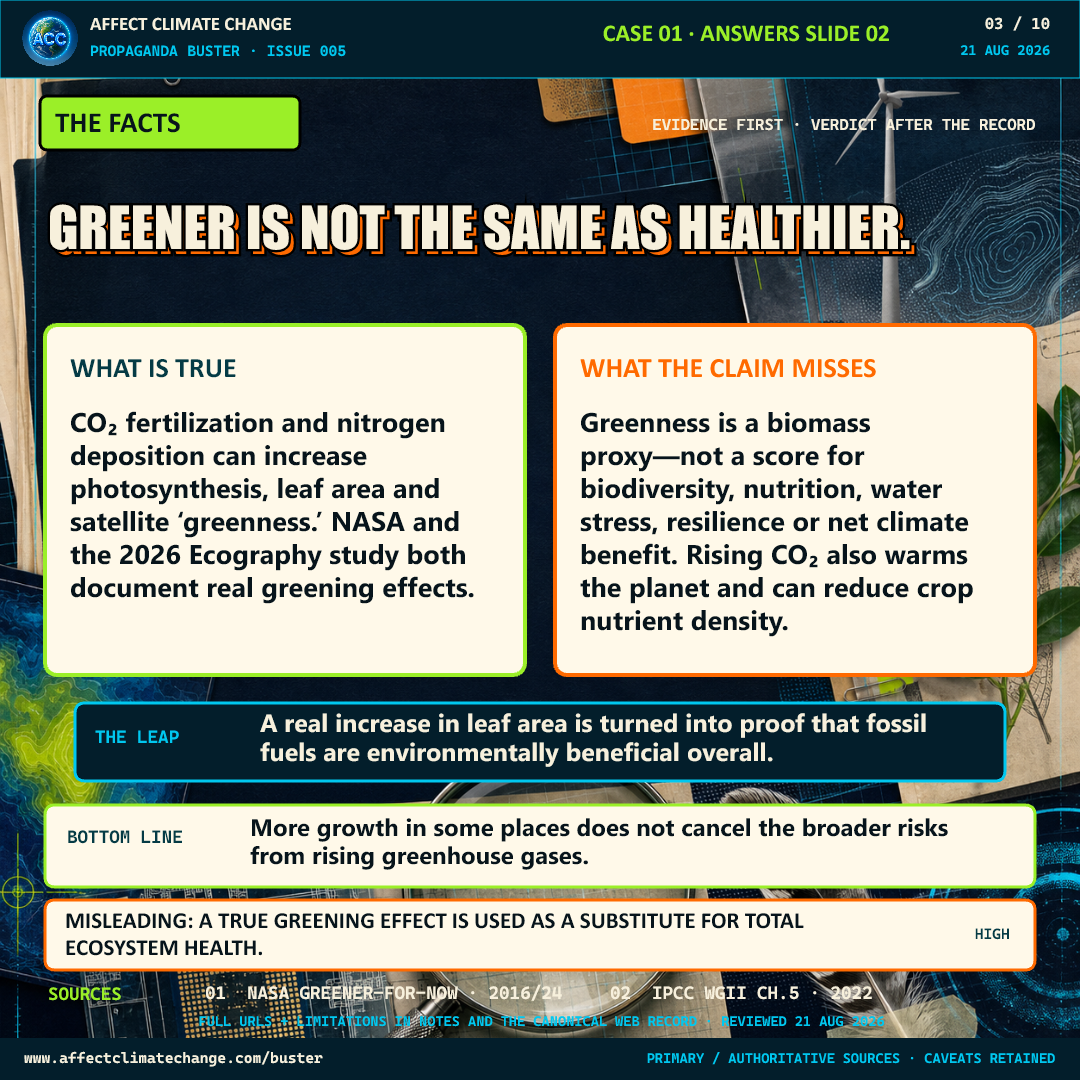
Satellite observations document widespread greening, and carbon dioxide fertilization is one important driver. The same evidence record does not turn greenness into a comprehensive ecosystem-health score or show that the benefits cancel warming, water stress, crop-quality losses, or other climate risks.
- NASA reports widespread satellite-observed greening and identifies carbon dioxide fertilization as a major driver, while warning that the effect is not unlimited.
- The 2026 Ecography study examines multiple greening drivers rather than reducing the observed pattern to a single universal benefit.
- IPCC Working Group II assesses simultaneous risks from warming, water stress, ecosystem disruption, and reduced crop quality.
- More leaf area in some places does not establish that greenhouse-gas emissions are beneficial overall.
Evidence chain
Each source is dated and paired with the finding it supports. The original post establishes what was claimed; it does not decide the scientific verdict.
CO2 is making Earth greener—for now
Published / source period: 2016-04-26
NASA · Reports widespread satellite-observed greening and identifies CO2 fertilization as a major driver while emphasizing that the effect is not an unlimited climate benefit.
Accessed August 21, 2026
Global analysis suggests nitrogen deposition as an underestimated driver of vegetation greening
Published / source period: 2026-07-20
Ecography · Examines satellite greening patterns and multiple drivers, including atmospheric CO2 and nitrogen deposition.
Accessed August 21, 2026
Climate Change 2022: Impacts Adaptation and Vulnerability — Chapter 5
Published / source period: 2022
IPCC Working Group II · Assesses climate risks to food systems and terrestrial ecosystems, including effects of elevated CO2, warming, water stress, and crop quality.
Accessed August 21, 2026
What is true
Higher carbon dioxide can increase photosynthesis and leaf area where nutrients, water, temperature, and other conditions permit. Nitrogen deposition and land management also contribute to observed greening.
Where the claim fails
The argument substitutes one measurable response—additional leaf area—for a much broader judgment about ecosystem health and total climate impact. That reasoning omits other biological, hydrological, nutritional, and regional outcomes.
Limits and uncertainty
Remote-sensing greenness is a biomass proxy rather than a direct measure of biodiversity, nutritional quality, resilience, or every regional outcome. Effects vary by ecosystem and limiting resource.
Assessment after the evidence
Satellite greening is real, but leaf area is not a complete measure of biodiversity, nutrition, water stress, resilience, or net climate harm.
How the framing works
Metric substitution: a real increase in one indicator is treated as proof of an overall environmental benefit.
How scientists know
Researchers combine satellite leaf-area records with process models, field observations, and attribution analyses, then compare greening with independent evidence on heat, water stress, crop nutrition, biodiversity, and ecosystem resilience.
Editorial boundaries
ACC evaluates the claim. It does not infer intent, coordination, funding, deception, or control without direct evidence specific to that attribution.
The source presentation and reuse decision are documented here: Approved bounded native-source crop for criticism and fact-checking, shown with attribution and a direct source link; unrelated page content is excluded.
Corrections and revision record
Corrections status: No change to the scientific verdict has been recorded.
v1.0 · August 21, 2026
Initial evidence review. Verdict: MISLEADING, high confidence.
v1.1 · August 28, 2026
Canonical website record created from the verified R1 ledger and native provenance.