Precise proposition checked
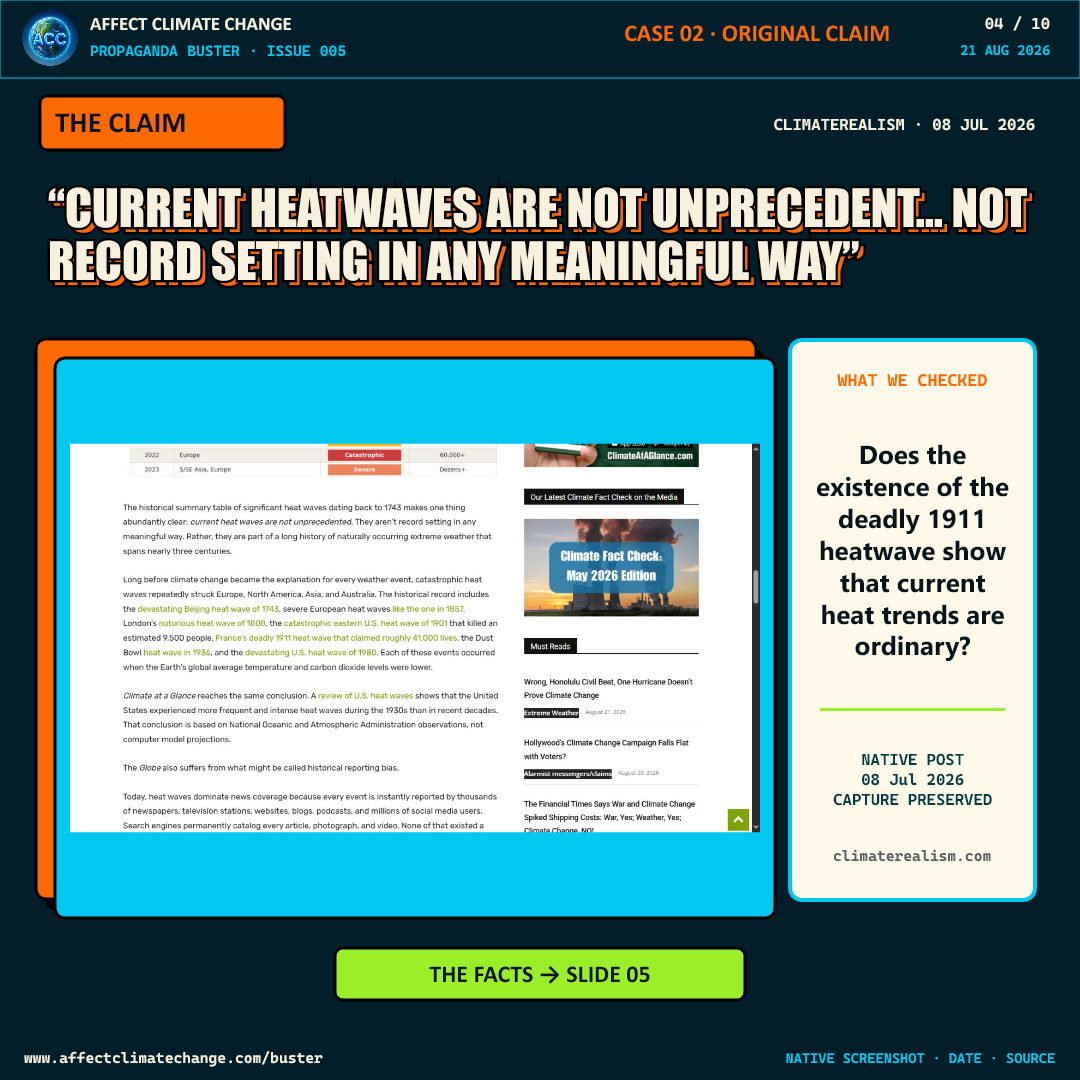
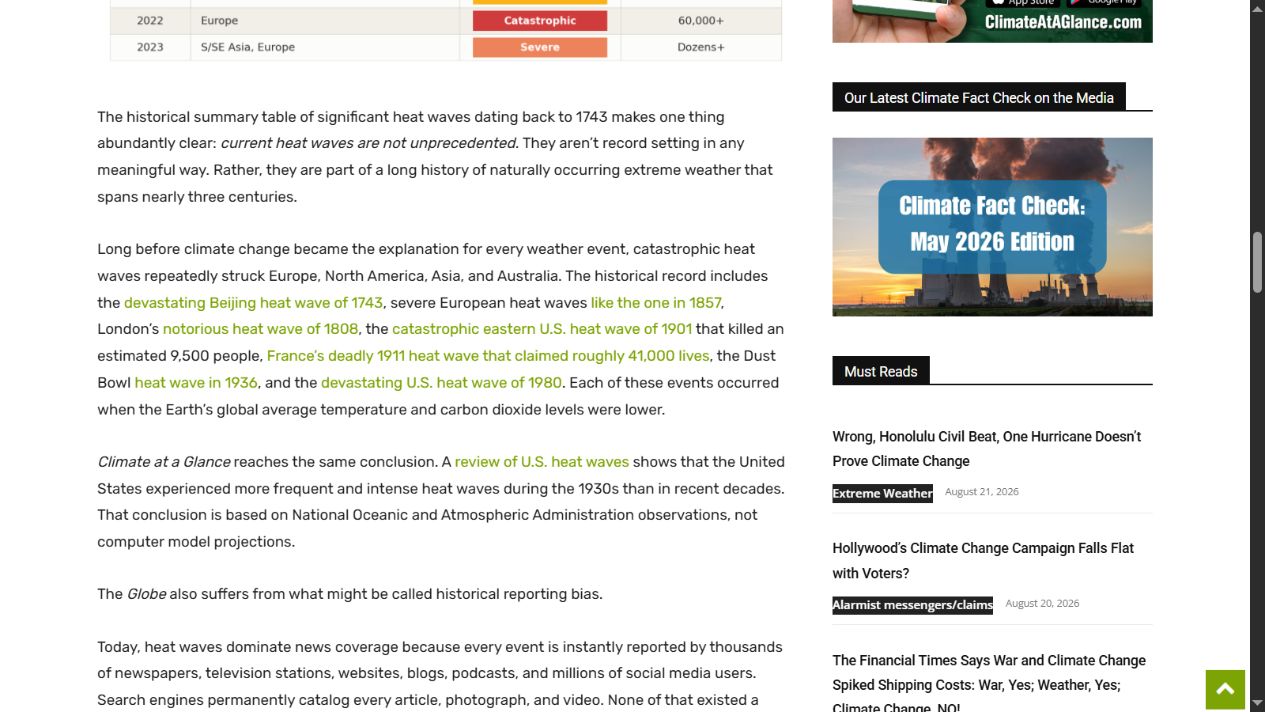
Because deadly heatwaves occurred before modern warming, present-day heat extremes are not changing in a meaningful long-term way.
Full post context: A July 8, 2026 ClimateRealism article cited severe historical heatwaves, including France in 1911, to dismiss the modern change in heat extremes.
Scope of this check: The check accepts that the 1911 heatwave and other historical extremes were real. It tests whether one or several past events erase changes in frequency and intensity measured across a consistent record.
What the evidence shows
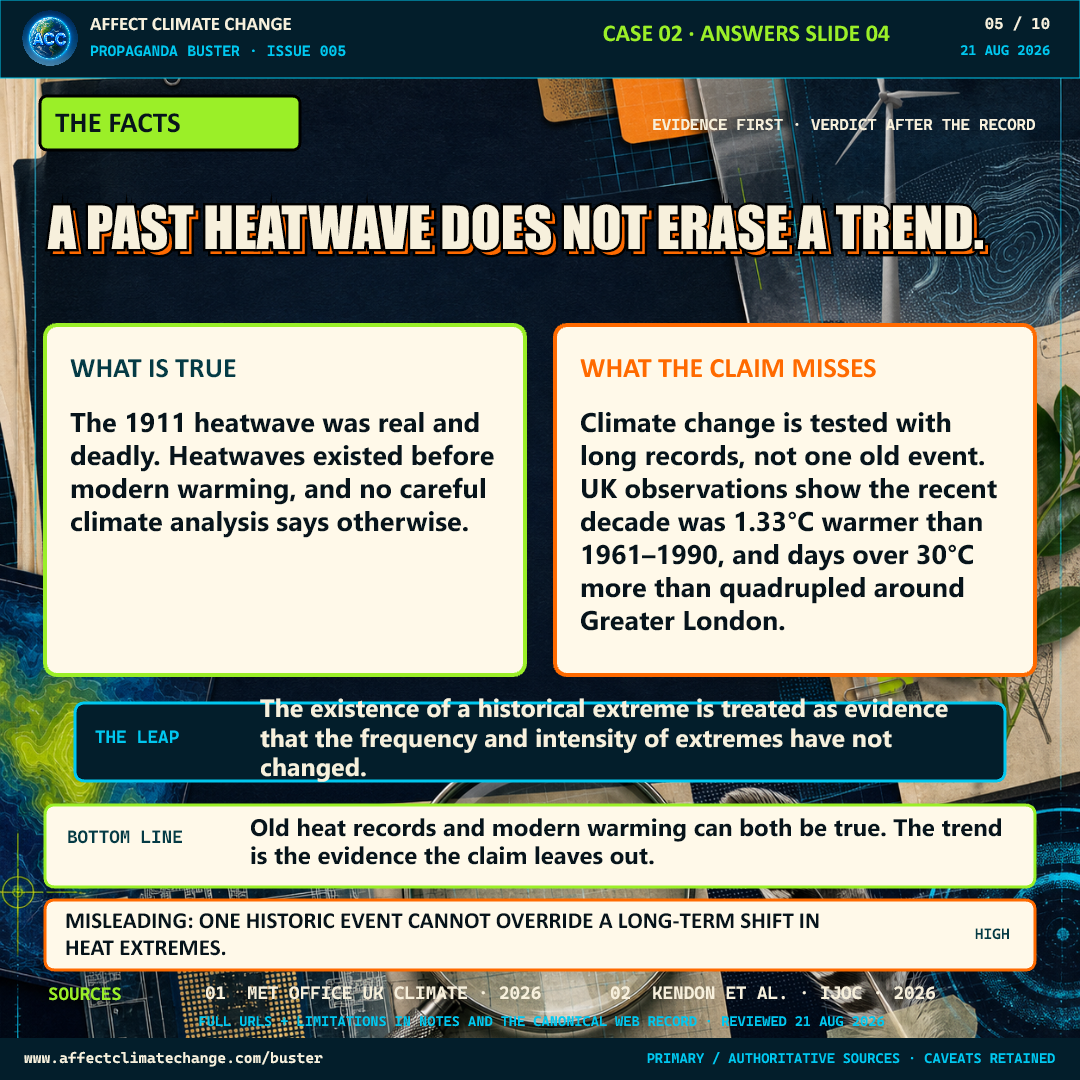
Long records test climate change across many years rather than asking whether heat existed in the past. UK observations show the recent decade was warmer than the 1961–1990 reference period and that days above 30°C became substantially more frequent around Greater London.
- Historical heatwaves occurred before the modern warming trend and remain part of the climate record.
- The Met Office reports that 2016–2025 was 1.33°C warmer than 1961–1990 for the UK.
- Days above 30°C more than quadrupled around Greater London in the cited comparison.
- IPCC Working Group I independently assesses observed and projected changes in heat extremes at global and regional scales.
- An old record and a modern long-term trend can both be true.
Evidence chain
Each source is dated and paired with the finding it supports. The original post establishes what was claimed; it does not decide the scientific verdict.
Climate extremes are becoming the new normal for the UK
Published / source period: 2026-07-14
Met Office · Reports that 2016–2025 was 1.33°C warmer than 1961–1990 and that days above 30°C more than quadrupled around Greater London.
Accessed August 21, 2026
State of the UK Climate in 2025
Published / source period: 2026-07-14
Kendon et al. / International Journal of Climatology · Documents the United Kingdom's 2025 climate and long-term changes using observational records; supports the cited recent-decade and extreme-heat comparisons.
Accessed August 21, 2026
1911 heatwave context
Published / source period: 1911
Historical record · The cited 1911 heatwave was real and severe.
Accessed August 21, 2026
AR6 WGI Chapter 11: Weather and Climate Extreme Events in a Changing Climate
Published / source period: 2021
Intergovernmental Panel on Climate Change · Assesses observed and projected changes in heat extremes globally, keeping individual events separate from changes in the long-term distribution.
Accessed August 28, 2026
What is true
The 1911 European heatwave was real and deadly, and no responsible climate analysis says extreme heat began only after modern warming. Individual events still depend on weather patterns and local vulnerability.
Where the claim fails
The argument treats the existence of an old disaster as evidence that the distribution of heat extremes has not shifted. That does not test whether hot conditions now occur more often, cover different areas, or arise from a warmer baseline.
Limits and uncertainty
The cited observational evidence is UK-specific and does not attribute every individual heatwave solely to climate change. Definitions, geography, and observing practices must remain consistent.
Assessment after the evidence
Past heatwaves were real, but an old extreme does not erase a long-term shift in average temperature or the frequency of very hot days.
How the framing works
Single-event substitution: one genuine historical extreme is used to dismiss a change measured across the full long-term record.
How scientists know
Meteorological agencies use homogenized station records and consistent thresholds to compare temperature distributions and extreme-day frequencies over decades, while event-attribution studies address specific events separately.
Editorial boundaries
ACC evaluates the claim. It does not infer intent, coordination, funding, deception, or control without direct evidence specific to that attribution.
The source presentation and reuse decision are documented here: Approved bounded native-source crop for criticism and fact-checking, shown with attribution and a direct source link; unrelated page content is excluded.
Corrections and revision record
Corrections status: No change to the scientific verdict has been recorded.
v1.0 · August 21, 2026
Initial evidence review. Verdict: MISLEADING, high confidence; the 1911 event is preserved as real.
v1.1 · August 28, 2026
Canonical website record created from the verified R1 ledger and native provenance.