Precise proposition checked
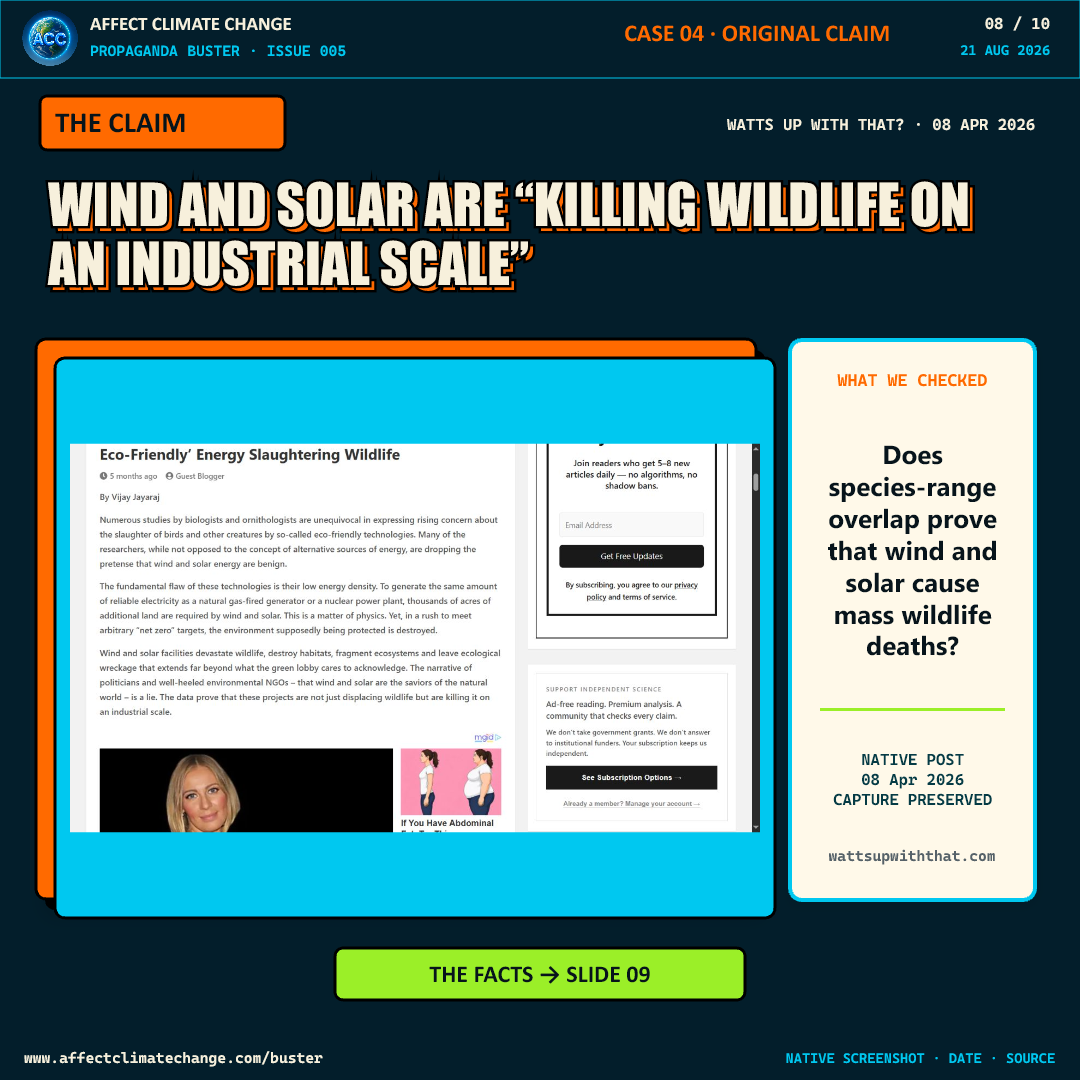
Mapped overlap between renewable facilities and threatened-species ranges demonstrates measured industrial-scale mortality or population harm across wind and solar development.
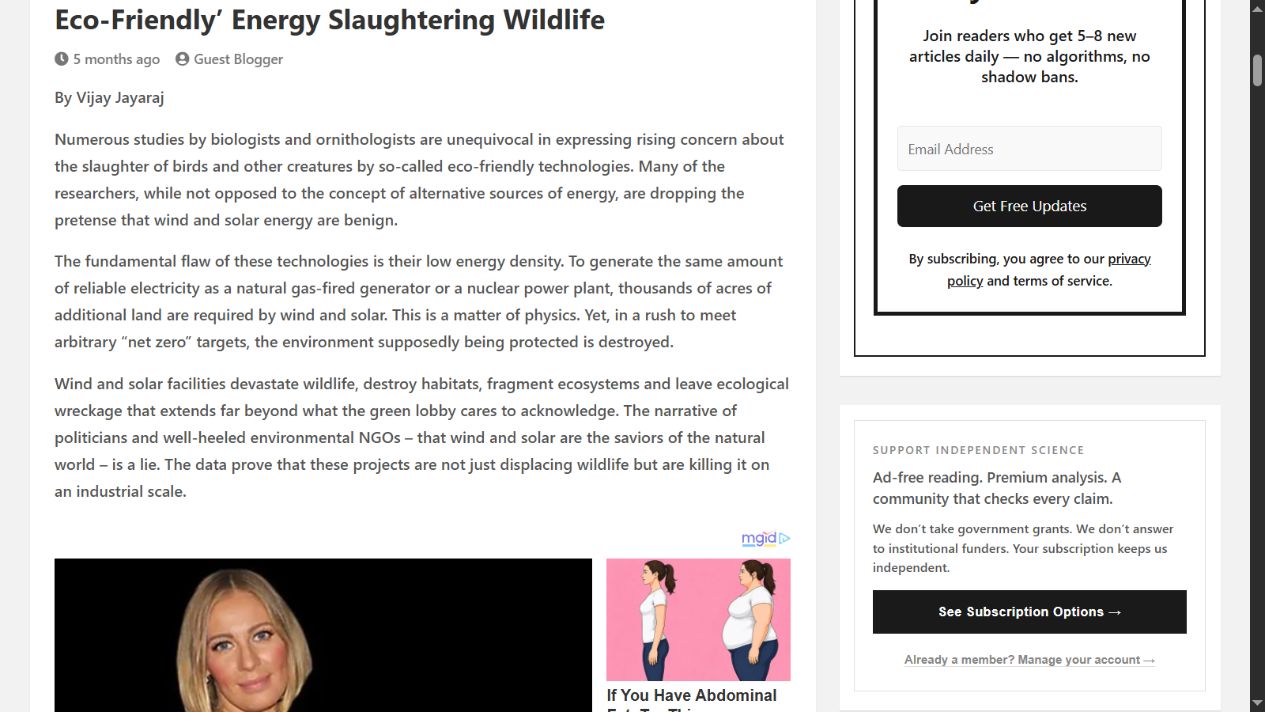
Full post context: An April 8, 2026 Watts Up With That? article used geographic overlap between renewable-energy facilities and threatened-species ranges to characterize wind and solar as killing wildlife on an industrial scale.
Scope of this check: The check does not deny real wildlife risks from collision, habitat loss, displacement, or fragmentation. It tests whether a screening map by itself measures mortality or population outcomes.
What the evidence shows
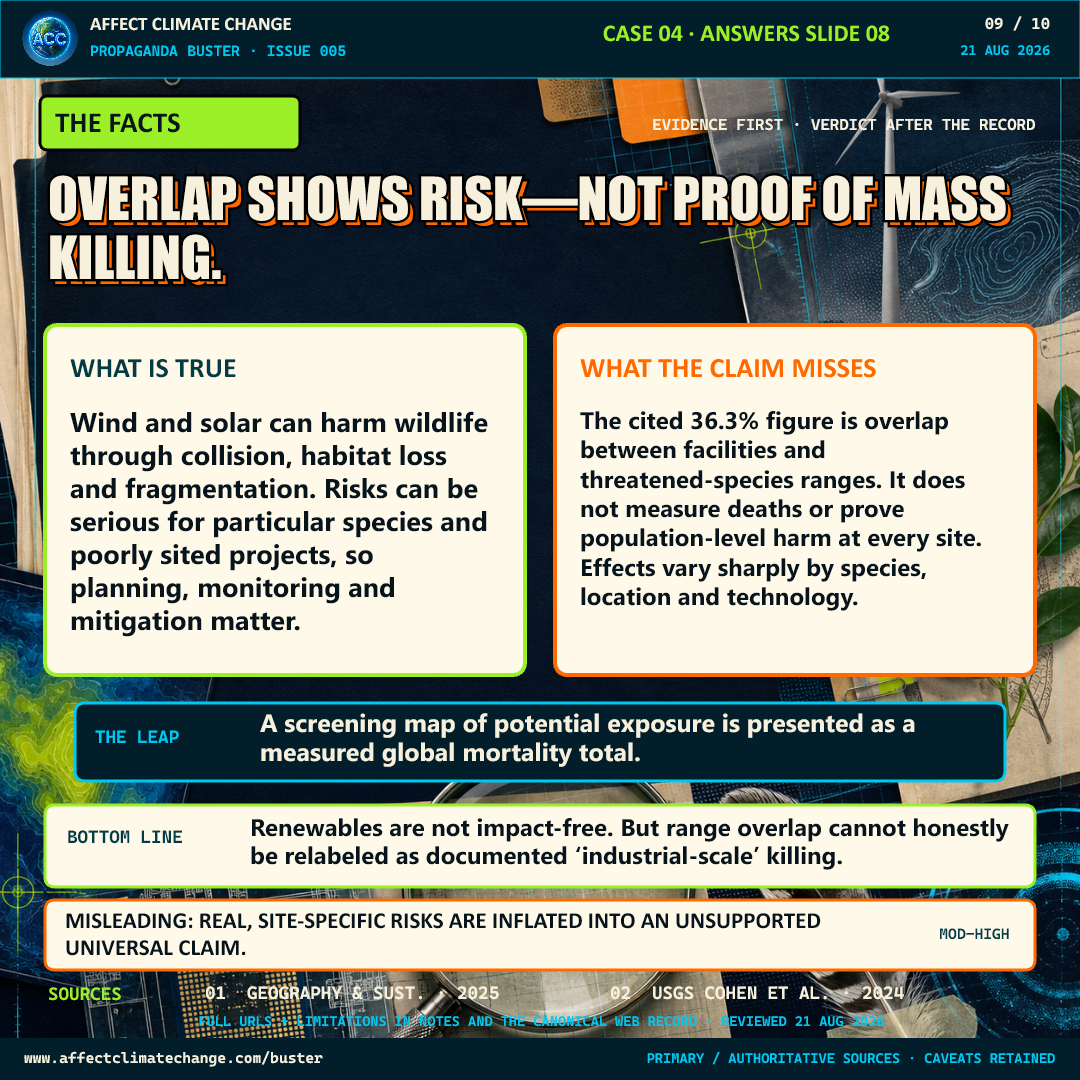
Wind and solar facilities can affect wildlife through collision, habitat loss, displacement, and fragmentation. Geographic overlap with threatened-species ranges is a useful screening indicator, but impact depends on species, site, technology, operation, mitigation, and measured outcomes.
- The cited global study maps overlap as a screening indicator of potential biodiversity risk.
- Range overlap is not the same measurement as mortality, reproduction, displacement, or population decline.
- USGS used feathers from observed dead birds to estimate geographic origin and population exposure, supporting species- and place-specific assessment rather than a universal population-harm label.
- U.S. Fish and Wildlife Service guidance confirms real risks and the need for siting, mitigation, and monitoring.
Evidence chain
Each source is dated and paired with the finding it supports. The original post establishes what was claimed; it does not decide the scientific verdict.
A global assessment of the risks to biodiversity and Indigenous people's lands from solar and wind farms
Published / source period: 2025
Geography and Sustainability · Maps geographic overlap between solar and wind facilities and threatened-species ranges as a screening indicator of potential biodiversity risk.
Accessed August 21, 2026
The geographic extent of bird populations affected by renewable-energy development
Published / source period: 2024-01-05
U.S. Geological Survey · Uses feathers from observed dead birds at renewable-energy facilities to estimate geographic origin and the extent of populations exposed, supporting species- and place-specific assessment.
Accessed August 21, 2026
Wind Energy
Published / source period: undated
U.S. Fish and Wildlife Service · Provides guidance for identifying, minimizing, and monitoring wildlife impacts from wind-energy development.
Accessed August 21, 2026
What is true
Renewable energy is not impact-free. Poor siting and operation can create serious species risks, which is why project-specific surveys, avoidance, monitoring, mitigation, and cumulative-impact assessment matter.
Where the claim fails
The claim relabels potential exposure as observed mass mortality. A range map cannot establish whether animals were present at a facility, how many were harmed, whether a population changed, or how impacts compare across technologies and locations.
Limits and uncertainty
The central study maps overlap rather than mortality. Moderate–high confidence is retained from the reviewed issue because the indicator distinction is clear while site-specific outcome data remain decisive.
Assessment after the evidence
Range overlap identifies places needing careful review; it does not by itself measure deaths, population decline, or universal impact at every site.
How the framing works
Indicator inflation: a potential-exposure map is presented as a direct measure of universal industrial-scale killing.
How scientists know
Researchers combine facility locations with species-range and habitat data to screen potential exposure, then use field surveys, fatality monitoring, population models, and before-and-after comparisons to evaluate actual effects.
Editorial boundaries
ACC evaluates the claim. It does not infer intent, coordination, funding, deception, or control without direct evidence specific to that attribution.
The source presentation and reuse decision are documented here: Approved bounded native-source crop for criticism and fact-checking, shown with attribution and a direct source link; unrelated page content is excluded.
Corrections and revision record
Corrections status: No change to the scientific verdict has been recorded.
v1.0 · August 21, 2026
Initial evidence review. Verdict: MISLEADING, moderate–high confidence.
v1.1 · August 28, 2026
Canonical website record created with the reviewed confidence boundary preserved.