Precise proposition checked
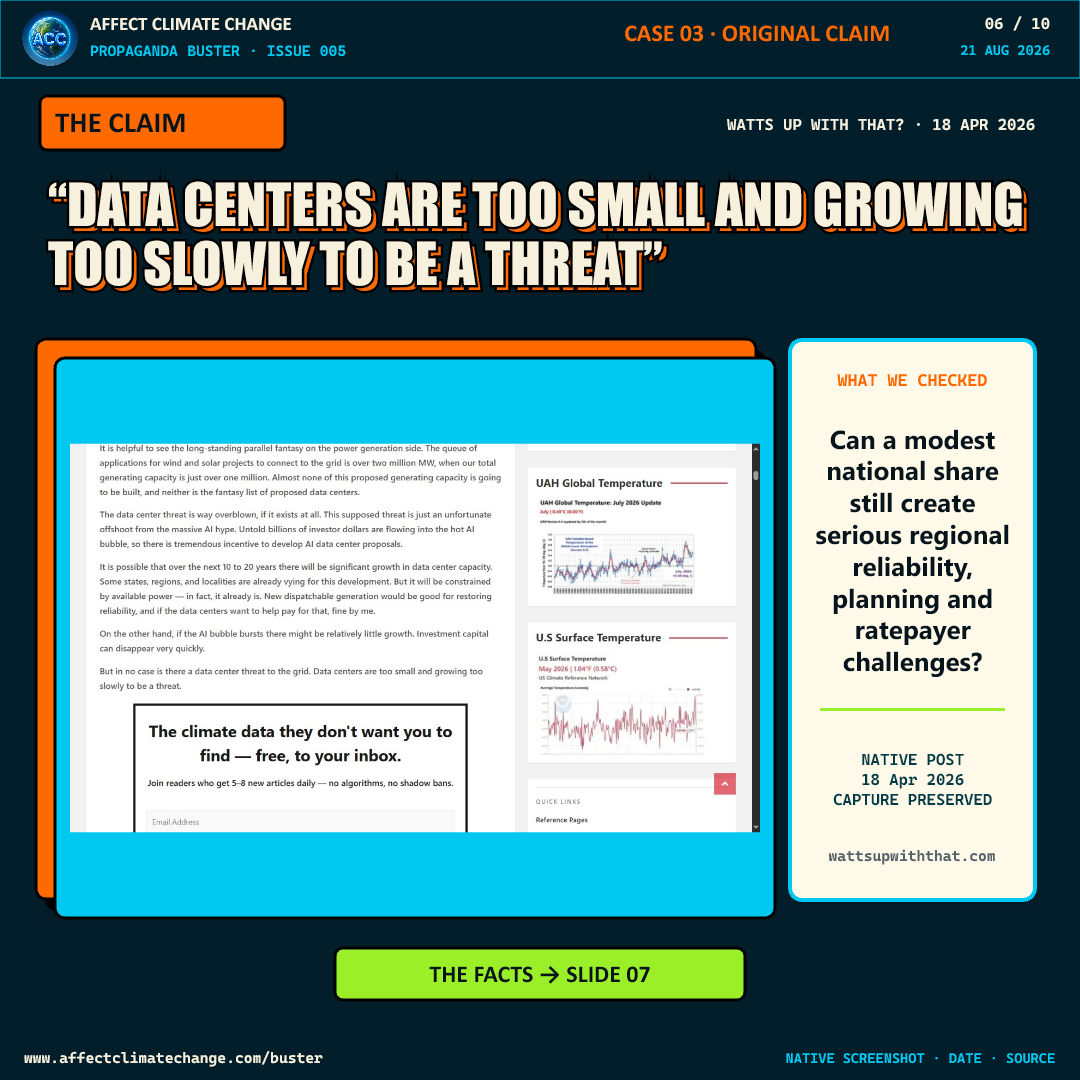
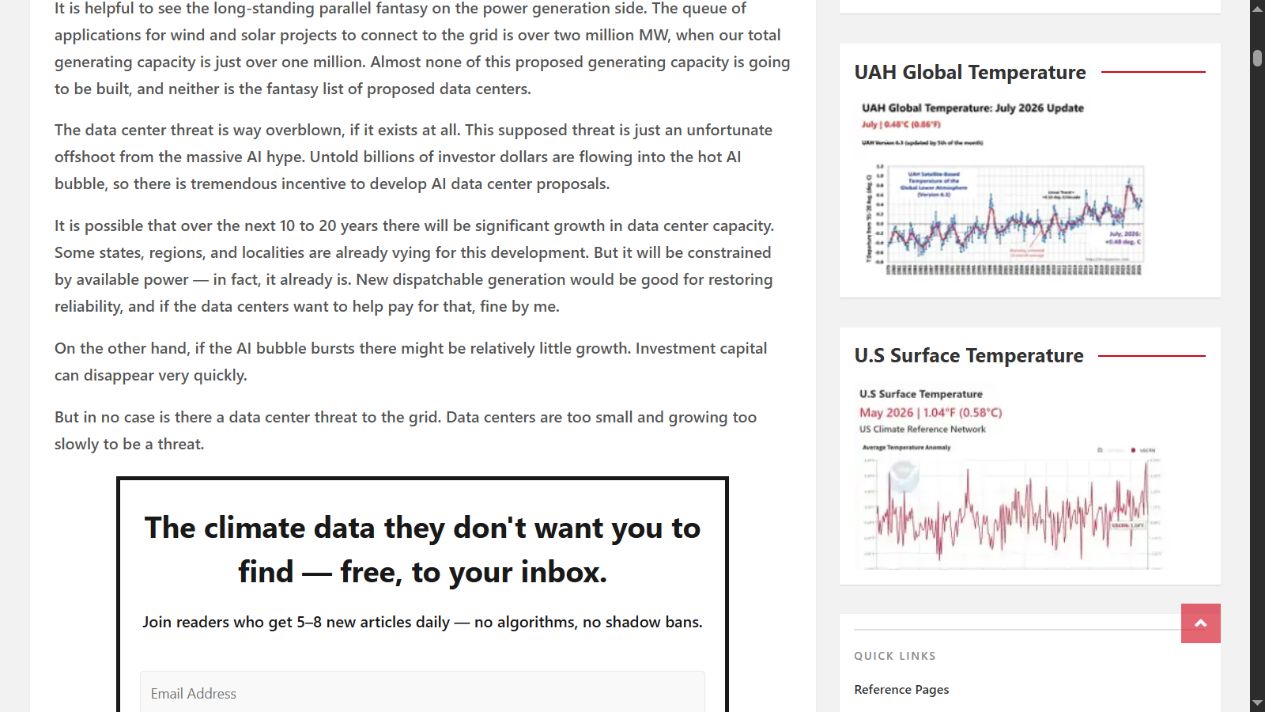
Current and proposed data-center electricity demand is universally too small and slow-growing to create material reliability, affordability, interconnection, or infrastructure challenges.
Full post context: An April 18, 2026 Watts Up With That? article used a limited national share and uncertainty about proposed projects to dismiss data-center grid risks in every case.
Scope of this check: The check does not predict nationwide grid collapse and does not assume every announced project will be built. It evaluates concentrated regional loads and the categorical ‘in no case’ language.
What the evidence shows
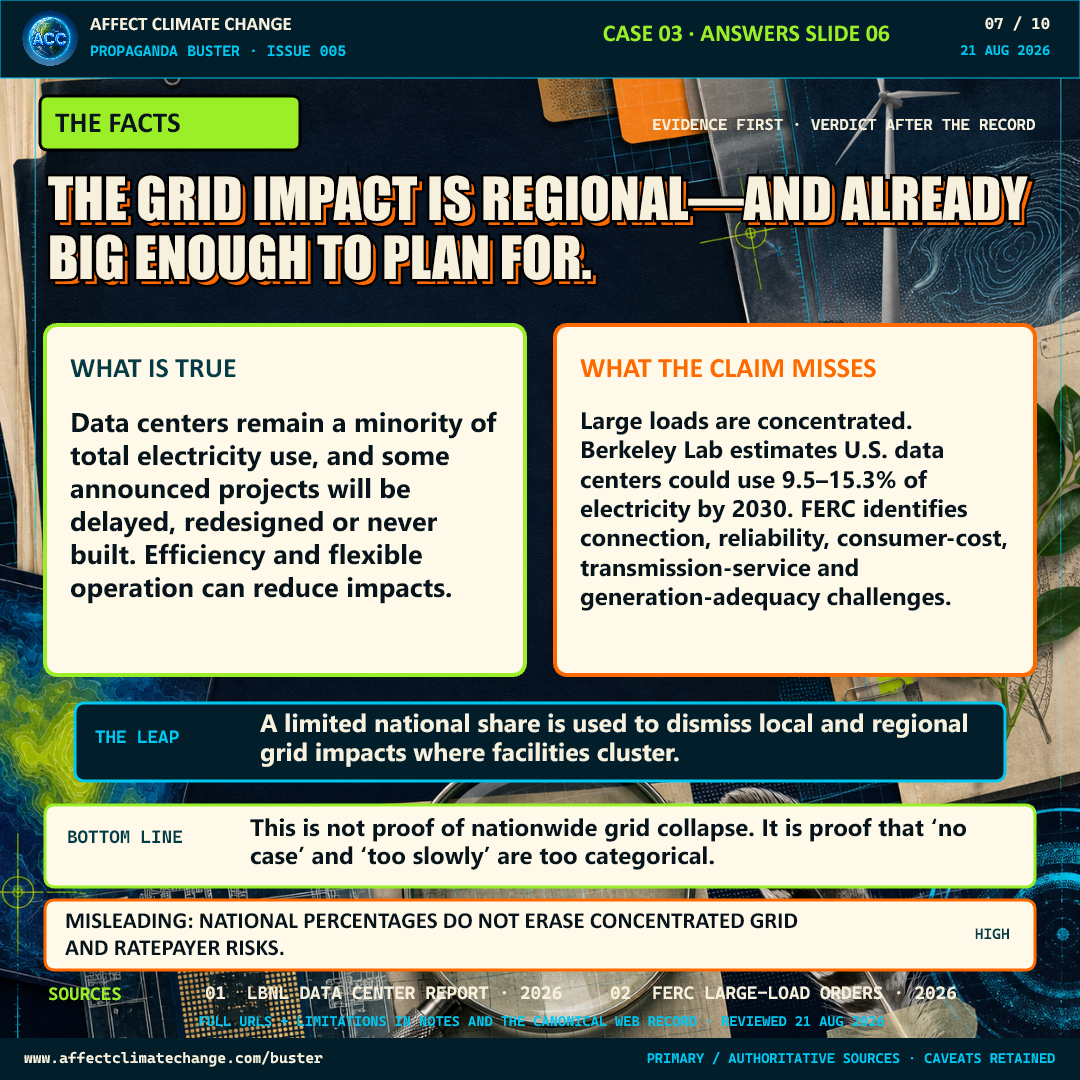
Data centers remain a minority of total electricity use, and project pipelines are uncertain. Yet large loads can cluster in particular regions, require generation and transmission upgrades, affect interconnection timing, and raise reliability and affordability questions long before they dominate national demand.
- Lawrence Berkeley National Laboratory estimates that U.S. data centers could reach 9.5–15.3% of national electricity use by 2030 under its scenarios.
- FERC identifies connection, reliability, consumer-cost, transmission-service, and generation-adequacy challenges from rapid large-load growth.
- IEA finds data-center demand is geographically concentrated and sensitive to technology, efficiency, utilization, and buildout assumptions.
- Planning for a regional risk is not the same as predicting national grid collapse.
Evidence chain
Each source is dated and paired with the finding it supports. The original post establishes what was claimed; it does not decide the scientific verdict.
United States Data Center Energy Usage Report: 2025 Update
Published / source period: 2026-06
Lawrence Berkeley National Laboratory · Estimates U.S. data centers could consume 9.5–15.3% of national electricity by 2030, with substantial uncertainty.
Accessed August 21, 2026
FERC launches aggressive targeted action to speed large-load integration
Published / source period: 2026-06-18
Federal Energy Regulatory Commission · FERC identifies rapid large-load growth as creating connection, reliability, consumer-cost, transmission-service, and generation-adequacy challenges that require targeted planning action.
Accessed August 21, 2026
Energy and AI — Energy demand from AI
Published / source period: 2025
International Energy Agency · Finds data-center electricity demand is geographically concentrated and highly uncertain, making local grid effects important even when national shares are smaller.
Accessed August 21, 2026
What is true
Efficiency, flexible operations, delayed projects, and cancellations can reduce demand. Announced pipelines are not guaranteed, and new dispatchable supply or well-planned upgrades can manage part of the load.
Where the claim fails
The argument switches from a national percentage to a universal claim about every grid region. Power systems are constrained locally and regionally, so national averages cannot determine whether a concentrated load creates a planning challenge.
Limits and uncertainty
Demand forecasts are scenario-based and uncertain. The evidence establishes a material planning concern in some regions, not inevitable nationwide failure or proof that every project creates the same impact.
Assessment after the evidence
A limited national share does not erase concentrated regional loads that utilities and regulators already must plan and build for.
How the framing works
Scale switching: a national denominator is used to dismiss geographically concentrated infrastructure effects.
How scientists know
National laboratories build demand scenarios from facility and equipment data, while grid operators and regulators evaluate where proposed large loads connect, which assets are constrained, and what upgrades are required.
Editorial boundaries
ACC evaluates the claim. It does not infer intent, coordination, funding, deception, or control without direct evidence specific to that attribution.
The source presentation and reuse decision are documented here: Approved bounded native-source crop for criticism and fact-checking, shown with attribution and a direct source link; unrelated page content is excluded.
Corrections and revision record
Corrections status: No change to the scientific verdict has been recorded.
v1.0 · August 21, 2026
Initial evidence review. Verdict: MISLEADING, high confidence; national-collapse language is explicitly excluded.
v1.1 · August 28, 2026
Canonical website record created from the verified R1 ledger and native provenance.