Precise proposition checked
A current 3% share under a broad primary-energy accounting method proves that wind and solar cannot become major electricity sources.
Full post context: An August 22, 2026 Watts Up With That? article used a broad primary-energy percentage to make a categorical claim about wind and solar's future role.
Scope of this check: The check preserves the accounting denominator and acknowledges real integration, permitting, financing, transmission, storage, and flexibility constraints.
What the evidence shows
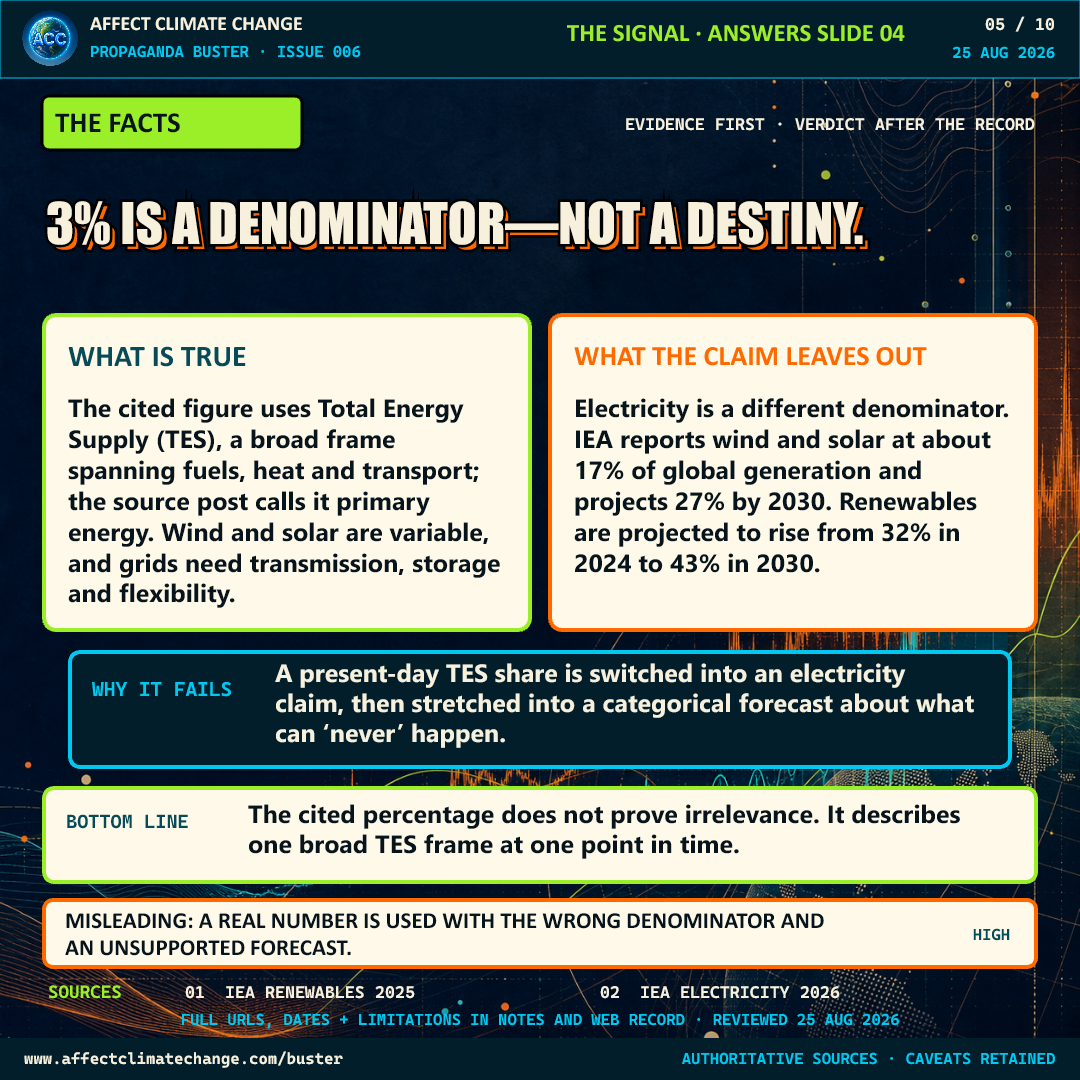
The Energy Institute source labels the broad denominator Total Energy Supply (TES), while the circulating article calls it primary energy. Electricity generation is different: IEA reports wind and solar at about 17% globally and projects about 27% by 2030; it projects all renewables rising from 32% in 2024 to 43% in 2030.
- The cited 3% figure uses the Energy Institute's broad Total Energy Supply denominator; the source post calls it primary energy.
- IEA reports wind and solar at about 17% of global electricity generation.
- IEA projects wind and solar at about 27% of global generation by 2030.
- IEA projects all renewables rising from 32% of generation in 2024 to 43% in 2030, with material uncertainty.
Evidence chain
Each source is dated and paired with the finding it supports. The original post establishes what was claimed; it does not decide the scientific verdict.
Statistical Review of World Energy 2026 Summary
Published / source period: 2026
Energy Institute · Provides the Total Energy Supply (TES) accounting frame behind the cited percentage; the circulating article calls the denominator primary energy.
Accessed August 25, 2026
Renewable electricity - Renewables 2025
Published / source period: 2025
International Energy Agency · Renewables projected from 32% of electricity in 2024 to 43% in 2030; variable renewables to 27%; more than 90% of electricity-demand growth met by renewables.
Accessed August 25, 2026
Electricity 2026 - Executive summary
Published / source period: 2026
International Energy Agency · Wind and solar are about 17% of global generation and projected to reach about 27% by 2030.
Accessed August 25, 2026
What is true
A roughly 3% share can be valid under the broad Total Energy Supply accounting frame, which the source post describes as primary energy. Variable renewables create real integration needs, and forecasts depend on policy, financing, permitting, grids, storage, and demand.
Where the claim fails
The claim switches denominators without telling the reader and stretches a present-day share into a categorical forecast. A small share under one accounting method does not determine the future electricity mix.
Limits and uncertainty
IEA projections are not guarantees and have been revised as conditions change. The evidence contradicts the categorical ‘never’ claim, not every concern about implementation speed or grid integration.
Assessment after the evidence
The 3% figure uses a broad primary-energy denominator; electricity is different, and a current share cannot prove what will never happen.
How the framing works
Denominator switching plus static-snapshot forecasting: one current percentage is treated as proof of a permanent ceiling.
How scientists know
Energy agencies publish denominator-specific historical balances and transparent scenarios, separating primary energy from electricity generation and identifying the assumptions and constraints behind projected growth.
Editorial boundaries
ACC evaluates the claim. It does not infer intent, coordination, funding, deception, or control without direct evidence specific to that attribution.
The source presentation and reuse decision are documented here: Approved bounded native-source crop for criticism and fact-checking, shown with attribution and a direct source link; unrelated page content is excluded.
Corrections and revision record
Corrections status: No change to the scientific verdict has been recorded.
v1.0 · August 25, 2026
Initial evidence review. Verdict: MISLEADING, high confidence.
v1.1 · August 28, 2026
Canonical website record integrated from the verified R1 handoff.