Precise proposition checked
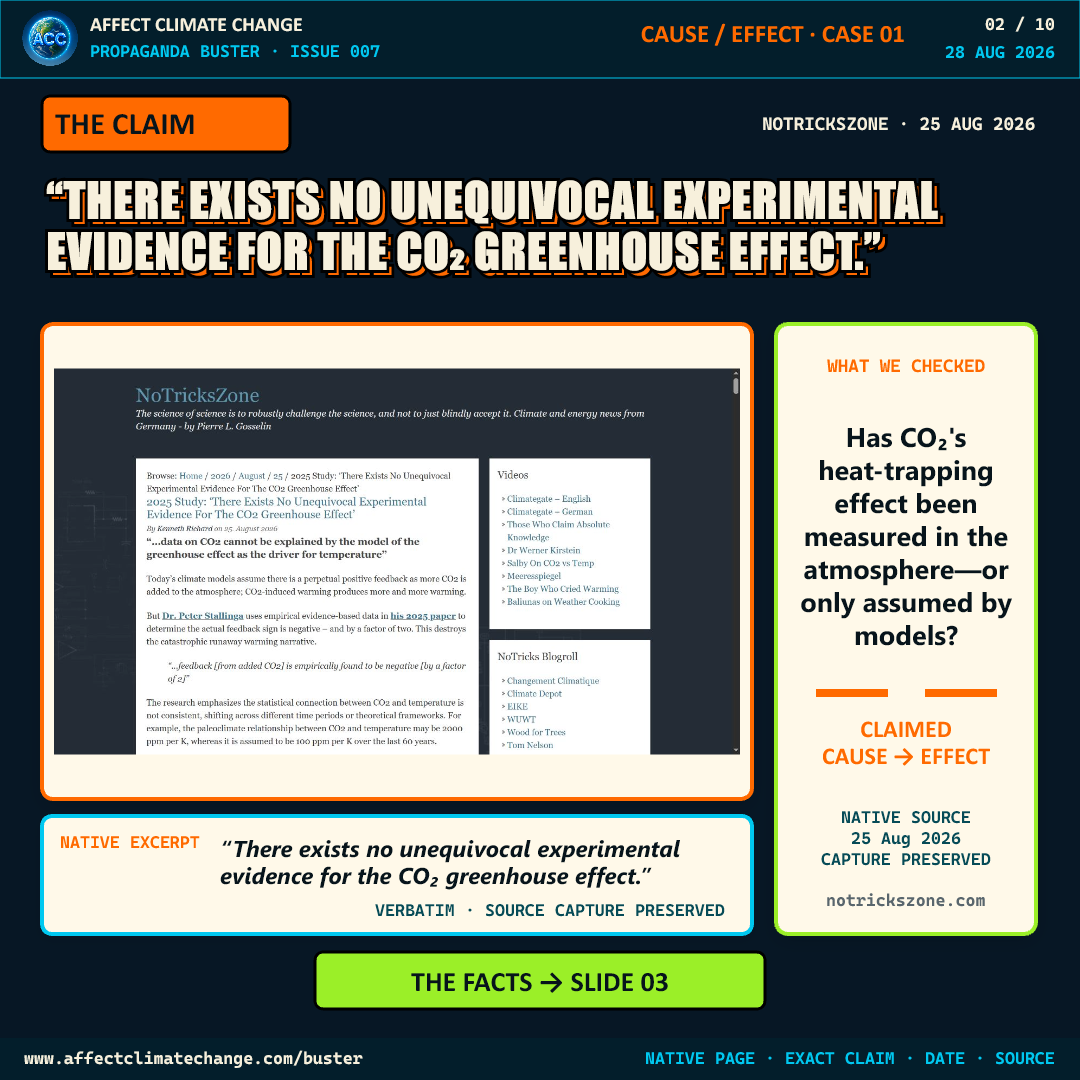
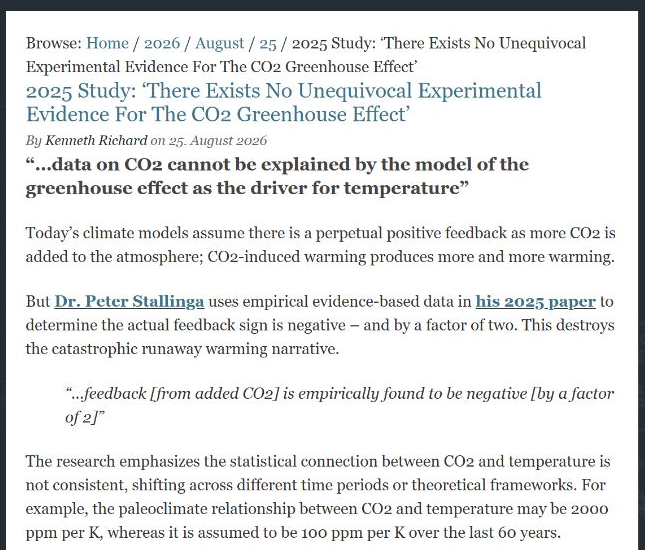
There is no unequivocal experimental or observational evidence that increasing atmospheric CO₂ strengthens Earth's greenhouse effect.
Full post context: A NoTricksZone article published August 25, 2026 quoted that categorical sentence from a 2025 paper and presented it as a challenge to measured greenhouse evidence.
Scope of this check: This verdict addresses the existence of measured CO₂ radiative effects. It does not claim that clouds, feedbacks, equilibrium climate sensitivity, or every regional consequence are known without uncertainty.
What the evidence shows
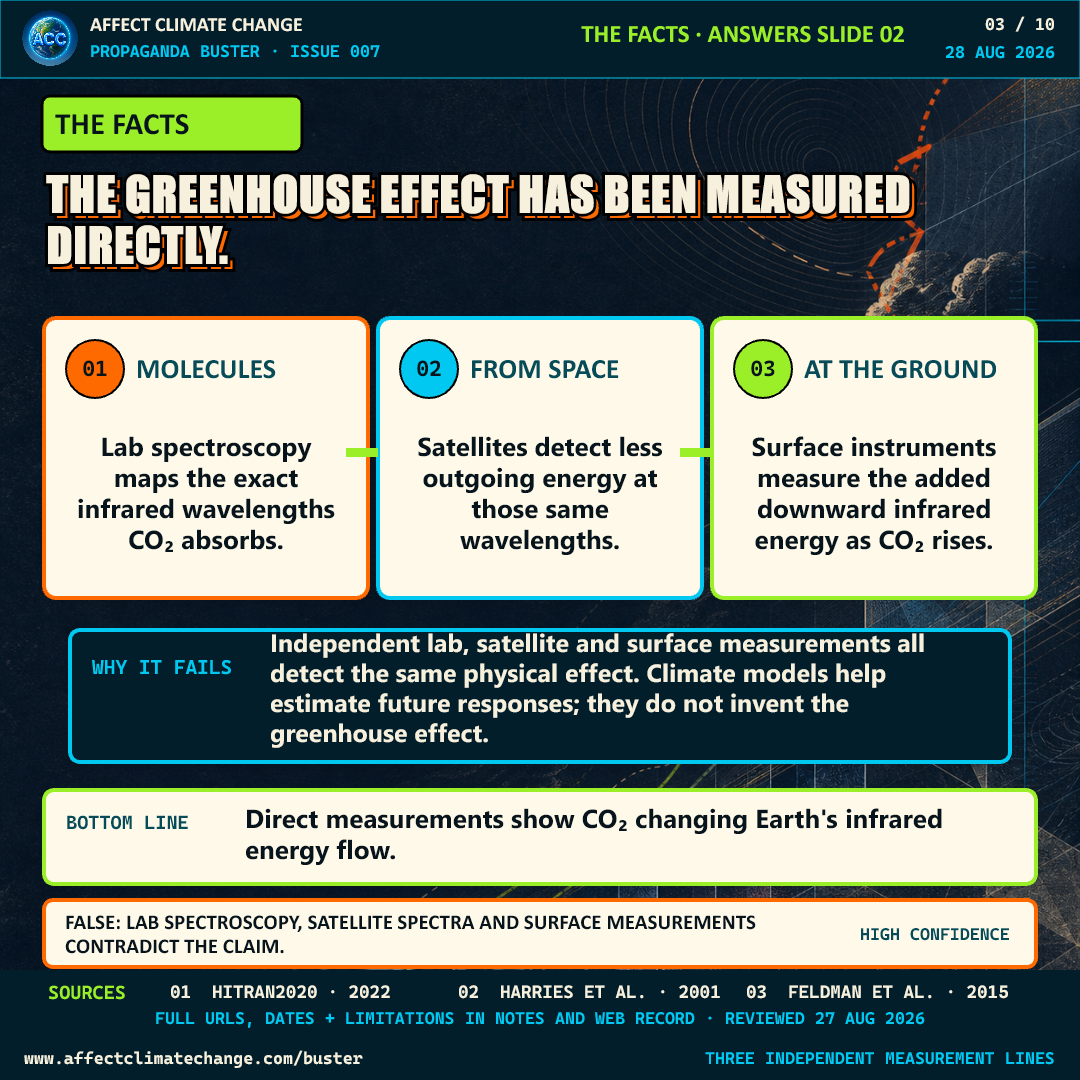
Scientists have measured the radiation changes expected when atmospheric CO₂ increases. Laboratory spectroscopy identifies the infrared wavelengths at which CO₂ absorbs radiation. Satellites have detected changes in heat escaping to space at those wavelengths. Ground instruments have measured increasing downward CO₂ radiation at the surface as atmospheric CO₂ rose.
- Laboratory spectroscopy catalogs the infrared absorption lines and strengths of CO₂.
- Satellite spectra from 1970 and 1997 detected changes in greenhouse-gas absorption bands consistent with increased forcing; the paper's published label correction is retained with the record.
- Surface instruments at two sites measured a statistically significant increase in downward CO₂ radiative forcing as atmospheric CO₂ rose.
- IPCC AR6 assesses CO₂ effective radiative forcing from 1750 to 2019 at 2.16 W/m², with a likely range of 1.90–2.41 W/m².
Evidence chain
Each source is dated and paired with the finding it supports. The original post establishes what was claimed; it does not decide the scientific verdict.
HITRAN2020 molecular spectroscopic database
Published / source period: 2022
Gordon et al. / Journal of Quantitative Spectroscopy and Radiative Transfer · Laboratory spectroscopy identifies the infrared wavelengths and line strengths at which CO₂ absorbs radiation.
Accessed August 27, 2026
Increases in greenhouse forcing inferred from the outgoing longwave radiation spectra of the Earth in 1970 and 1997
Published / source period: 2001-03-15
Harries et al. / Nature · Satellite spectra detected changes in greenhouse-gas absorption bands consistent with increased greenhouse forcing.
Accessed August 27, 2026
Author Correction to Harries et al.
Published / source period: 2001-04-26
Nature · The correction records that two labels in Figure 1a were interchanged; it does not reverse the reported spectral finding.
Accessed August 27, 2026
Observational determination of surface radiative forcing by CO₂ from 2000 to 2010
Published / source period: 2015-02-25
Feldman et al. / Nature · Surface instruments measured a statistically significant increase in downward CO₂ radiative forcing as atmospheric CO₂ rose.
Accessed August 27, 2026
AR6 WGI Chapter 7: The Earth's Energy Budget, Climate Feedbacks, and Climate Sensitivity
Published / source period: 2021
IPCC · Assesses CO₂ effective radiative forcing from 1750 to 2019 at 2.16 W/m², with a likely range of 1.90–2.41 W/m².
Accessed August 27, 2026
What is true
Cloud behavior and other feedbacks remain important sources of uncertainty. Measuring CO₂ forcing does not by itself determine the exact equilibrium climate sensitivity or every regional consequence.
Where the claim fails
The claim erases three independent measurement lanes by shifting from uncertainty about later feedbacks and total warming to denial of the initial radiative effect. Uncertainty about clouds or eventual warming does not erase direct spectroscopic and atmospheric observations.
Limits and uncertainty
The atmospheric studies use calibrated observations and radiative-transfer analysis rather than a controlled experiment on a duplicate Earth. Feldman et al. examined clear-sky measurements at two sites. These limitations affect scope, not the existence of the measured CO₂ radiative effect.
Assessment after the evidence
Laboratory spectroscopy, satellite spectra, and surface instruments independently measure the radiative behavior expected as atmospheric CO₂ increases. The categorical no-evidence claim is false.
How the framing works
Evidence erasure and scope shifting: uncertainty about later feedbacks is presented as if it invalidated direct measurements of the initial greenhouse forcing.
How scientists know
Scientists compare laboratory absorption spectra with satellite observations of outgoing longwave radiation and calibrated surface measurements of downward infrared radiation as atmospheric CO₂ changes.
Editorial boundaries
ACC evaluates the claim. It does not infer intent, coordination, funding, deception, or control without direct evidence specific to that attribution.
The source presentation and reuse decision are documented here: Approved bounded native-source crop for criticism and fact-checking, shown with attribution and a direct source link; unrelated page content is excluded.
Corrections and revision record
Corrections status: No change to the scientific verdict has been recorded.
v1.0 · August 27, 2026
Initial evidence review. Verdict: FALSE, high confidence. The Harries et al. correction is explicitly included.