Precise proposition checked
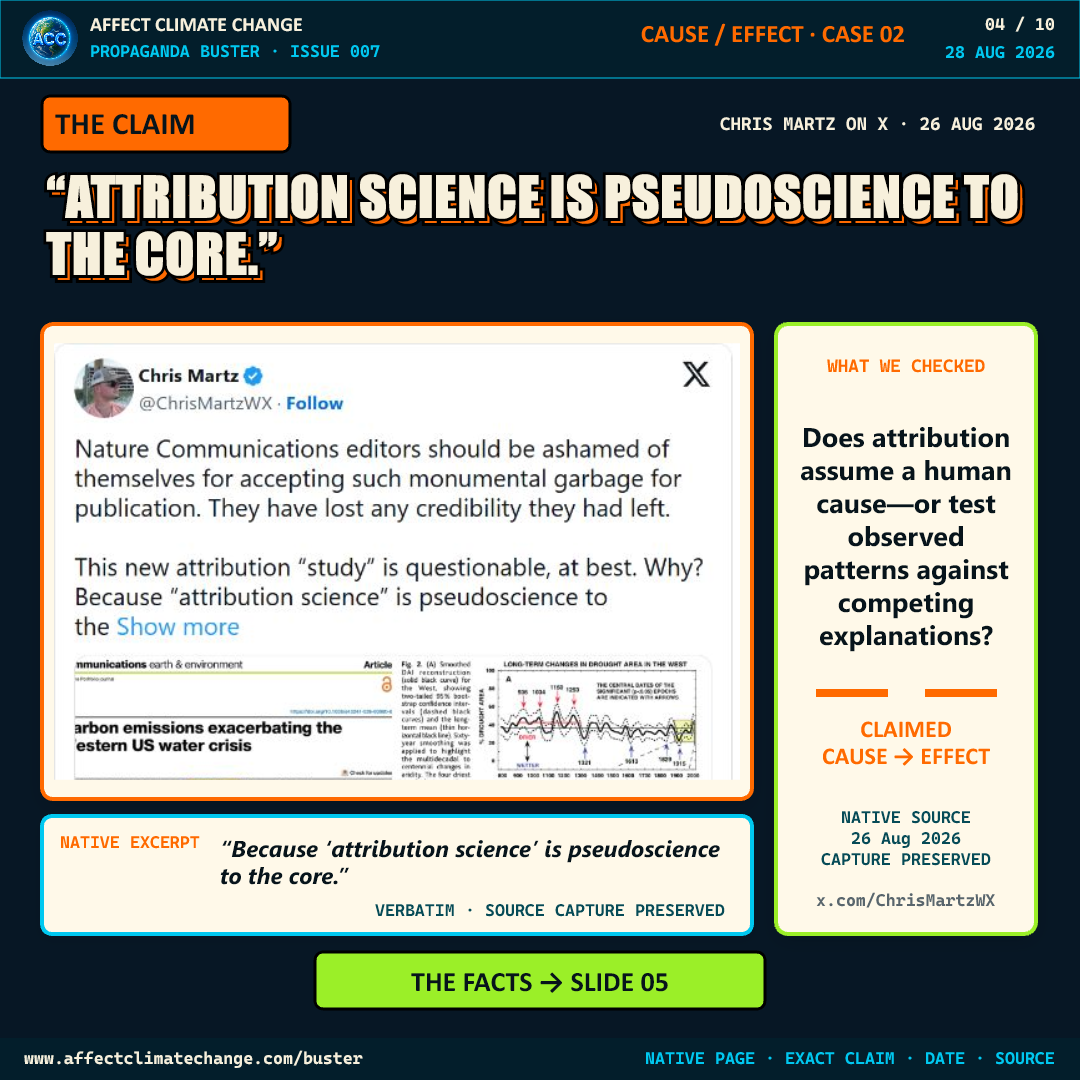
Climate attribution is not a legitimate scientific field because it assumes human causation in advance and selects data or models to produce a predetermined answer.
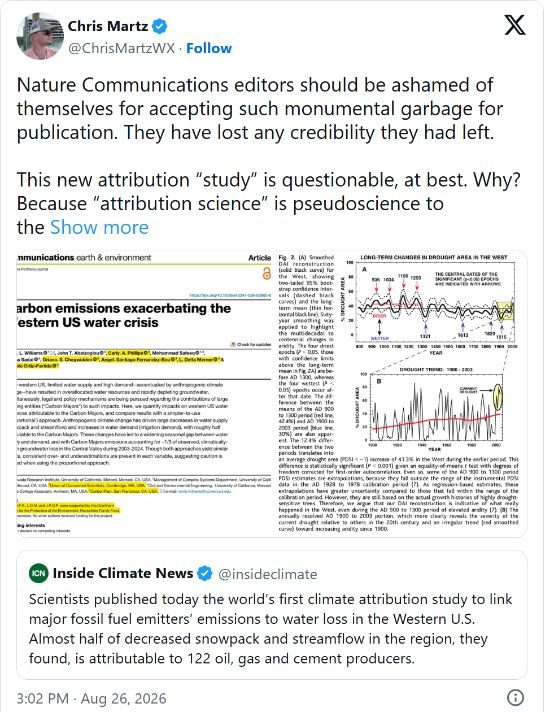
Full post context: A public X post on August 26, 2026 categorically dismissed attribution science while criticizing a specific Western U.S. water study and making broader allegations outside this check.
Scope of this check: The FALSE verdict applies only to the categorical rejection of attribution science. It does not declare every statement or study-specific criticism in the longer post false. Assertions about researchers' motives, funding influence, or predetermined intent require separate direct evidence and are outside this check.
What the evidence shows
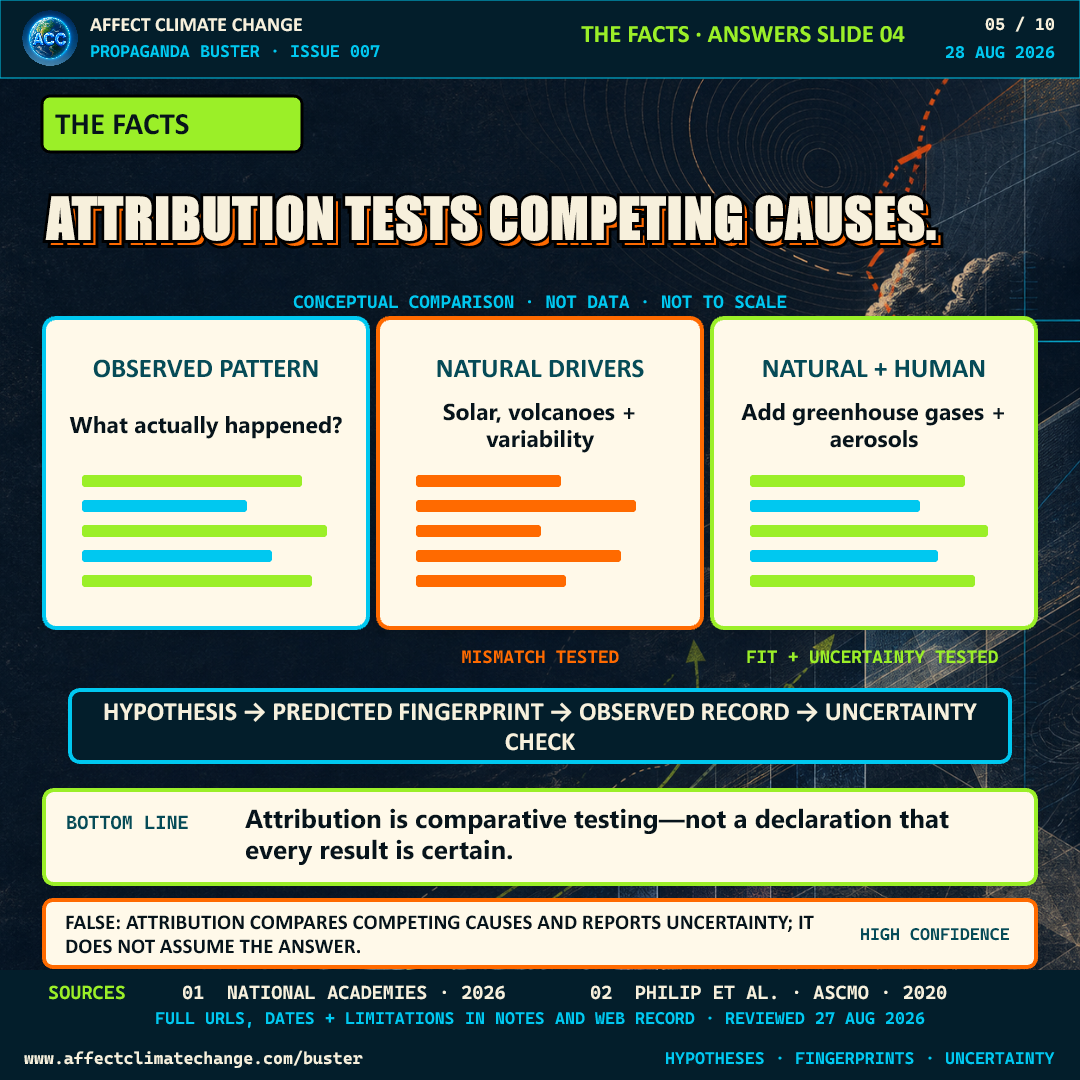
Attribution science asks whether human-caused climate change altered an event's probability or severity. Researchers compare observations and simulations of the current climate with a counterfactual climate without human forcing, evaluate model performance, quantify uncertainty, and report when an influence cannot be detected.
- A 2026 National Academies consensus review finds mature attribution capabilities for several extreme-event types while documenting real limits.
- IPCC assessments use calibrated confidence and distinguish strong findings from event types with insufficient evidence.
- A peer-reviewed attribution protocol documents event selection, observations, model evaluation, counterfactual comparison, synthesis, and uncertainty.
- The Williams study cited in the post uses observational datasets, 114 CMIP6 simulations from 12 models, 600 MAGICC7 realizations, and hydrologic counterfactuals while acknowledging limitations.
Evidence chain
Each source is dated and paired with the finding it supports. The original post establishes what was claimed; it does not decide the scientific verdict.
Attribution of Extreme Weather and Climate Events and Their Impacts
Published / source period: 2026-07-15
National Academies of Sciences, Engineering, and Medicine · Concludes that decades of evidence support attribution for several kinds of extremes while documenting limits for small-scale, compound, and poorly modelled events.
Accessed August 27, 2026
AR6 WGI Chapter 11: Weather and Climate Extreme Events in a Changing Climate
Published / source period: 2021
IPCC · Finds especially strong evidence for human influence on heat extremes and evidence for several heavy-precipitation changes while assigning lower confidence where observations or models are inadequate.
Accessed August 27, 2026
A protocol for probabilistic extreme event attribution analyses
Published / source period: 2020-11-10
Philip et al. / Advances in Statistical Climatology, Meteorology and Oceanography · Documents event selection, definition, observations, model evaluation, multi-model attribution, synthesis, vulnerability and exposure, and communication; selection should not depend on the expected result.
Accessed August 27, 2026
Carbon emissions exacerbating the Western US water crisis
Published / source period: 2026-08-25
Williams et al. / Communications Earth & Environment · Uses observational datasets, multiple climate models, and hydrologic counterfactuals and reports methodological limitations.
Accessed August 27, 2026
What is true
Attribution studies vary in strength. Results can depend on event definition, observational coverage, model performance, counterfactual design, and uncertainty treatment. Heat attribution is generally more mature than attribution for some regional droughts, compound events, or downstream impacts.
Where the claim fails
The categorical dismissal omits the field's observation checks, event definitions, counterfactual comparisons, model evaluation, uncertainty estimates, multi-method synthesis, and possible weak or null findings.
Limits and uncertainty
The Williams study links several models and assumptions and cannot capture every form of structural uncertainty. Questions about its model selection, climate sensitivity, regional hydrology, and numerical estimates deserve separate examination. This verdict makes no finding about motive or funding influence.
Assessment after the evidence
Attribution uses testable observation, model-evaluation, counterfactual, multi-method, and uncertainty procedures. The categorical description of the field as pseudoscience is false; individual studies can still warrant specific criticism.
How the framing works
Blanket dismissal and straw-man methodology: limitations in one application are generalized to an entire field while observation checks, counterfactual tests, uncertainty estimates, and possible null findings are omitted.
How scientists know
Established protocols define the event, inspect observations, test whether models reproduce relevant behavior, compare factual and counterfactual climates, quantify uncertainty, synthesize across methods, and communicate the limits.
Editorial boundaries
ACC evaluates the claim. It does not infer intent, coordination, funding, deception, or control without direct evidence specific to that attribution.
The source presentation and reuse decision are documented here: Approved bounded native-source crop for criticism and fact-checking, shown with attribution and direct source and official oEmbed links; no live third-party embed is used.
Corrections and revision record
Corrections status: No change to the scientific verdict has been recorded.
v1.0 · August 27, 2026
Initial evidence and provenance review. Verdict explicitly limited to the categorical rejection of the field.