Precise proposition checked
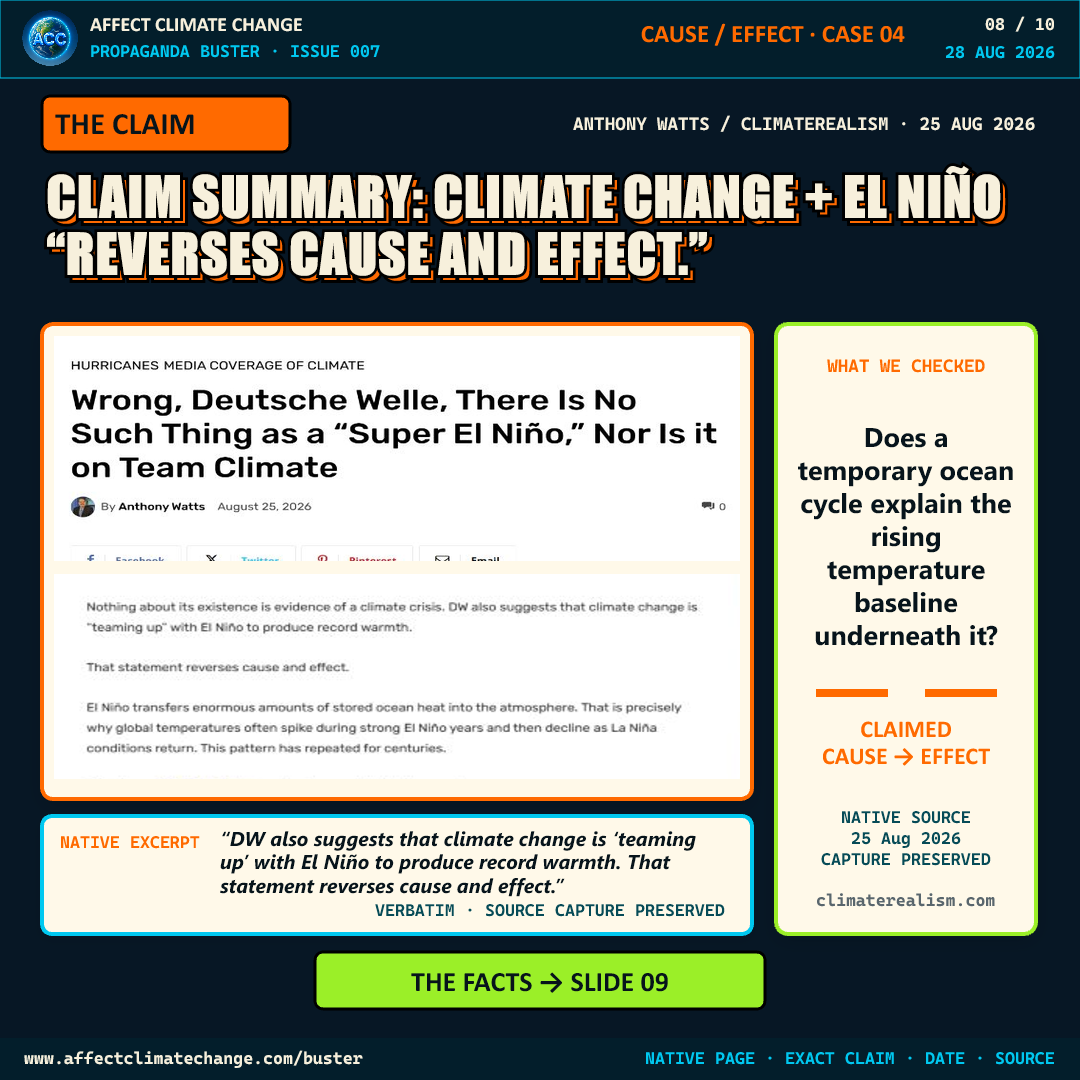
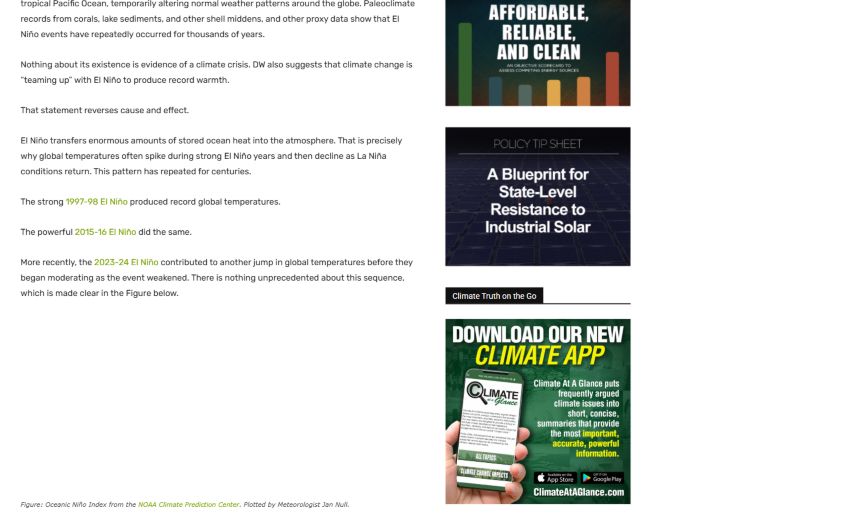
Saying human-caused warming raises the long-term temperature baseline while El Niño temporarily adds warmth reverses the actual causal relationship.
Full post context: A ClimateRealism article published August 25, 2026 criticized a Deutsche Welle video and said that describing a greenhouse-warmed baseline plus El Niño as contributors to record warmth reverses cause and effect; the article was syndicated by Watts Up With That the same day.
Scope of this check: This verdict does not establish that climate change caused the current El Niño, determine how strong it will become, or validate every extreme-weather example in the Deutsche Welle video. Those are separate questions.
What the evidence shows
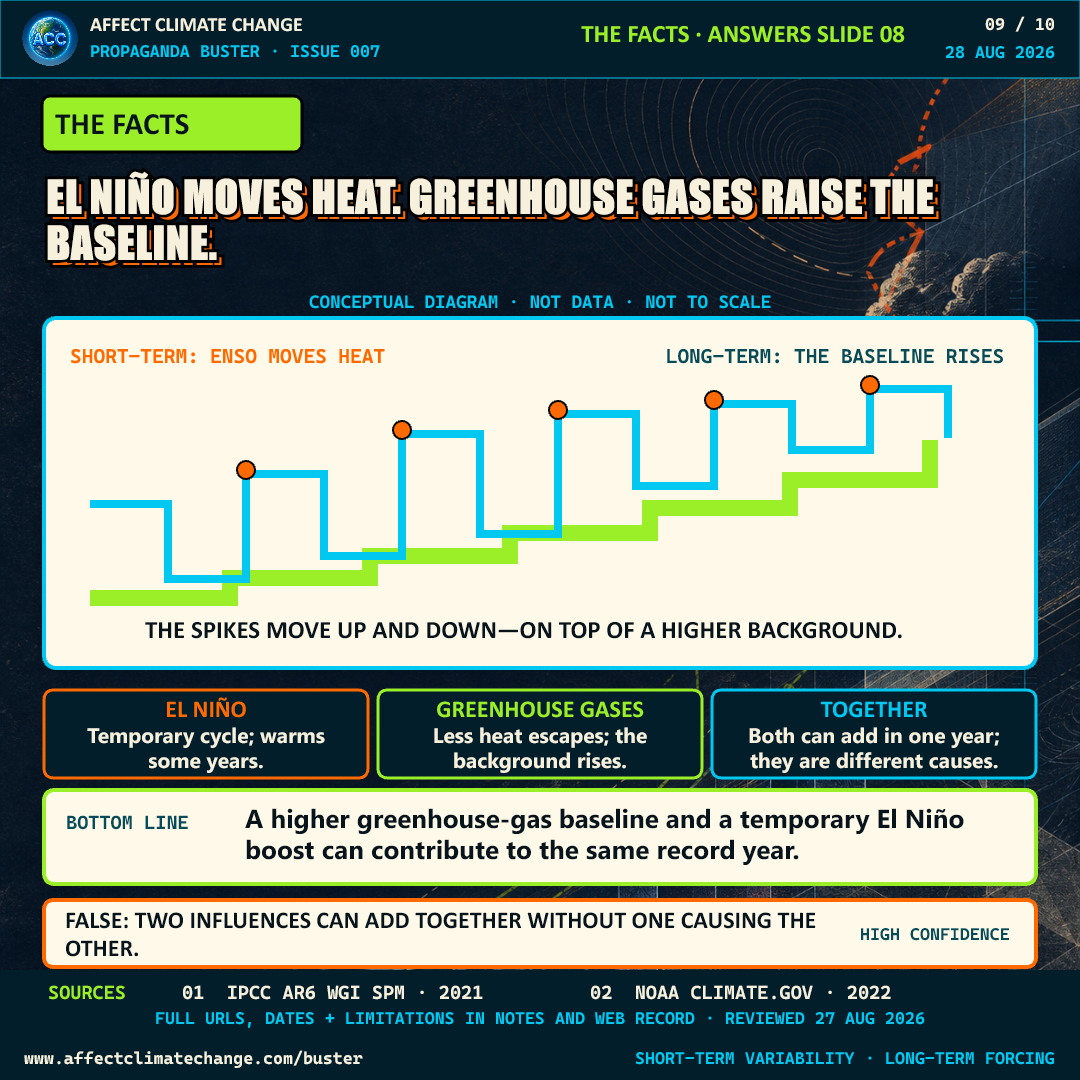
El Niño and human-caused warming operate on different timescales. Greenhouse gases raise the long-term global temperature baseline. El Niño temporarily moves additional ocean heat into the atmosphere, often making an individual year warmer. Both effects can operate simultaneously.
- IPCC AR6 estimates human-caused warming through 2010–2019 at 1.07°C while internal variability contributed a much smaller amount over the assessed historical period.
- NOAA explains that El Niño temporarily warms the atmosphere by redistributing heat while greenhouse gases control the long-term trend.
- Forster et al. estimate that almost all warming averaged over 2015–2024 was human-induced, while individual annual peaks also include internal variability such as El Niño.
Evidence chain
Each source is dated and paired with the finding it supports. The original post establishes what was claimed; it does not decide the scientific verdict.
AR6 WGI Summary for Policymakers
Published / source period: 2021-08
IPCC · Assesses best-estimate human-caused warming through 2010–2019 at 1.07°C and a much smaller contribution from internal variability over the assessed historical period.
Accessed August 27, 2026
Where does global warming go during La Niña?
Published / source period: 2022-10-31
NOAA Climate.gov · Explains that ENSO redistributes heat and temporarily affects annual global temperature while greenhouse gases control the long-term trend.
Accessed August 27, 2026
Indicators of Global Climate Change 2024: annual update of key indicators of the state of the climate system and human influence
Published / source period: 2025
Forster et al. / Earth System Science Data · Estimates that almost all warming averaged over 2015–2024 was human-induced while annual peaks also contain internal variability including El Niño.
Accessed August 27, 2026
What is true
El Niño is a natural cycle that predates industrial warming and can strongly influence year-to-year global temperature. ‘Super El Niño’ is an informal term rather than an official NOAA or WMO classification.
Where the claim fails
The claim presents short-term natural variability as though it replaces the independently measured long-term greenhouse-gas trend. Adding a temporary El Niño boost to a warmer baseline is not a claim that climate change caused El Niño.
Limits and uncertainty
This verdict does not establish that climate change caused the current El Niño, determine how strong it will become, or validate every extreme-weather example in the Deutsche Welle video. Those are separate questions requiring separate evidence.
Assessment after the evidence
Greenhouse gases raise the long-term baseline while El Niño temporarily redistributes heat. Both can contribute to one warm year without either process causing the other, so the claimed cause-and-effect reversal is false.
How the framing works
Timescale switching and false choice: short-term natural variability is presented as though it replaces the independently measured long-term human-caused trend.
How scientists know
Assessments separate long-term forced warming from internal variability, while observations and ENSO research track how Pacific ocean heat redistribution temporarily affects annual global temperature.
Editorial boundaries
ACC evaluates the claim. It does not infer intent, coordination, funding, deception, or control without direct evidence specific to that attribution.
The source presentation and reuse decision are documented here: Approved bounded native-source crop for criticism and fact-checking, shown with attribution and direct original, syndicated, and context links; unrelated page content is excluded.
Corrections and revision record
Corrections status: No change to the scientific verdict has been recorded.
v1.0 · August 27, 2026
Initial evidence review. Verdict: FALSE for the cause-and-effect reversal claim, high confidence.