Precise proposition checked
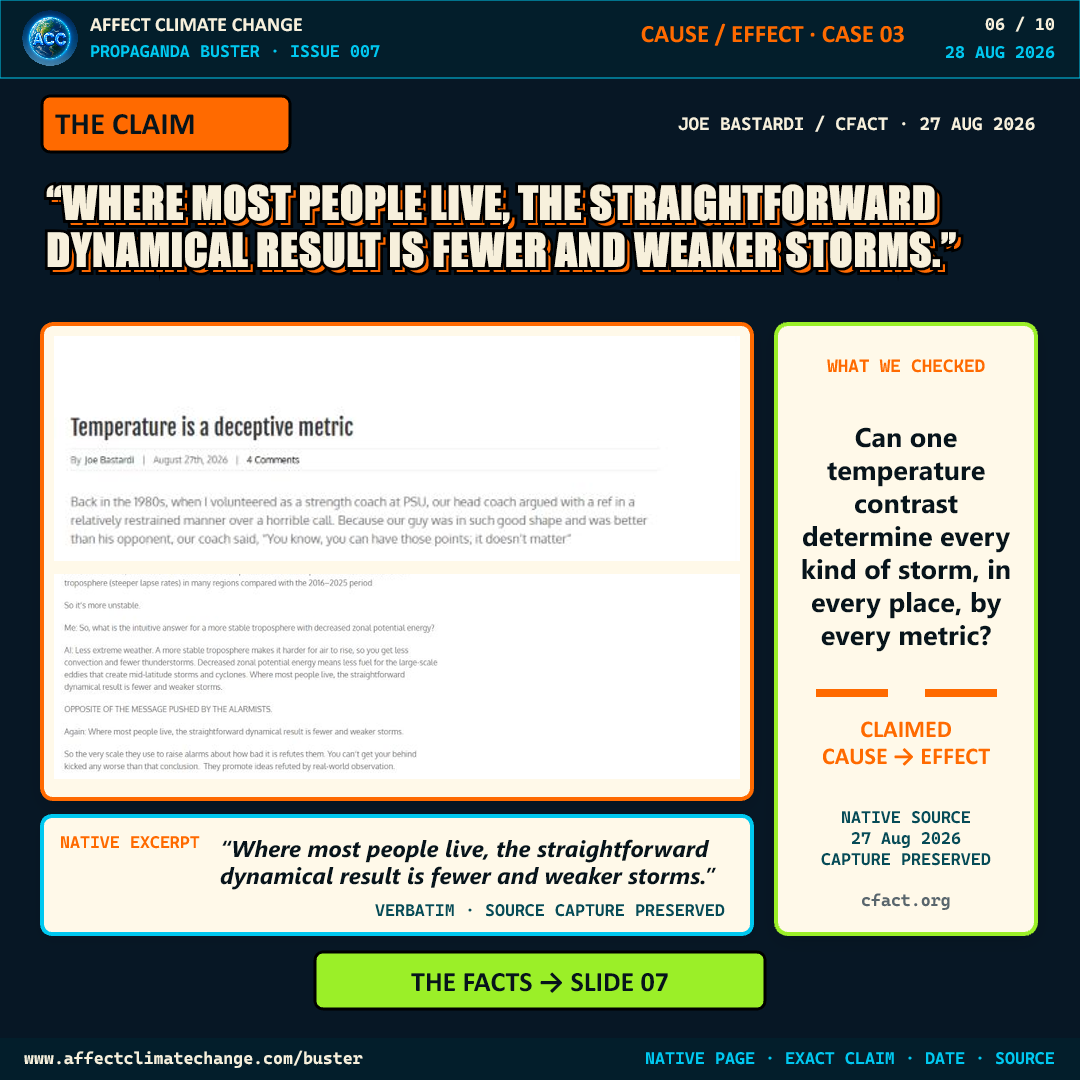
Atmospheric warming and polar amplification necessarily make the atmosphere more stable and produce fewer, weaker storms across populated regions.
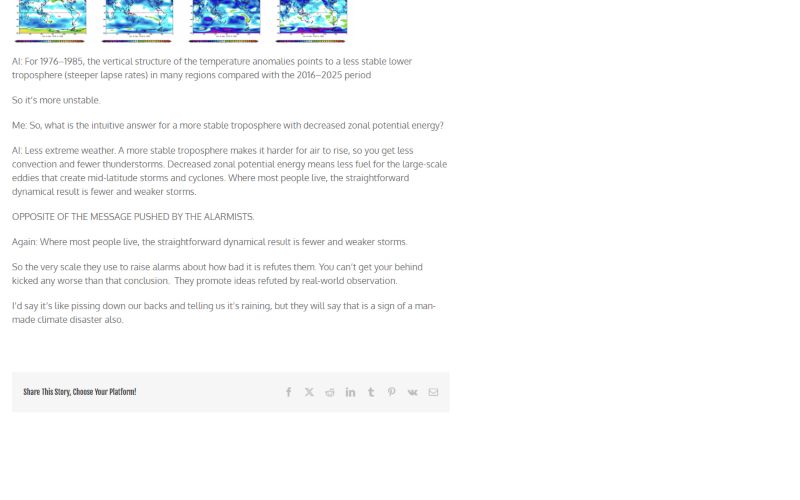
Full post context: The sentence appears first as a Grok response in Joe Bastardi's August 27, 2026 CFACT article and is then repeated and endorsed by the author.
Scope of this check: This verdict does not say every storm type is becoming more frequent or stronger everywhere. It assesses the universal fewer-and-weaker inference drawn from one temperature-gradient argument.
What the evidence shows
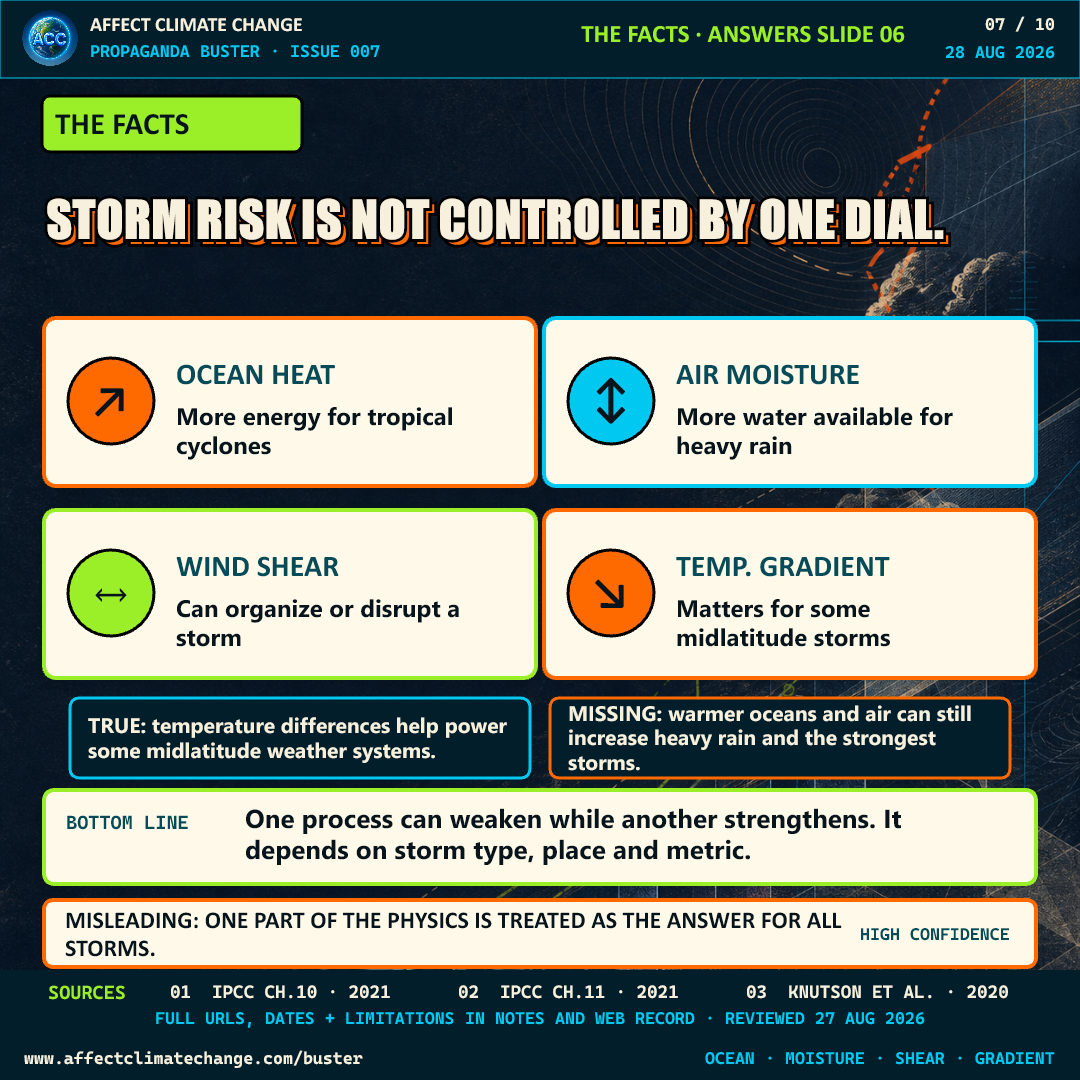
Warming does not turn one universal storm dial downward. Some storm counts may decrease. At the same time, warmer air can contain more water vapour, increasing heavy rainfall, and tropical cyclones can become wetter and stronger at the high end even if their total global number falls or remains unchanged.
- Regional storm outcomes depend on multiple thermodynamic and circulation processes; one global temperature-gradient argument is not a universal projection.
- Heavy precipitation generally intensifies with warming, and tropical-cyclone rainfall and peak intensity are projected to increase even when total frequency may fall or remain unchanged.
- A 2020 assessment's median 2°C-warming projections included about 14% more tropical-cyclone rainfall, 5% higher maximum winds, and a 13% larger Category 4–5 proportion.
- Theory and cloud-resolving simulations illustrate why warmer upper air does not automatically eliminate convective potential.
Evidence chain
Each source is dated and paired with the finding it supports. The original post establishes what was claimed; it does not decide the scientific verdict.
AR6 WGI Chapter 10: Linking Global to Regional Climate Change
Published / source period: 2021
IPCC · Explains that regional climate outcomes depend on multiple thermodynamic and circulation processes rather than one universal storm control.
Accessed August 27, 2026
AR6 WGI Chapter 11: Weather and Climate Extreme Events in a Changing Climate
Published / source period: 2021
IPCC · Assesses stronger heavy precipitation and projected increases in tropical-cyclone rainfall and peak intensity alongside possible decreases or little change in total frequency.
Accessed August 27, 2026
Tropical Cyclones and Climate Change Assessment Part II: Projected Response to Anthropogenic Warming
Published / source period: 2020
Knutson et al. / Bulletin of the American Meteorological Society · Assesses projected increases in tropical-cyclone rainfall, maximum wind speed, and the high-category proportion alongside a possible lower total frequency.
Accessed August 27, 2026
The effect of global warming on severe thunderstorms in the United States
Published / source period: 2015
Seeley and Romps / Geophysical Research Letters · Uses theory and cloud-resolving simulations to show why warmer upper air does not automatically eliminate convective potential.
Accessed August 27, 2026
What is true
Polar amplification can weaken part of the equator-to-pole temperature gradient, and warming aloft can increase some dry-stability measures. Some projections also show fewer total tropical cyclones globally. Those facts do not establish that storms generally become weaker.
Where the claim fails
The article treats pressure-level temperature patterns and one gradient as if they directly determined storm frequency and strength across storm types and populated regions. Those maps are not direct measurements of storm counts or intensity.
Limits and uncertainty
The evidence does not show that every storm type is becoming more frequent or stronger everywhere. Historical trends remain uncertain for several categories, including tornadoes, hail, extratropical-cyclone winds, and total tropical-cyclone counts.
Assessment after the evidence
Storm outcomes depend on moisture, instability, ocean heat, wind shear, circulation, place, and storm type. Some counts may fall while heavy rain or high-end intensity rises, so the one-dial conclusion is misleading.
How the framing works
Single-variable reasoning and context collapse: one part of atmospheric physics is treated as a complete explanation for every kind of storm.
How scientists know
Scientists evaluate moisture, thermodynamic instability, ocean heat, wind shear, circulation, regional observations, and storm-specific model projections rather than inferring all outcomes from a single temperature gradient.
Editorial boundaries
ACC evaluates the claim. It does not infer intent, coordination, funding, deception, or control without direct evidence specific to that attribution.
The source presentation and reuse decision are documented here: Approved bounded native-source crop for criticism and fact-checking, shown with attribution and a direct source link; unrelated page content is excluded.
Corrections and revision record
Corrections status: No change to the scientific verdict has been recorded.
v1.0 · August 27, 2026
Initial evidence review. Verdict: MISLEADING, high confidence.