Precise proposition checked
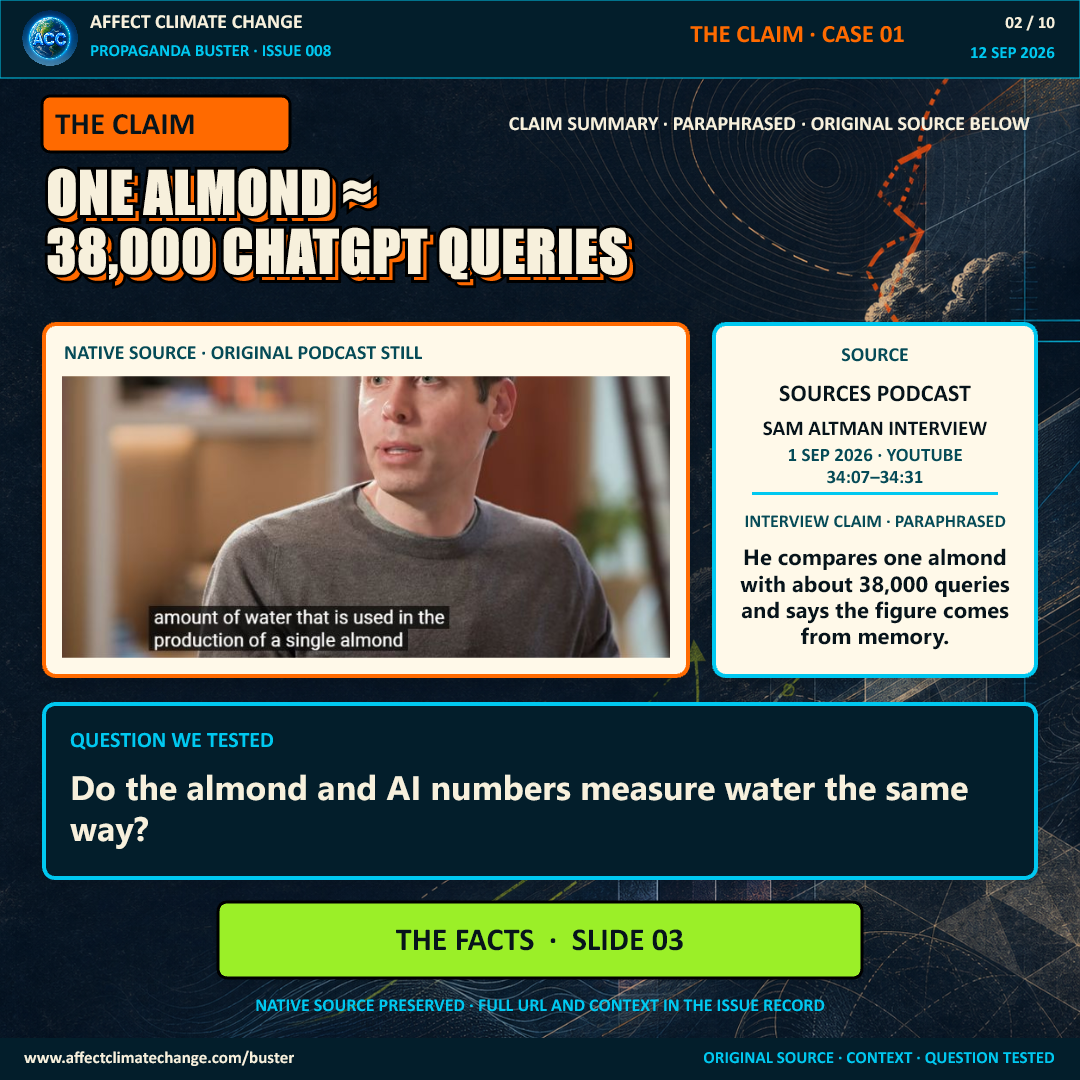
A reproducible, boundary-matched calculation shows that the total water footprint of one California almond equals the total water footprint of about 38,000 present-day ChatGPT queries.
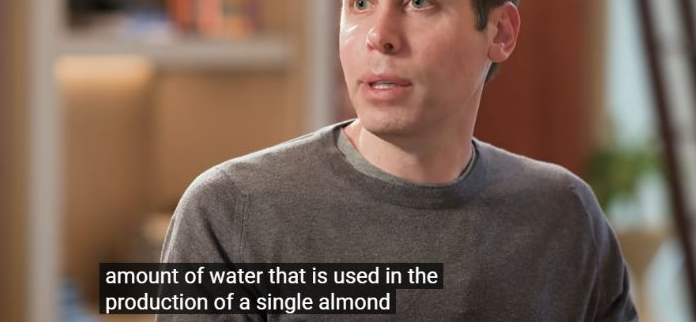
Full post context: During a Sources Podcast interview, Sam Altman recalled an approximate comparison from memory and then described it as full water accounting. ACC does not imply that the interview account endorsed the calculation merely by reporting his words.
Scope of this check: This verdict addresses whether the exact ratio is independently supported. It does not establish a universal per-query footprint, compare total AI water use with agriculture, or allege that the speaker knowingly misstated the figure.
What the evidence shows
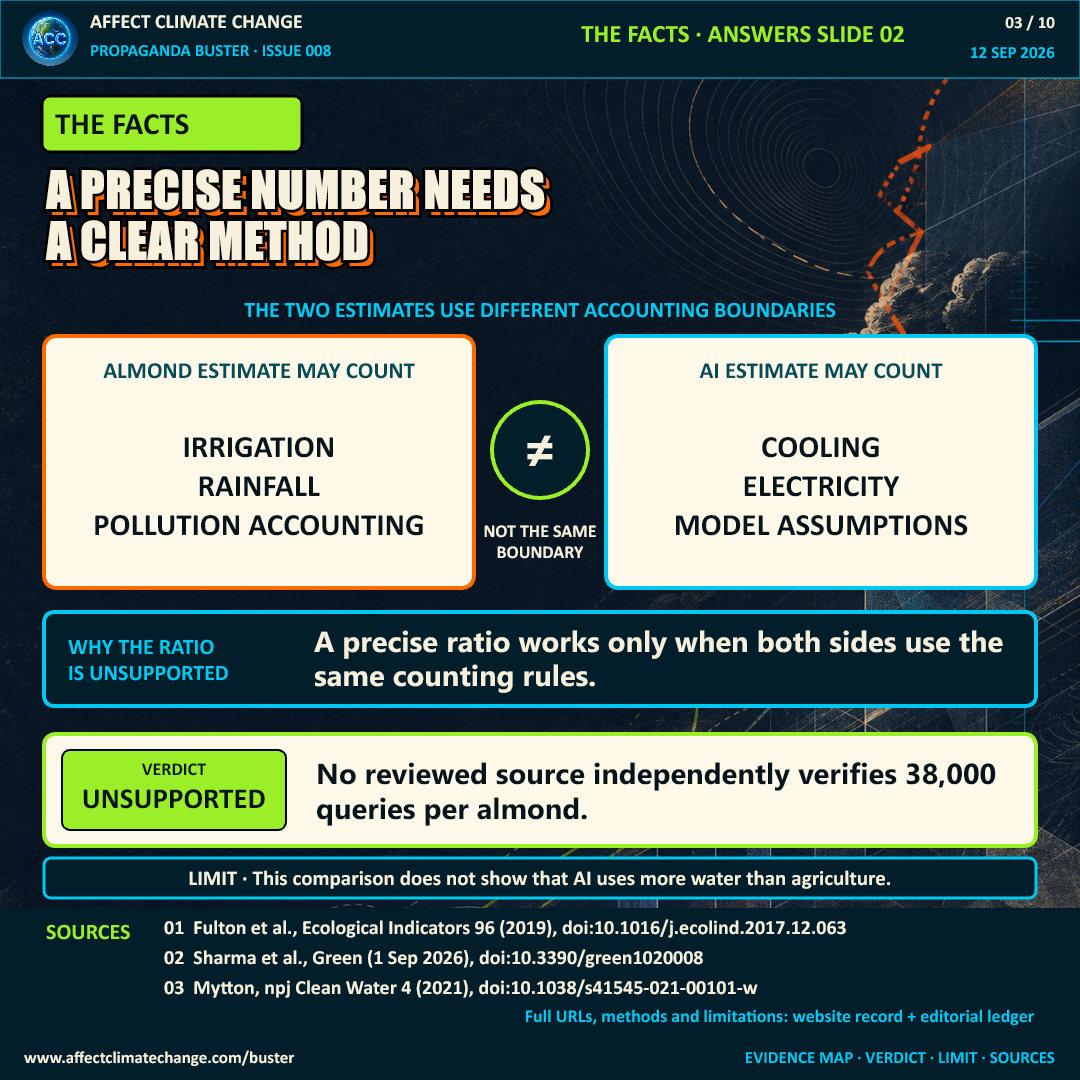
Almond water-footprint studies may combine irrigation, rainfall and pollution-related grey-water accounting. AI estimates may combine on-site cooling, water associated with electricity generation and modeled operating assumptions. The reviewed sources do not provide matched, product-specific measurements needed to reproduce the exact comparison.
- The almond study distinguishes irrigation, rain and pollution-related grey-water accounting rather than treating every component as directly consumed irrigation water.
- AI estimates change with the task, cooling system, location, electricity mix and whether indirect electricity-generation water is counted.
- The 2026 AI-water study uses scenarios, proxies and exclusions; it does not measure a universal ChatGPT query footprint.
- The reviewed public record does not disclose a boundary-matched calculation that another analyst can reproduce.
Evidence chain
Each source is dated and paired with the finding it supports. The original post establishes what was claimed; it does not decide the scientific verdict.
Water-indexed benefits and impacts of California almonds
Published / source period: 2019-01
Fulton, Norton and Shilling / Ecological Indicators · The study separates irrigation, rainfall and pollution-related grey-water accounting for California almond production during 2004 to 2015.
Accessed September 12, 2026
The Hidden Thirst of AI
Published / source period: 2026-09-01
Sharma et al. / Green · The study separates on-site cooling and electricity-generation water but uses proxies and modeled OpenAI scenarios rather than measured ChatGPT footprints.
Accessed September 12, 2026
Data centre water consumption
Published / source period: 2021-02-15
Mytton / npj Clean Water · The paper supports separating site-only data-center consumption from water associated with electricity generation and records a later author correction.
Accessed September 12, 2026
What is true
Both almond production and AI services can consume water, and data-center impacts vary with cooling technology, workload, location and electricity supply. Approximate comparisons can inform readers when their boundaries and uncertainty are disclosed.
Where the claim fails
The memorable ratio presents unlike and uncertain accounting lanes as if they were a single measured constant. Without the calculation, matching geography, period and water definitions, the equivalence cannot be independently reproduced.
Limits and uncertainty
No reviewed source supplies a current, metered ChatGPT footprint paired with the almond study's full boundary. The AI paper uses proxies and scenarios, while the almond study covers California production from 2004 to 2015. The actual ratio remains unresolved.
Assessment after the evidence
The reviewed public sources do not independently validate the exact ratio using matched definitions, system boundaries and current measured ChatGPT data.
How the framing works
Precision without reproducible accounting: a vivid exact-seeming comparison is presented without the data and matched boundaries needed to verify it.
How scientists know
Researchers define system boundaries, separate direct and indirect consumption, document data sources and test assumptions. A valid product comparison requires the inventories to count equivalent water categories over comparable places and periods.
Editorial boundaries
ACC evaluates the claim. It does not infer intent, coordination, funding, deception, or control without direct evidence specific to that attribution.
The source presentation and reuse decision are documented here: Approved bounded native-source crop for criticism and fact-checking with attribution and a direct source link; it is not presented as licensed, endorsed, or a complete transcript.
Corrections and revision record
Corrections status: No change to the scientific verdict has been recorded.
R6-web-1 · September 13, 2026
Translated the approved R6 evidence record into the website schema without changing the unsupported verdict or its boundaries.