Precise proposition checked
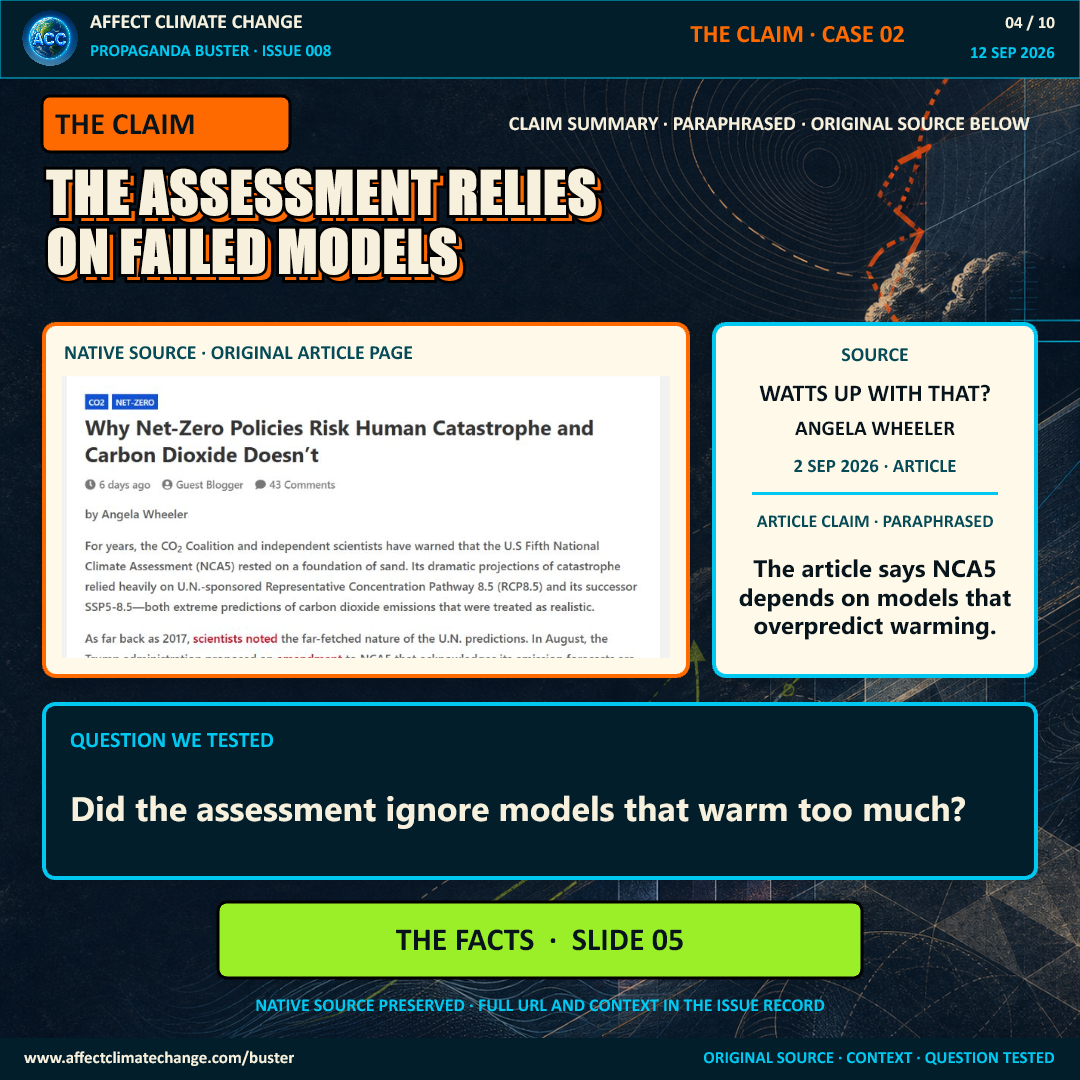
The Fifth National Climate Assessment's regional projection process treated overly sensitive models without adjustment, so its results simply inherit the hot-model problem.
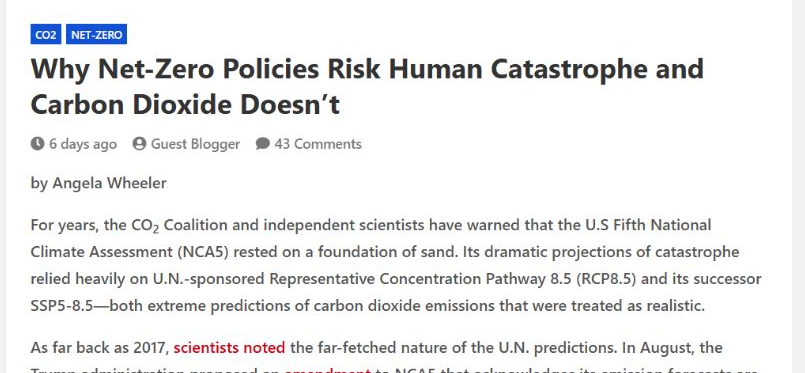
Full post context: A Watts Up With That article by Angela Wheeler, identified as a Daily Wire reprint, argues that models used by the assessment overpredict warming and fail observational tests. ACC checks omission of a directly relevant safeguard, not the article's whole policy argument.
Scope of this check: This verdict does not claim every model or NCA5 projection is accurate. It checks whether the criticism fairly discloses NCA5's documented weighting of overly sensitive models in its downscaled regional products.
What the evidence shows
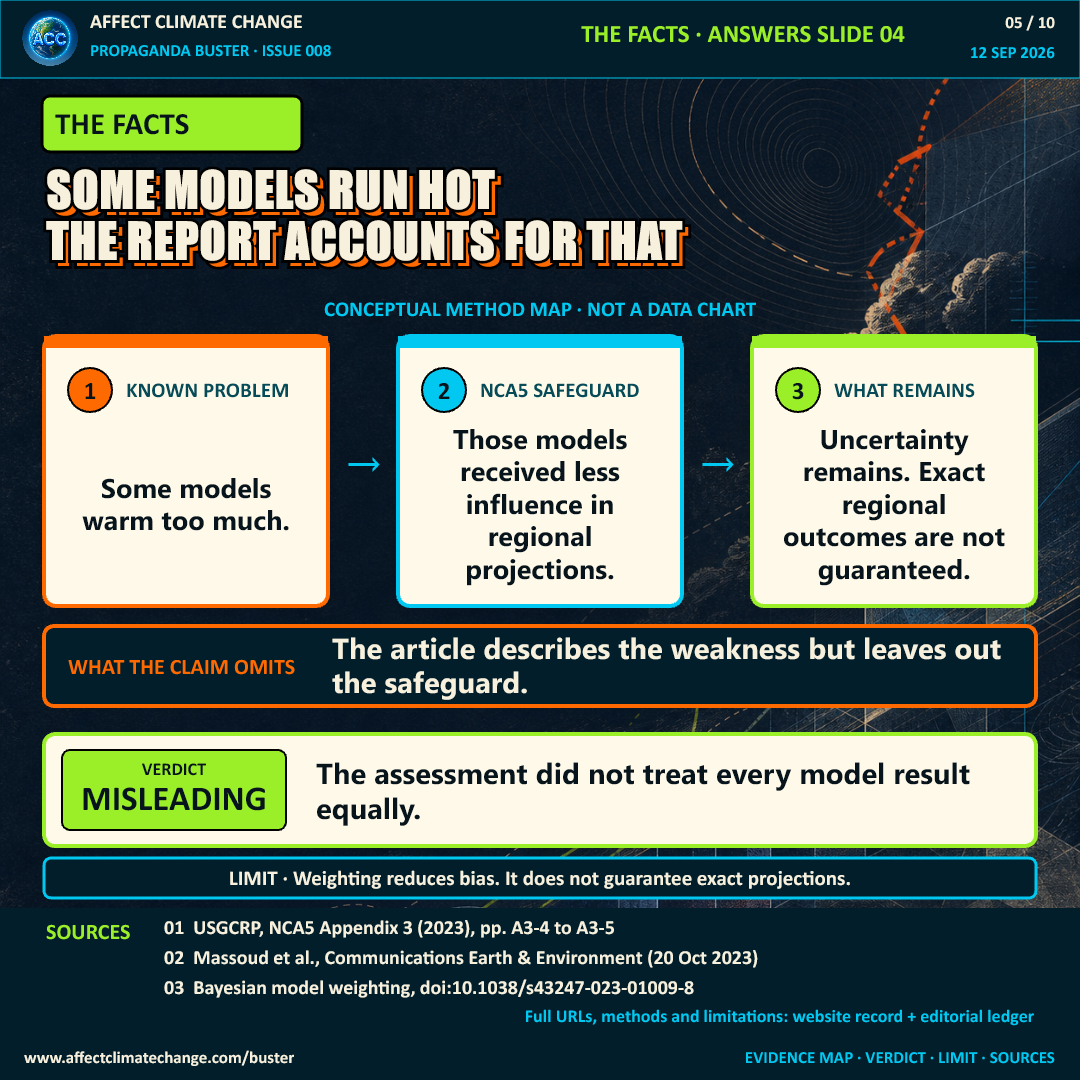
NCA5 Appendix 3 documents climate-sensitivity weighting for 16 models in its downscaled regional products. The supporting peer-reviewed method paper recognizes the hot-model problem and describes Bayesian weighting intended to reduce the influence of models with implausibly high sensitivity.
- NCA5 Appendix 3 acknowledges climate-sensitivity concerns in CMIP6 models.
- The assessment's downscaled regional products apply weights across 16 models rather than treating every result equally.
- The peer-reviewed Bayesian method explicitly targets the excessive influence of hot models.
- Weighting reduces one source of bias but does not eliminate scenario, regional or model uncertainty.
Evidence chain
Each source is dated and paired with the finding it supports. The original post establishes what was claimed; it does not decide the scientific verdict.
Fifth National Climate Assessment, Appendix 3: Scenarios and Datasets
Published / source period: 2023
U.S. Global Change Research Program · Pages A3-4 to A3-5 document climate-sensitivity weighting of 16 models in the assessment's downscaled regional products and record limitations.
Accessed September 12, 2026
Bayesian weighting of climate models based on climate sensitivity
Published / source period: 2023-10-20
Massoud et al. / Communications Earth & Environment · The method recognizes the hot-model problem and describes weighting that reduces the influence of overly sensitive climate models.
Accessed September 12, 2026
What is true
Some CMIP6 models respond too strongly to greenhouse gases, and weighting does not make projections exact. Local projections retain uncertainty, scenarios are conditional, and data availability and geographic coverage still limit the assessment.
Where the claim fails
The criticism identifies a real model-development concern but presents it as if the assessment ignored that concern. Omitting the directly relevant weighting safeguard materially changes how readers are likely to understand the projection method.
Limits and uncertainty
The method paper supports the assessment's weighting approach rather than providing a fully independent replication of NCA5 performance. This check does not evaluate every historical simulation, local output or policy claim in the article.
Assessment after the evidence
Some models do run too hot, but the article omits that NCA5 reduced their influence in downscaled regional projections through documented climate-sensitivity weighting.
How the framing works
Omission of methodological context: a genuine model weakness is described without the assessment safeguard designed to reduce its influence.
How scientists know
Assessment authors document the ensemble, compare sensitivity with assessed evidence, apply transparent weights and test how those choices change regional distributions. The official appendix and peer-reviewed method record those steps and limits.
Editorial boundaries
ACC evaluates the claim. It does not infer intent, coordination, funding, deception, or control without direct evidence specific to that attribution.
The source presentation and reuse decision are documented here: Approved bounded native-source crop for criticism and fact-checking with attribution and a direct source link; unrelated page material is excluded and no endorsement is implied.
Corrections and revision record
Corrections status: No change to the scientific verdict has been recorded.
R6-web-1 · September 13, 2026
Translated the approved R6 record into the website schema while retaining the narrow omission-based misleading verdict.