Precise proposition checked
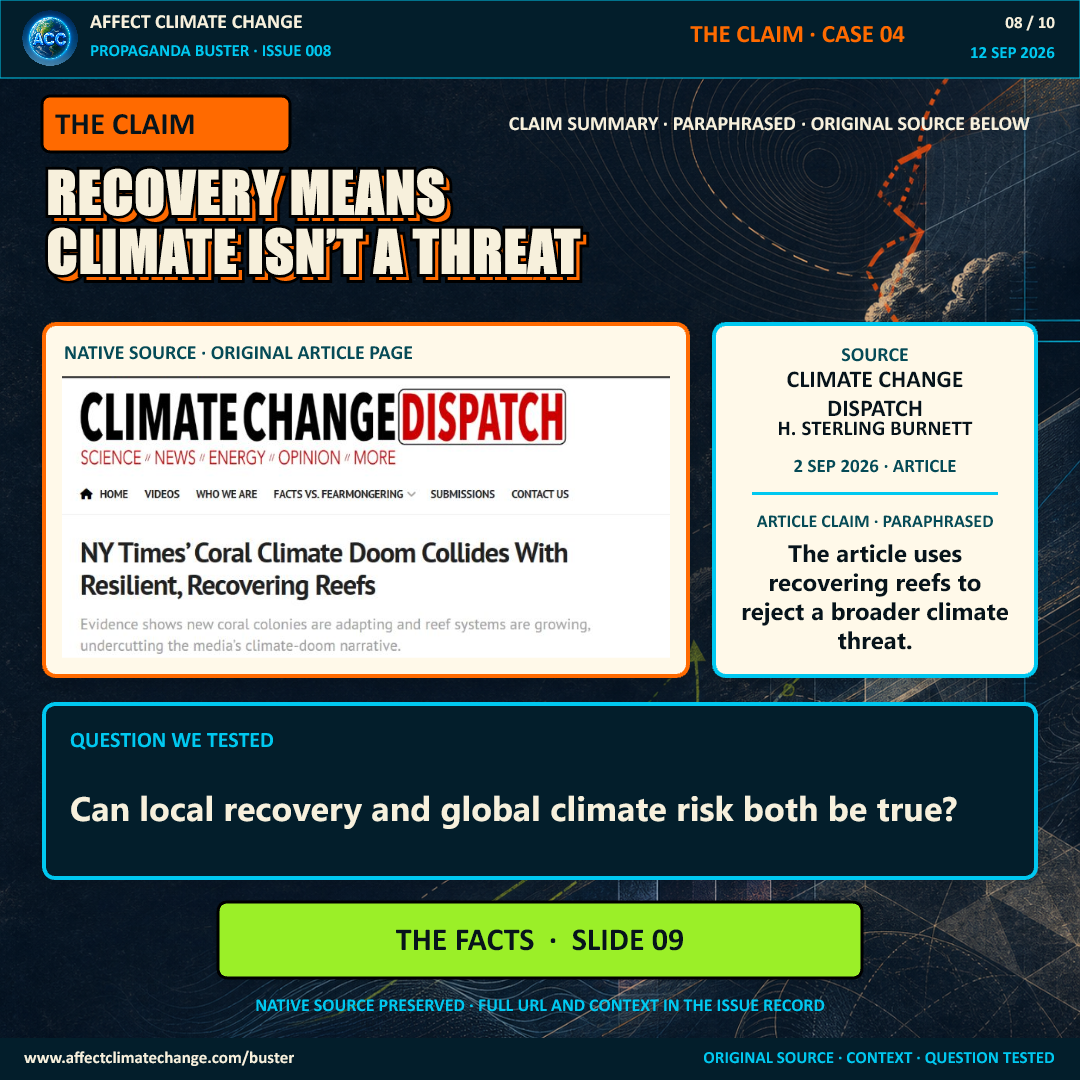
Observed local coral recovery and newly documented reefs directly contradict the global scientific conclusion that climate-driven marine heatwaves threaten coral reefs.
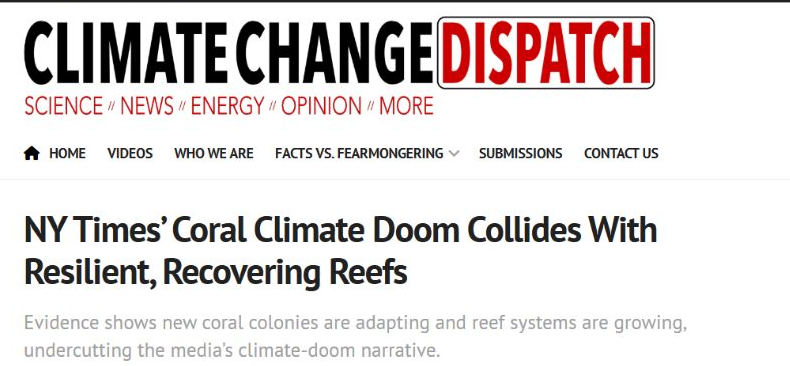
Full post context: A Climate Change Dispatch article by H. Sterling Burnett rejects the proposition that climate change threatens coral reefs and points to recovery and newly found reefs. ACC retains those examples and checks only categorical denial of climate risk.
Scope of this check: This verdict does not call local recovery false, claim all reefs are declining, or treat every bleaching exposure as coral death. It addresses the categorical inference that recovery means climate change is not a reef threat.
What the evidence shows
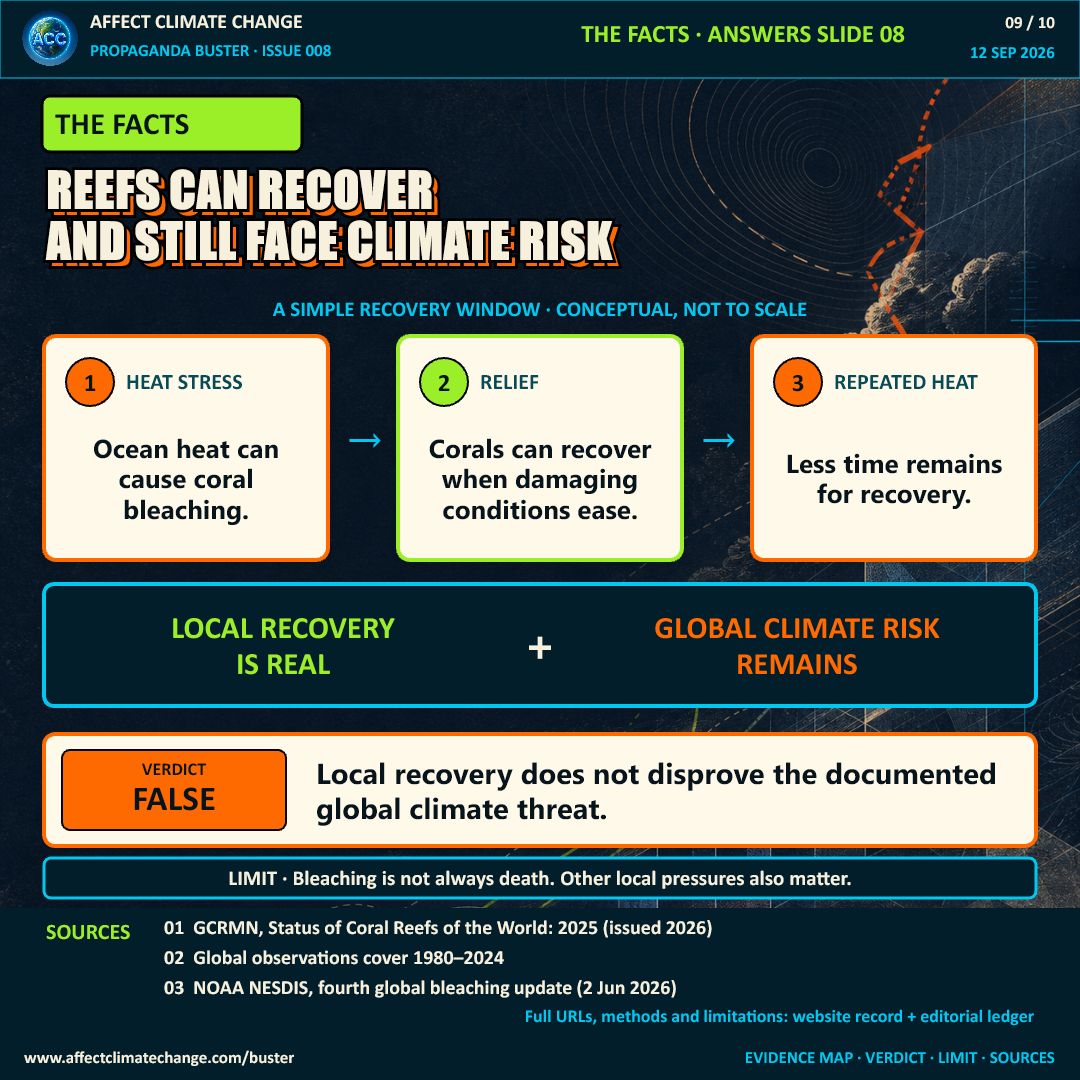
The Global Coral Reef Monitoring Network assessment identifies climate-driven marine heatwaves as the principal cause of declining global hard-coral cover while recognizing recovery during reduced disturbance. NOAA monitoring documents widespread heat stress and bleaching during the fourth global event. Recovery and climate risk can coexist.
- The global assessment recognizes real coral recovery when damaging conditions ease.
- The same assessment identifies climate-driven marine heatwaves as the principal cause of declining global hard-coral cover.
- NOAA monitoring documents widespread heat stress and bleaching during the 2023 to mid-2025 event.
- Local recovery does not negate the global hazard, and repeated heat can shorten the recovery window.
Evidence chain
Each source is dated and paired with the finding it supports. The original post establishes what was claimed; it does not decide the scientific verdict.
Status of Coral Reefs of the World: 2025
Published / source period: 2026
Global Coral Reef Monitoring Network · The assessment identifies climate-driven marine heatwaves as the principal cause of declining global hard-coral cover and recognizes recovery during periods of reduced disturbance.
Accessed September 12, 2026
World's Fourth Mass Coral Bleaching Event Likely Ended in 2025
Published / source period: 2026-06-02
NOAA NESDIS · NOAA summarizes widespread marine heat stress and documented bleaching during 2023 through mid-2025 without equating every exposure with mortality.
Accessed September 12, 2026
What is true
Corals can recover, acclimate and adapt, and reef outcomes also depend on pollution, fishing, storms and local management. Protecting water quality and reducing local pressures can strengthen resilience even while global heat risk remains.
Where the claim fails
The claim generalizes real local recovery into categorical denial of a broader, independently documented hazard. Recovery after stress does not show the stressor is harmless, especially when repeated heat leaves less time between damaging events.
Limits and uncertainty
Bleaching is not mortality, and exposure monitoring does not yield a universal death percentage. Regional improvements can be substantial. The assessment is a scientific synthesis, and its title says 2025 although its citation lists 2026 editors.
Assessment after the evidence
Global assessment and monitoring evidence identifies climate-driven heat stress as a major reef threat; local recovery during relief from disturbance does not contradict that risk.
How the framing works
Scale substitution: selected recovery examples are generalized into rejection of a global climate risk documented by the broader monitoring record.
How scientists know
Global networks combine standardized field observations across regions and time, while satellite and in-water systems track accumulated heat stress and bleaching exposure. Assessments compare recovery periods with disturbance histories and report uncertainty and regional differences.
Editorial boundaries
ACC evaluates the claim. It does not infer intent, coordination, funding, deception, or control without direct evidence specific to that attribution.
The source presentation and reuse decision are documented here: Approved bounded native-source crop for criticism and fact-checking with attribution and a direct source link; unrelated page material is excluded and no endorsement is implied.
Corrections and revision record
Corrections status: No change to the scientific verdict has been recorded.
R6-web-1 · September 13, 2026
Mapped R6's narrow FALSE slide label to the current CONTRADICTED website taxonomy; claim scope, evidence and high-confidence conclusion are unchanged.