Precise proposition checked
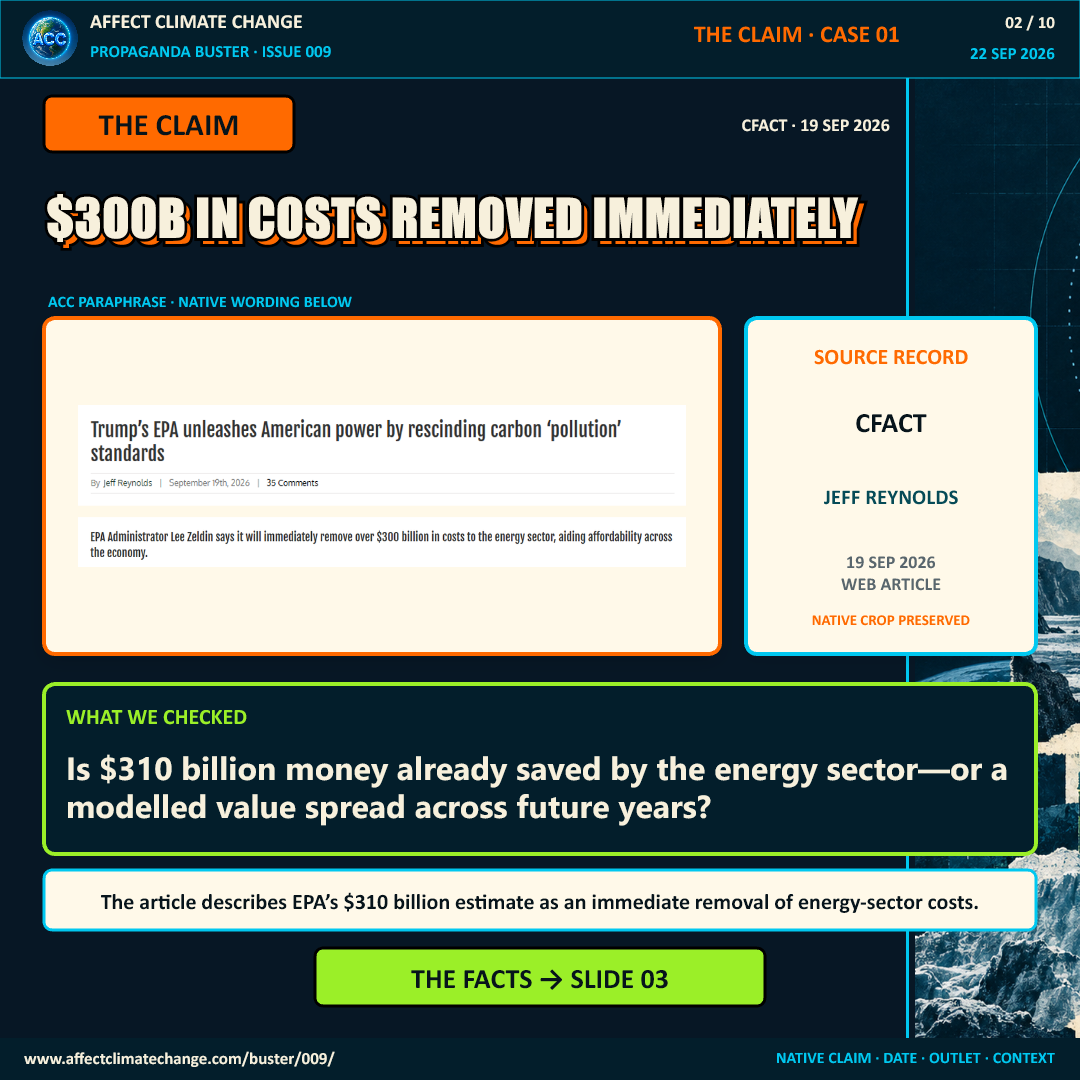
That EPA's Regulatory Impact Analysis shows roughly $310 billion already removed from energy-sector costs as an immediate effect of the repeal.
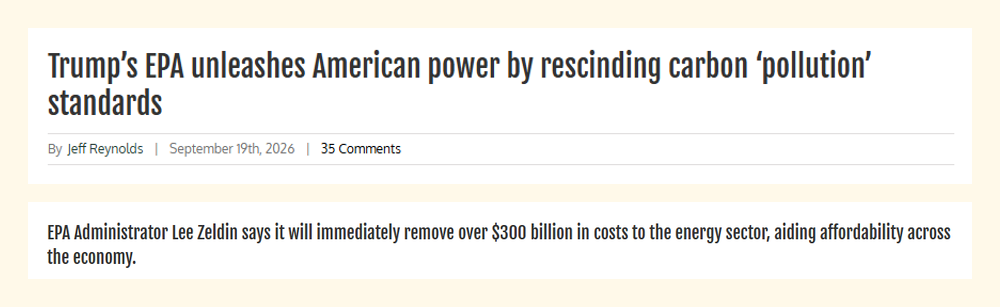
Full post context: CFACT commentary (Jeff Reynolds, Sep 19, 2026) framed EPA's partial repeal of 2024 power-plant carbon standards as delivering an immediate $300+ billion cost removal to the energy sector.
Scope of this check: The RIA leaves some climate, health, and water effects unmonetized; this check does not assume those omitted values or claim EPA projects zero savings.
What the evidence shows
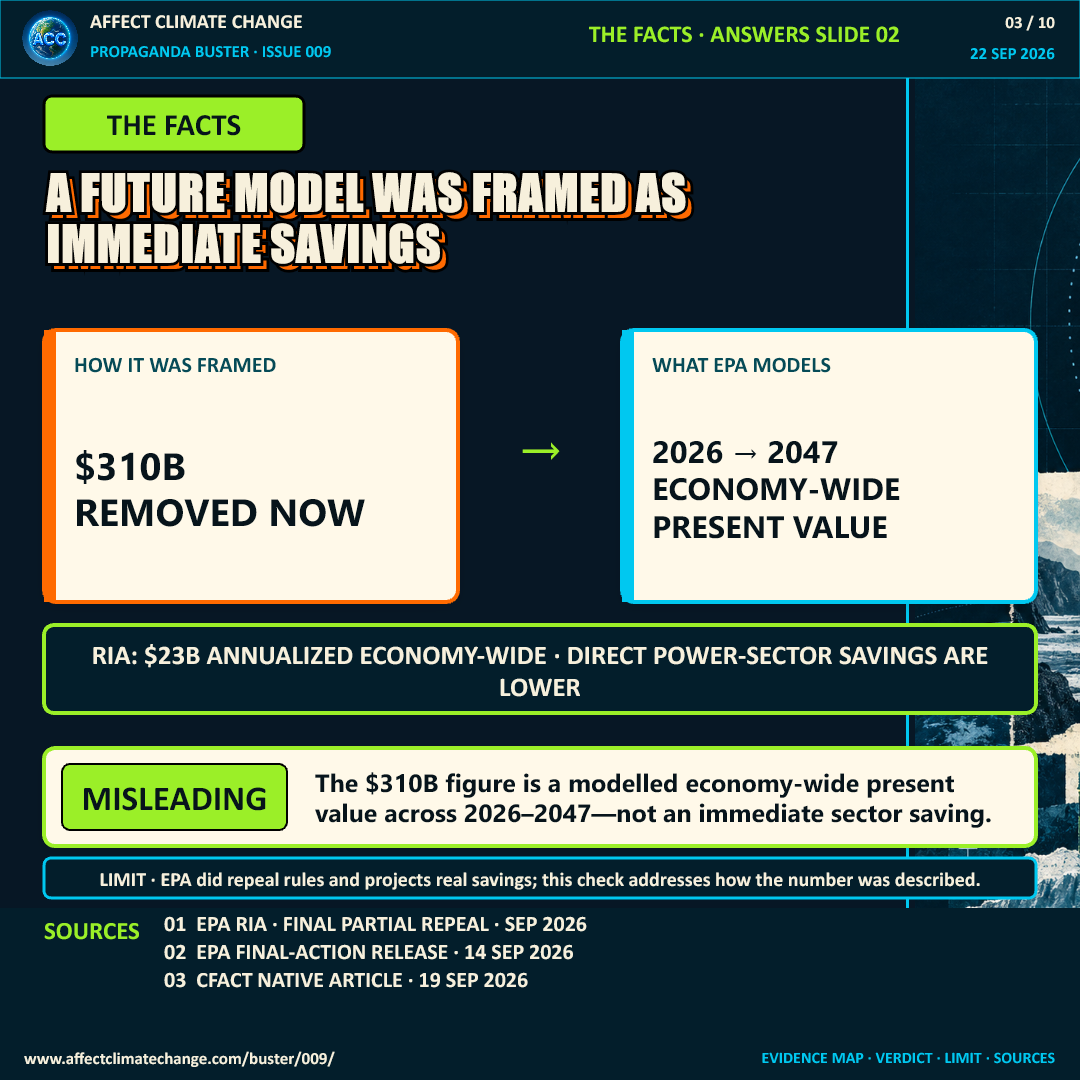
EPA's own Regulatory Impact Analysis reports the roughly $310 billion figure as a modeled present value of economy-wide social costs over 2026-2047, annualized near $23 billion, while EPA's direct power-sector cost estimates are lower, about $95-160 billion present value and $8.6-10 billion annualized depending on discount rate.
- RIA Table 5-4 lists the ~$310B figure as a 2026-2047 economy-wide present value, annualized ~$23B.
- RIA Tables 3-7, 3-19, and 1-1 give power-sector-specific present values of roughly $95-160B and annualized $8.6-10B.
- EPA’s announcement confirms a finalized partial repeal and a projected $300 billion-plus estimate. The RIA, rather than the headline alone, defines the dollar basis, period, discount rate and scope.
Evidence chain
Each source is dated and paired with the finding it supports. The original post establishes what was claimed; it does not decide the scientific verdict.
Regulatory Impact Analysis for the Partial Repeal of the Carbon Pollution Standards for Fossil Fuel-Fired Electric Generating Units
Published / source period: 2026-09
U.S. EPA · Tables 1-1, 3-7, 3-19, and 5-4 separate the economy-wide $310B present-value figure from smaller, lower power-sector-specific cost estimates.
Accessed October 11, 2026
EPA Finalizes Repeal of 2024 Power Plant Regulations, Delivering $300 Billion in Savings
Published / source period: 2026-09-14
U.S. EPA · EPA announced the final partial repeal and projected savings; the underlying RIA provides the full modeled time horizon and definitions.
Accessed October 11, 2026
What is true
EPA finalized a partial repeal and its analysis projects substantial future savings. This check concerns how the timing and economy-wide scope of the estimate were described, not a finding that savings are zero.
Where the claim fails
The claim converts a multi-decade, economy-wide modeled estimate into an immediate, energy-sector-only savings figure, which the RIA tables do not support.
Limits and uncertainty
The RIA leaves some climate, health, and water effects unmonetized; this check does not assume those omitted values or claim EPA projects zero savings.
Assessment after the evidence
Future, economy-wide modeled savings were described as immediate, sector-specific costs removed.
How the framing works
Time-horizon collapse and category shift, presenting a future economy-wide model result as immediate sector-specific savings.
How scientists know
EPA's RIA presents itemized cost tables across discount rates and time horizons, allowing direct comparison between the economy-wide and power-sector-specific figures cited.
Editorial boundaries
ACC evaluates the claim. It does not infer intent, coordination, funding, deception, or control without direct evidence specific to that attribution.
The source presentation and reuse decision are documented here: Bounded native excerpt used for identification and criticism with attribution and a direct source link. No license or endorsement implied.
Corrections and revision record
Corrections status: No change to the scientific verdict has been recorded.
web-1 · October 11, 2026
First website edition authorized by Jesse on October 11, 2026. Original issue, claim and evidence dates preserved; original provenance, evidence, limitations and verdict appear in that order.