Precise proposition checked
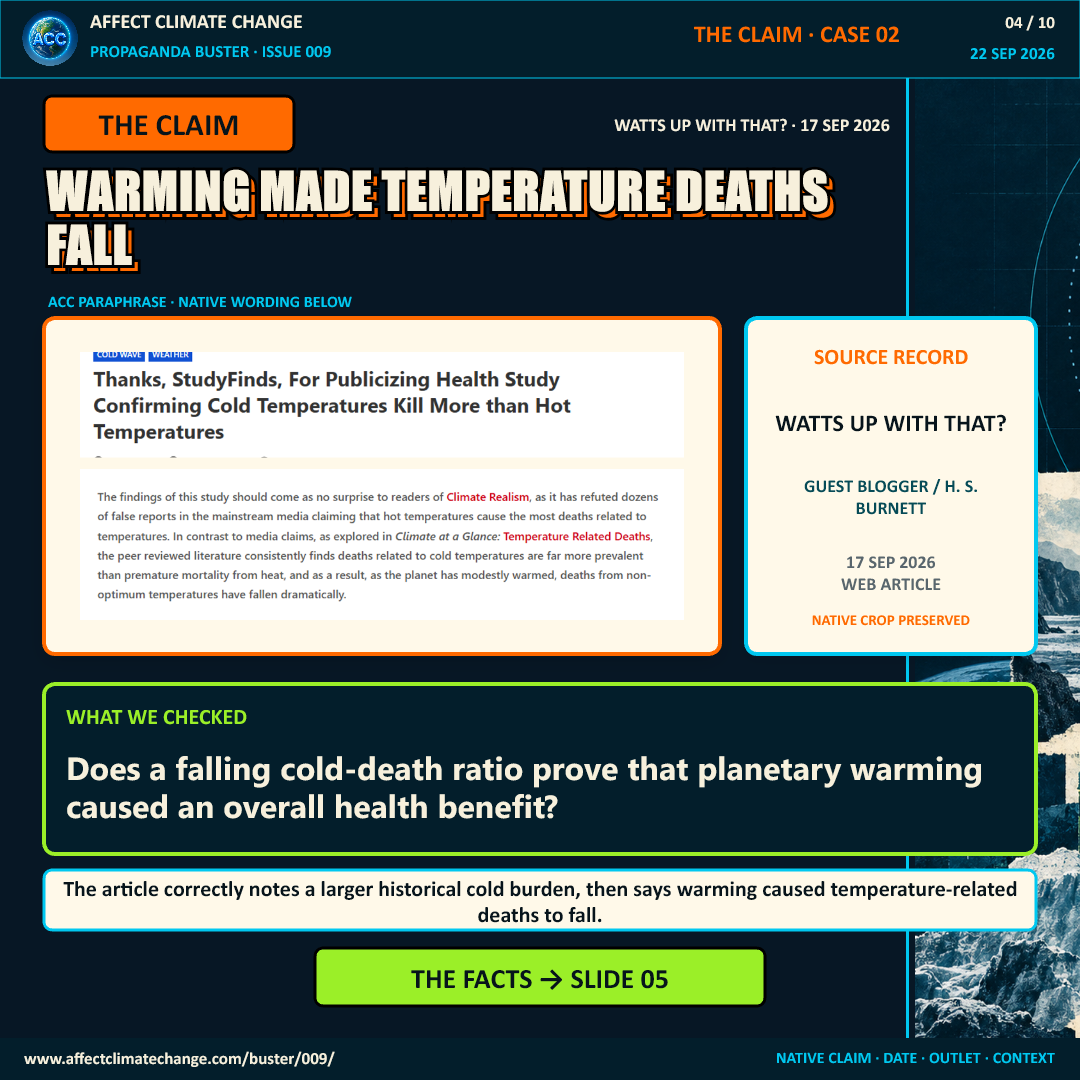
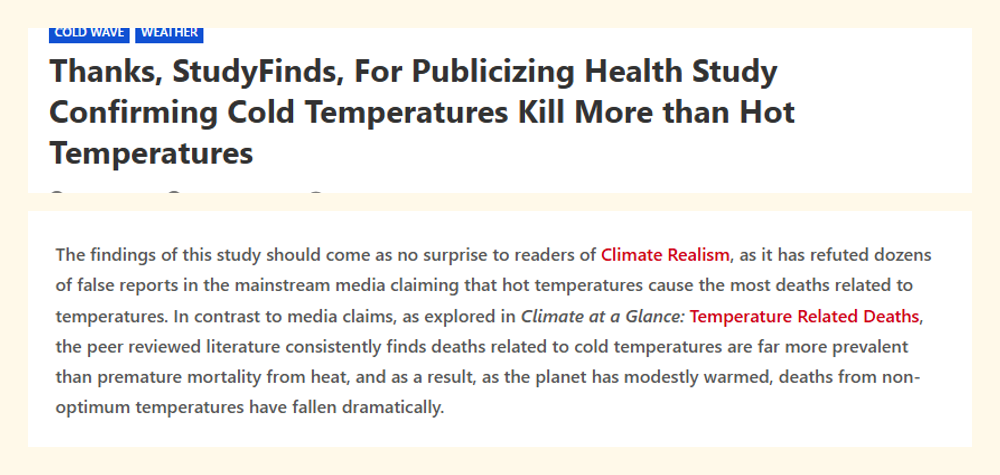
That a historical comparison of cold- versus heat-related death ratios establishes warming as the cause of a dramatic net decline in temperature-related mortality.
Full post context: Watts Up With That (Sep 17, 2026, sourced to H. Sterling Burnett) cited a mortality study's larger historical cold-death burden to argue warming has sharply cut temperature-related deaths overall.
Scope of this check: IPCC reports variable evidence for winter-mortality reductions and high confidence that future heat-related deaths will rise with strong regional variation; some colder regions may see fewer cold deaths as temperatures rise.
What the evidence shows
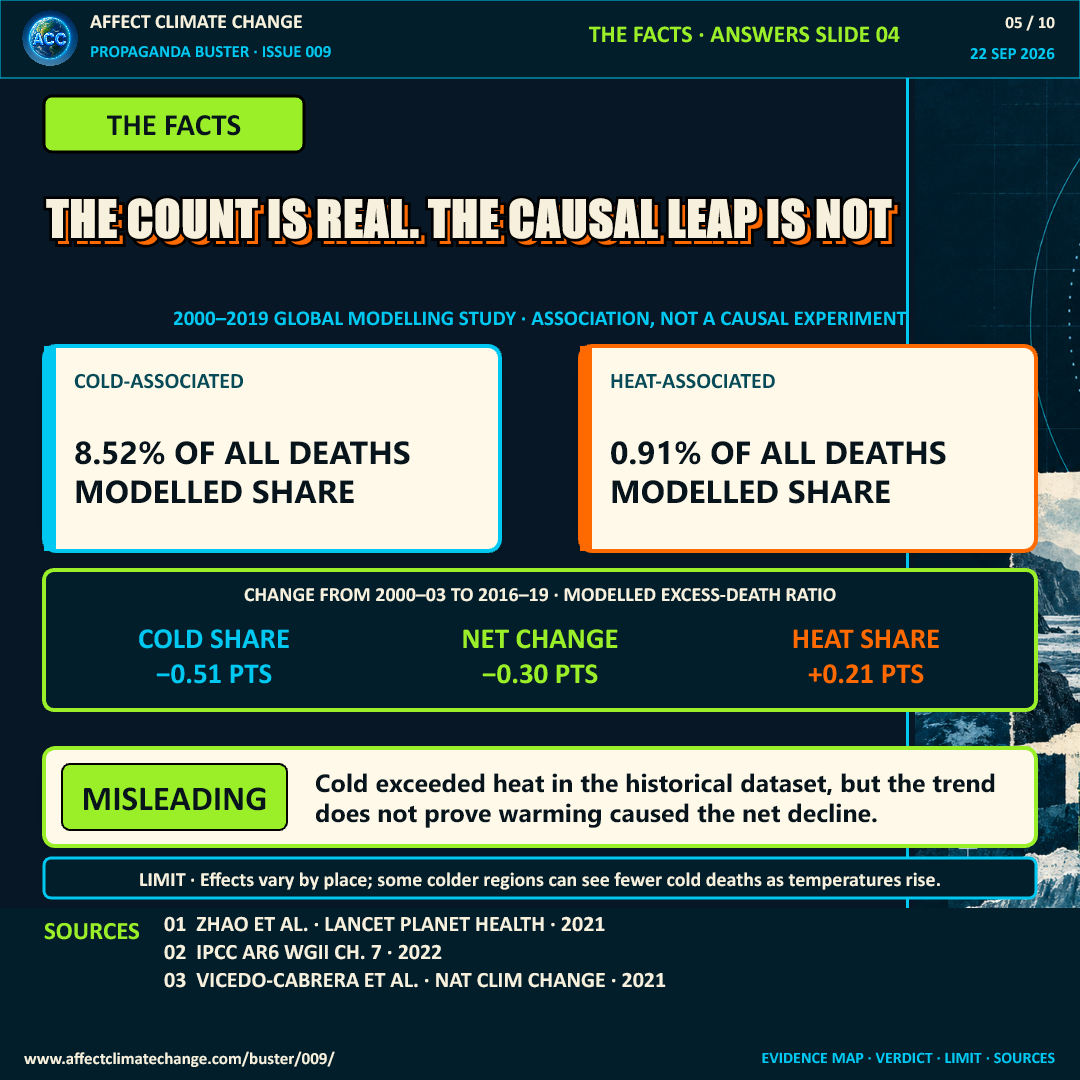
The underlying study found cold-related excess-death ratios fell about 0.51 percentage points while heat-related ratios rose about 0.21 points between 2000-2003 and 2016-2019, an association, not a controlled causal test isolating warming from housing, health care, demographics, and adaptation changes.
- Zhao et al. estimate changes of −0.51 percentage points for cold and +0.21 for heat, a net −0.30 points, between 2000–2003 and 2016–2019. That modeled decline is real; its cause is the question.
- IPCC AR6 WGII Chapter 7 finds high confidence that heat-related deaths are expected to increase going forward, varying by region.
- Vicedo-Cabrera et al. attribute a measurable share of heat-related deaths to human-induced climate change, countering a one-sided reading.
Evidence chain
Each source is dated and paired with the finding it supports. The original post establishes what was claimed; it does not decide the scientific verdict.
Global, regional, and national burden of mortality associated with non-optimal ambient temperatures from 2000 to 2019
Published / source period: 2021-07
The Lancet Planetary Health · Cold-related excess-death ratios declined while heat-related ratios rose between the two measured periods, an association rather than a causal test.
Accessed October 11, 2026
AR6 Working Group II, Chapter 7
Published / source period: 2022-02-28
IPCC · Evidence for winter-mortality reductions is variable, while confidence is high that heat-related deaths will increase in the future with regional variation.
Accessed October 11, 2026
The burden of heat-related mortality attributable to recent human-induced climate change
Published / source period: 2021-05-31
Vicedo-Cabrera et al., Nature Climate Change · Attribution analysis estimates heat-related mortality associated with human-induced warming in the studied locations.
Accessed October 11, 2026
What is true
The cited global modelling literature does estimate a larger historical cold-associated mortality burden than heat-associated mortality worldwide.
Where the claim fails
The phrase 'as a result' asserts causation that the cited observational comparison cannot establish on its own.
Limits and uncertainty
IPCC reports variable evidence for winter-mortality reductions and high confidence that future heat-related deaths will rise with strong regional variation; some colder regions may see fewer cold deaths as temperatures rise.
Assessment after the evidence
A historical association between temperature and mortality was presented as a proven causal result.
How the framing works
Causal leap from a historical association, with one-sided use of a dataset whose cold and heat trends move in opposite directions.
How scientists know
Researchers model excess deaths attributable to non-optimal temperatures using long time series and compare ratios across periods, which shows association but requires further study to isolate causal drivers.
Editorial boundaries
ACC evaluates the claim. It does not infer intent, coordination, funding, deception, or control without direct evidence specific to that attribution.
The source presentation and reuse decision are documented here: Bounded native excerpt used for identification and criticism with attribution and a direct source link. No license or endorsement implied.
Corrections and revision record
Corrections status: No change to the scientific verdict has been recorded.
web-1 · October 11, 2026
First website edition authorized by Jesse on October 11, 2026. Original issue, claim and evidence dates preserved; original provenance, evidence, limitations and verdict appear in that order.