Precise proposition checked
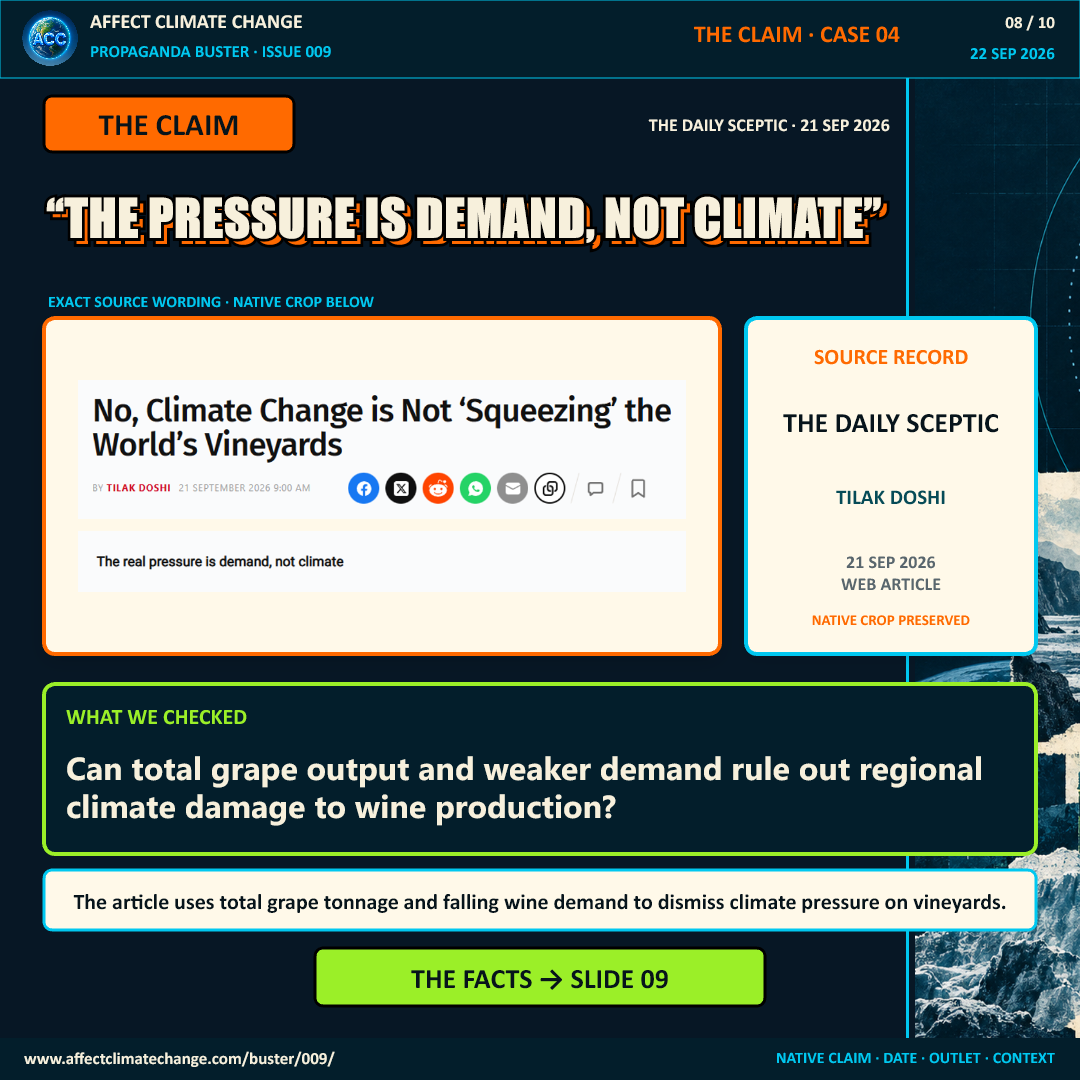
Rising total fresh-grape tonnage and lower wine demand establish that climate change is not putting pressure on vineyards.
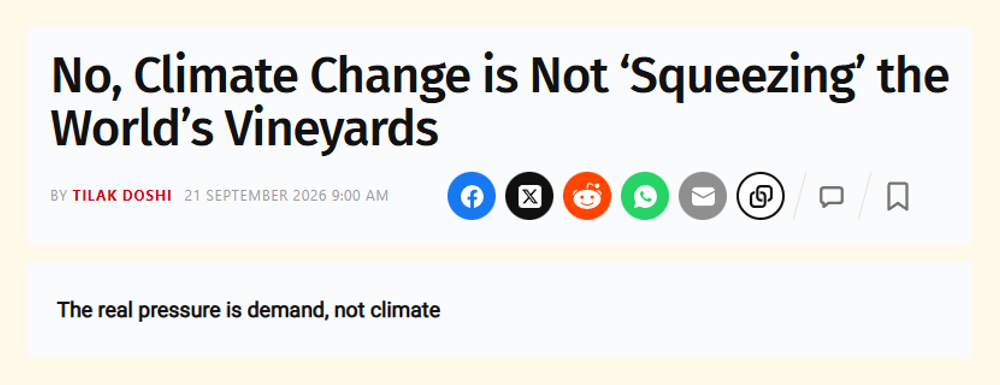
Full post context: The Daily Sceptic / Tilak Doshi, September 21, 2026, uses rising total grape tonnage and falling wine demand to reject climate as a source of pressure on vineyards.
Scope of this check: The Australian study directly covers five regions, not all vineyards. Outcomes and adaptation differ by region. This check does not assign every production decline to human-caused warming.
What the evidence shows
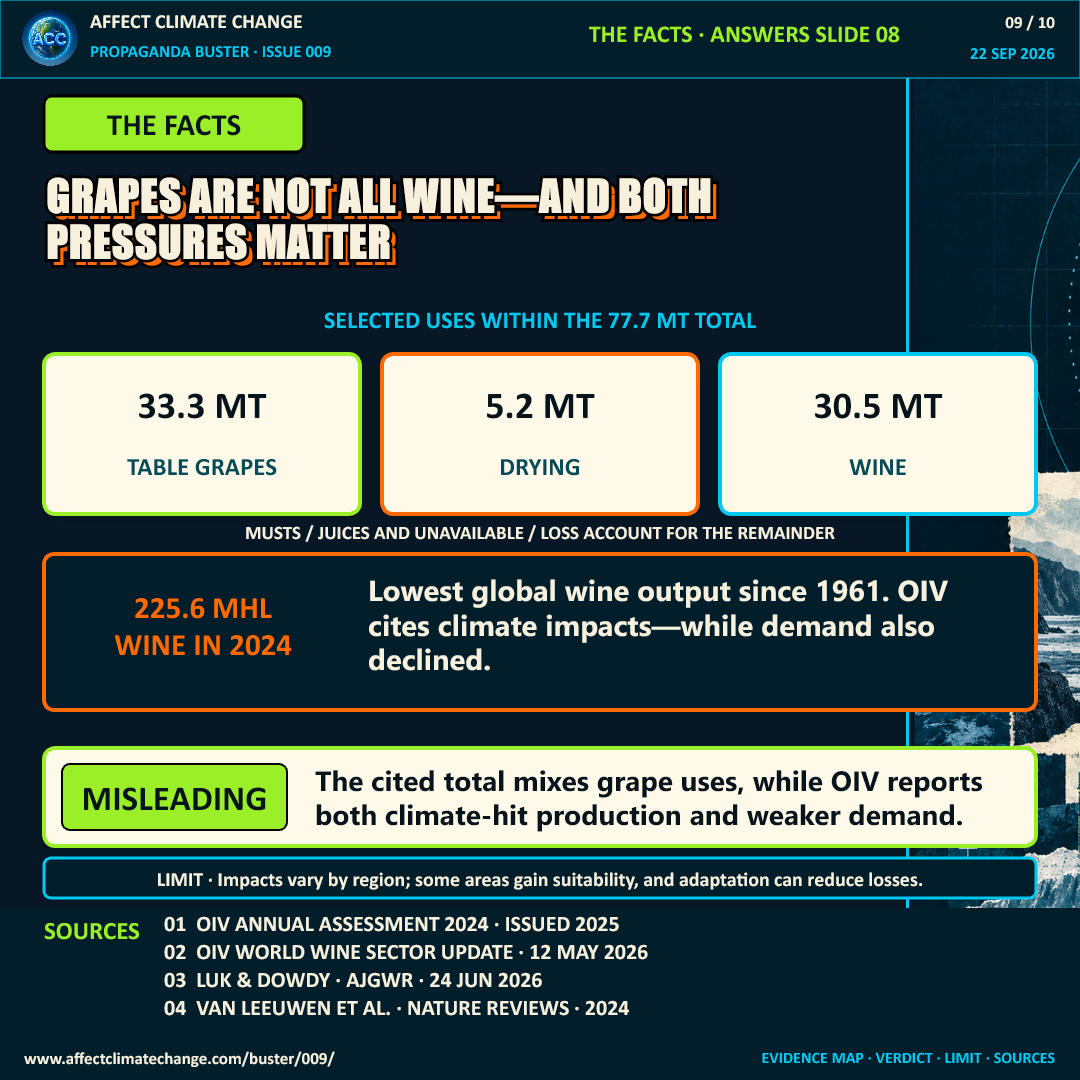
OIV’s 2024 balance reports 77.7 million tonnes harvested and 71.8 million available after 5.9 million tonnes of losses. Available grapes include 33.3 million tonnes for table grapes, 5.2 million for drying, 30.5 million for wine, and 2.8 million for musts and juices. This mixed total does not measure wine production or climate damage. OIV reports 2024 wine production of 225.6 million hectolitres, the lowest since 1961, largely due to climate impacts. Its May 2026 update describes climate-hit production alongside weaker demand.
- Total grapes include several end uses and losses; the headline total is not a wine-output statistic.
- OIV describes low wine production linked to climate impacts and weaker demand at the same time.
- Regional effects and adaptation differ, so a global aggregate cannot establish that every vineyard is unaffected.
Evidence chain
Each source is dated and paired with the finding it supports. The original post establishes what was claimed; it does not decide the scientific verdict.
Annual Assessment of the World Vine and Wine Sector in 2024
Published / source period: 2025-09
International Organisation of Vine and Wine · The grape balance separates table grapes, drying, wine, musts/juices and losses; 2024 wine output was 225.6 million hectolitres.
Accessed October 11, 2026
State of the World Vine and Wine Sector
Published / source period: 2026-05-12
International Organisation of Vine and Wine · Climate events affected production in both hemispheres during a third low vintage; wine demand also declined.
Accessed October 11, 2026
Observed and projected climate shifts in five Australian wine regions
Published / source period: 2026-06-24
Luk and Dowdy, Australian Journal of Grape and Wine Research · Examines climate shifts and implications for five Australian wine regions.
Accessed October 11, 2026
Climate change impacts and adaptations in viticulture
Published / source period: 2024-03-26
van Leeuwen et al., Nature Reviews Earth & Environment · Reviews changing suitability, risks and adaptation in viticulture across regions.
Accessed October 11, 2026
What is true
Wine demand has weakened. Climate effects differ across regions, some places can benefit, and adaptation can reduce losses. Climate pressure and a demand slowdown can both affect the same sector.
Where the claim fails
The argument substitutes all-grape tonnage for wine production and uses a global aggregate to exclude regional climate pressure. Neither comparison can rule out regional losses, relocation, irrigation, variety changes or newly suitable areas.
Limits and uncertainty
The Australian study directly covers five regions, not all vineyards. Outcomes and adaptation differ by region. This check does not assign every production decline to human-caused warming.
Assessment after the evidence
Weaker demand and climate pressure can occur together; total grape tonnage cannot rule out climate effects on wine production.
How the framing works
Metric substitution, geographic aggregation and false either/or framing.
How scientists know
OIV separately accounts for harvested grapes, their uses, wine production and demand. Regional studies and scientific reviews examine climate exposure, suitability and adaptation rather than relying on one global total.
Editorial boundaries
ACC evaluates the claim. It does not infer intent, coordination, funding, deception, or control without direct evidence specific to that attribution.
The source presentation and reuse decision are documented here: Bounded native excerpt used for identification and criticism with attribution and a direct source link. No license or endorsement implied.
Corrections and revision record
Corrections status: No change to the scientific verdict has been recorded.
web-1 · October 11, 2026
First website edition authorized by Jesse on October 11, 2026. Original issue, claim and evidence dates preserved; original provenance, evidence, limitations and verdict appear in that order.