Precise proposition checked
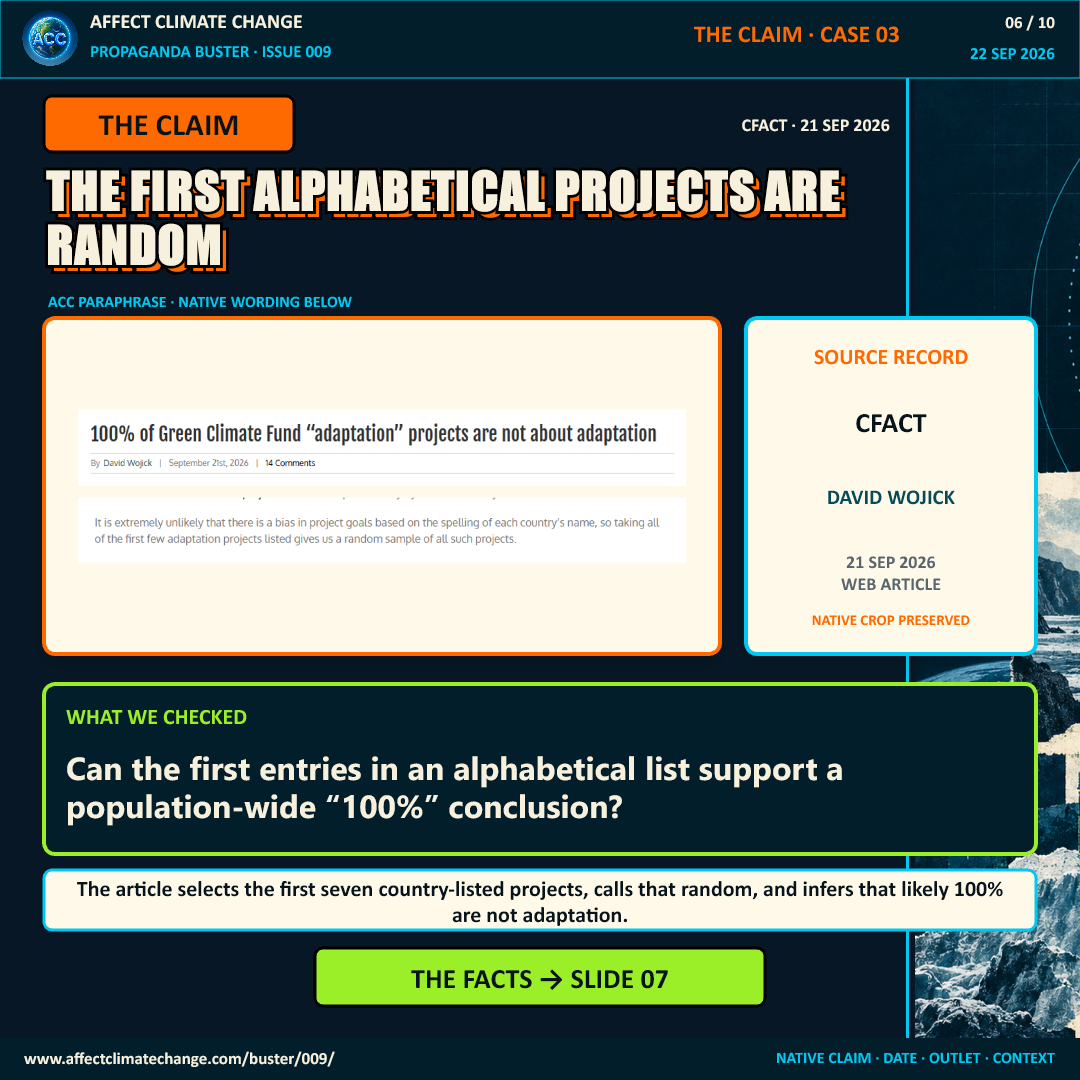
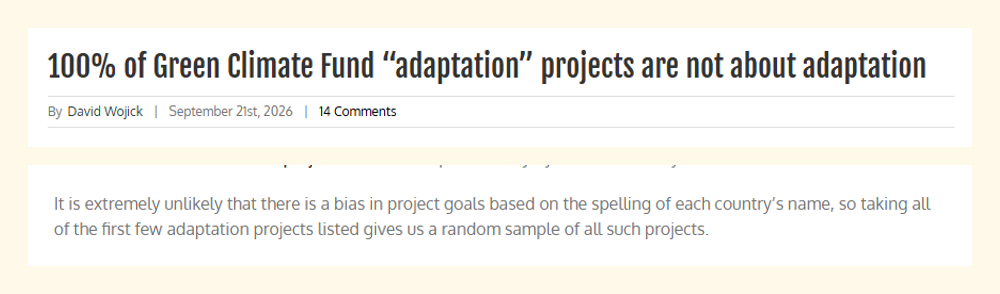
That a sample selected by alphabetical order of country names is a random, representative sample capable of supporting a population-wide conclusion about GCF adaptation projects.
Full post context: CFACT commentary (David Wojick, Sep 21, 2026) examined an alphabetically ordered subset of Green Climate Fund adaptation projects and generalized the findings to the entire GCF adaptation portfolio.
Scope of this check: This evidence does not establish that every GCF project is effective, additional to ordinary development aid, or cost-effective; it only addresses the sampling and definitional claims.
What the evidence shows
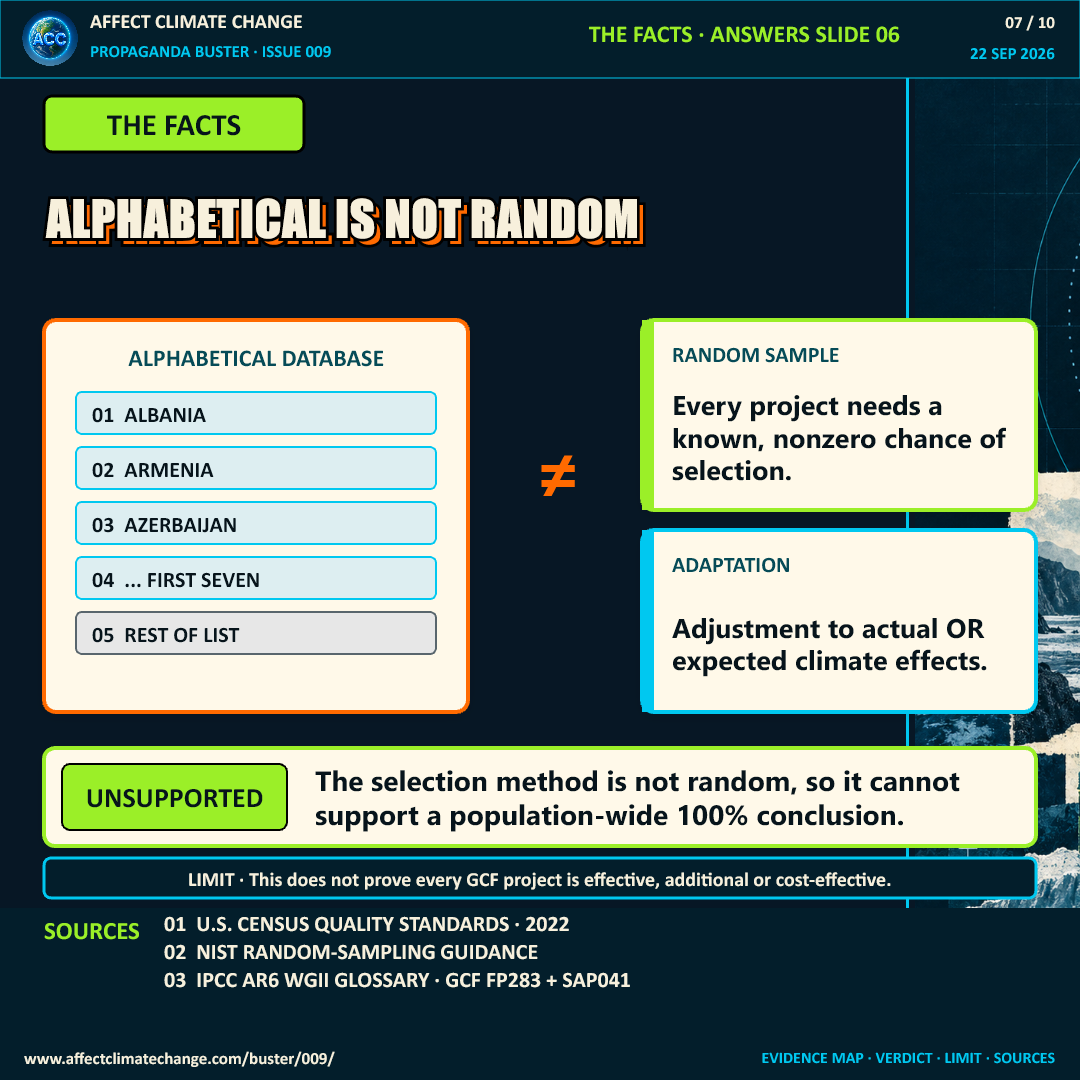
Recognized statistical standards require every unit in a population to have a known, nonzero chance of selection for a sample to be called random; an alphabetically ordered list systematically excludes later-listed countries' projects from any chance of selection, so it cannot be treated as random or representative of the full GCF adaptation portfolio.
- U.S. Census Bureau standards require known, nonzero selection probability for a sample to be called random; an alphabetical cutoff violates this.
- NIST's handbook defines simple random sampling as giving every unit an equal chance of selection, which an alphabetized list does not provide.
- GCF project FP283 and SAP041 both explicitly link observed and projected climate risks to the funded water, agriculture, and early-warning activities, undercutting a strict needs-versus-adaptation split.
Evidence chain
Each source is dated and paired with the finding it supports. The original post establishes what was claimed; it does not decide the scientific verdict.
Statistical Quality Standards
Published / source period: 2022-04-26
U.S. Census Bureau · Probability sampling requires known, nonzero selection probabilities for population units.
Accessed October 11, 2026
Simple Random Sampling
Published / source period: Undated guidance
NIST/SEMATECH · Simple random sampling gives every response an equal chance of observation.
Accessed October 11, 2026
AR6 WGII Annex II: Glossary
Published / source period: 2022
IPCC · Adaptation means adjustment to actual or expected climate and its effects.
Accessed October 11, 2026
FP283: Glaciers to Farms
Published / source period: 2025-10-30 approval
Green Climate Fund · Project documentation connects water and agricultural measures to actual and projected climate risks.
Accessed October 11, 2026
SAP041: ALBAdapt
Published / source period: 2024-07-18 approval
Green Climate Fund · Project documentation connects climate services, early warning and resilience measures to climate risks.
Accessed October 11, 2026
What is true
GCF funds both adaptation and other categories of projects, and reasonable people can question how individual projects define adaptation activities.
Where the claim fails
The selection method guarantees zero chance of inclusion for projects later in the alphabetical order, which directly contradicts calling it a random sample.
Limits and uncertainty
This evidence does not establish that every GCF project is effective, additional to ordinary development aid, or cost-effective; it only addresses the sampling and definitional claims.
Assessment after the evidence
A non-random, alphabetically ordered sample cannot support the sweeping population-wide conclusion drawn.
How the framing works
Nonrandom selection presented as random, combined with false precision and a false dichotomy between current needs and climate adaptation.
How scientists know
U.S. Census quality standards and NIST's statistical handbook both define random sampling as requiring equal or known selection probability, a condition an alphabetized partial list fails to meet.
Editorial boundaries
ACC evaluates the claim. It does not infer intent, coordination, funding, deception, or control without direct evidence specific to that attribution.
The source presentation and reuse decision are documented here: Bounded native excerpt used for identification and criticism with attribution and a direct source link. No license or endorsement implied.
Corrections and revision record
Corrections status: No change to the scientific verdict has been recorded.
web-1 · October 11, 2026
First website edition authorized by Jesse on October 11, 2026. Original issue, claim and evidence dates preserved; original provenance, evidence, limitations and verdict appear in that order.