
Precise proposition checked
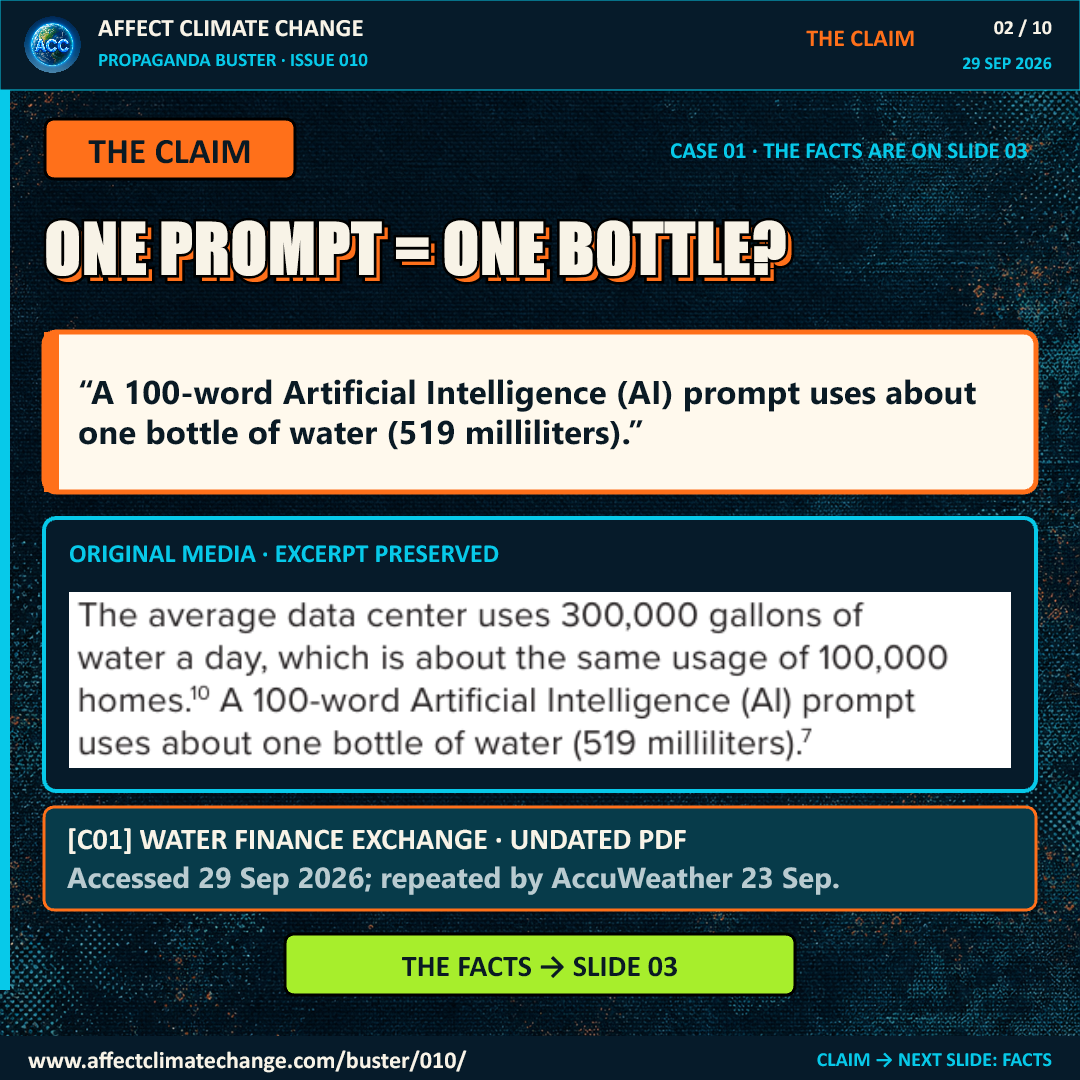
A 100-word AI prompt generally consumes about 519 mL of water.
Full post context: Original claim. Water Finance Exchange (WFX) writes: “A 100-word Artificial Intelligence (AI) prompt uses about one bottle of water (519 milliliters).” [C01] Its four-page Data Centers & Water Systems PDF prints no publication date; file metadata records creation on 13 August 2025, which is not proof of public release that day. AccuWeather recirculated a stronger “Each 100-word AI prompt” wording on 23 September 2026 [A01]. The R5 slide uses WFX's exact “about” wording and identifies WFX as C01.
Scope of this check: Bounded to the universal interpretation, not a claim that WFX explicitly says every prompt has this exact cost.
What the evidence shows
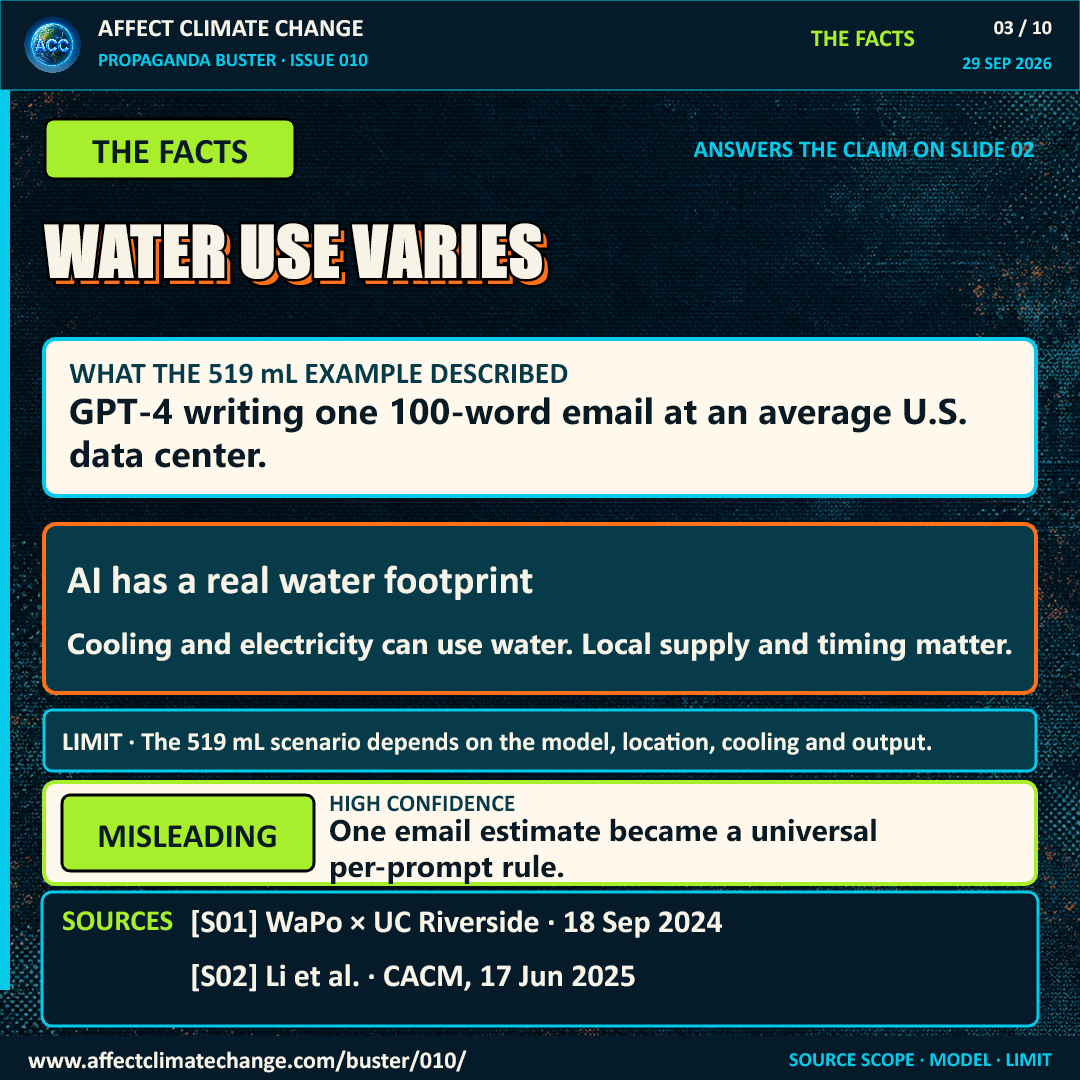
What the estimate covered. The Washington Post and University of California, Riverside researchers modeled the water associated with GPT-4 writing an average 100-word email at an average U.S. data center, published 18 September 2024 [S01]. That is a scenario, not a meter reading or an invariant cost of all prompts. The model, output length, time and place, cooling arrangement, and electricity source can change the result. Li and colleagues separately modeled roughly one 500-millilitre bottle for 10–50 medium-length GPT-3 responses, depending on where and when the model runs [S02]. The GPT-3 and GPT-4 examples should not be combined into a single universal number.
- Indexed article text names the scenario and says location can change water and electricity costs.
- Authors estimate 500 mL for roughly 10–50 medium-length GPT-3 responses depending on when and where deployed. Sections 2.2 and 4 discuss cooling and electricity-related water, local supply, temporal variation and reporting.
- The WFX PDF is undated; creation metadata is not a publication date. The GPT-4 scenario and the separate GPT-3 estimate cannot be combined. The Post was restricted in the earlier browser review; its article text was reopened through the research tool on September 30.
Evidence chain
Each source is dated and paired with the finding it supports. The original post establishes what was claimed; it does not decide the scientific verdict.
A bottle of water per email: the hidden environmental costs of using AI chatbots
Published / source period: 2024-09-18
Pranshu Verma and Shelly Tan with UC Riverside researcher Shaolei Ren · Indexed article text names the scenario and says location can change water and electricity costs.
Accessed September 30, 2026
Making AI Less Thirsty: Uncovering and Addressing the Secret Water Footprint of AI Models
Published / source period: 2025-03-26 author manuscript v5; CACM publication 2025-06-17
Pengfei Li; Jianyi Yang; Mohammad A. Islam; Shaolei Ren · Authors estimate 500 mL for roughly 10–50 medium-length GPT-3 responses depending on when and where deployed. Sections 2.2 and 4 discuss cooling and electricity-related water, local supply, temporal variation and reporting.
Accessed September 30, 2026
What is true
AI has a real water footprint through cooling and electricity generation. Its magnitude varies by model, location and time; a modeled average cannot establish a fixed cost for every request.
Where the claim fails
The modeled 519-millilitre example should not become “every prompt uses one bottle.” This does not establish zero water demand per prompt or zero aggregate impact. The Post's full page was restricted in our browser; its indexed methodology and the accessible author manuscript for S02 support this scope distinction, but a final editor should reopen S01 at publication time.
Limits and uncertainty
The WFX PDF is undated; creation metadata is not a publication date. The GPT-4 scenario and the separate GPT-3 estimate cannot be combined. The Post was restricted in the earlier browser review; its article text was reopened through the research tool on September 30.
Assessment after the evidence
A modeled average for one data-center scenario should not be presented as a universal water cost for every AI prompt.
How the framing works
A specific modeled scenario becomes a general present-tense claim without its operating assumptions.
How scientists know
Researchers model cooling and electricity-related water using assumptions about compute, location, timing and energy supply. These are scenario estimates, not a meter reading for each individual prompt.
Editorial boundaries
ACC evaluates the claim. It does not infer intent, coordination, funding, deception, or control without direct evidence specific to that attribution.
The source presentation and reuse decision are documented here: Bounded source-native excerpt for identification and criticism, with attribution and direct links; no license or endorsement implied.
Corrections and revision record
Corrections status: No change to the scientific verdict has been recorded.
R7-web-1 · September 30, 2026
Integrated approved R7 into the website without changing September 29 evidence date or verdict boundary.