Precise proposition checked
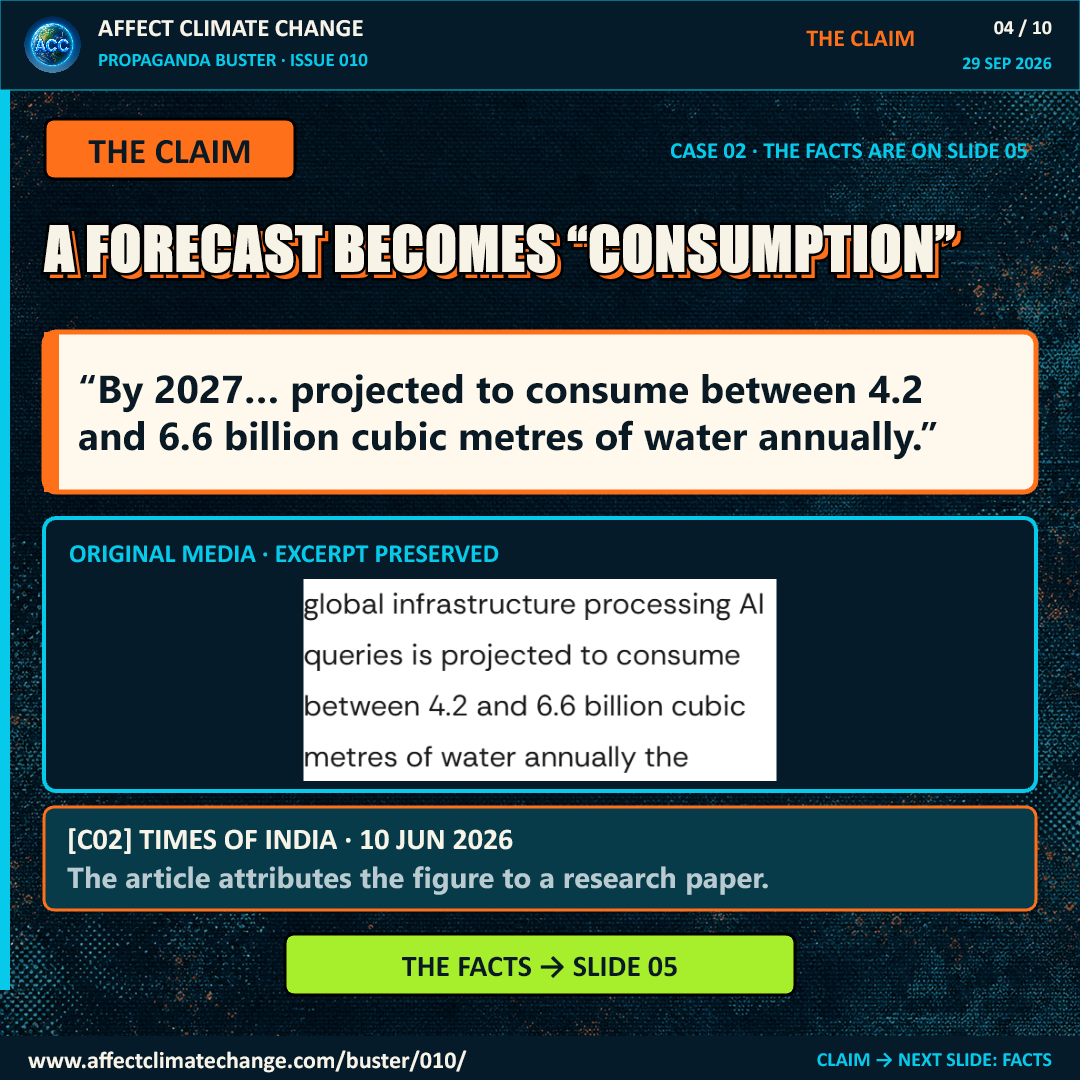
The 4.2–6.6 billion m³ global AI range for 2027 is water consumption.
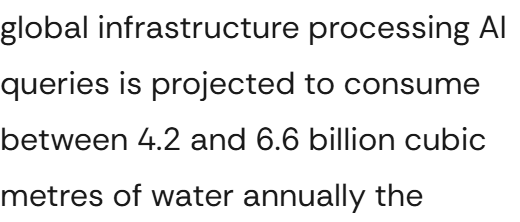
Full post context: Original claim. A Times of India article updated 10 June 2026 says global infrastructure processing AI queries is projected to “consume between 4.2 and 6.6 billion cubic metres of water annually” by 2027 [C02]. The article points to research by Pengfei Li and colleagues.
Scope of this check: Only the word consume is contradicted, not the existence of a water-withdrawal projection.
What the evidence shows
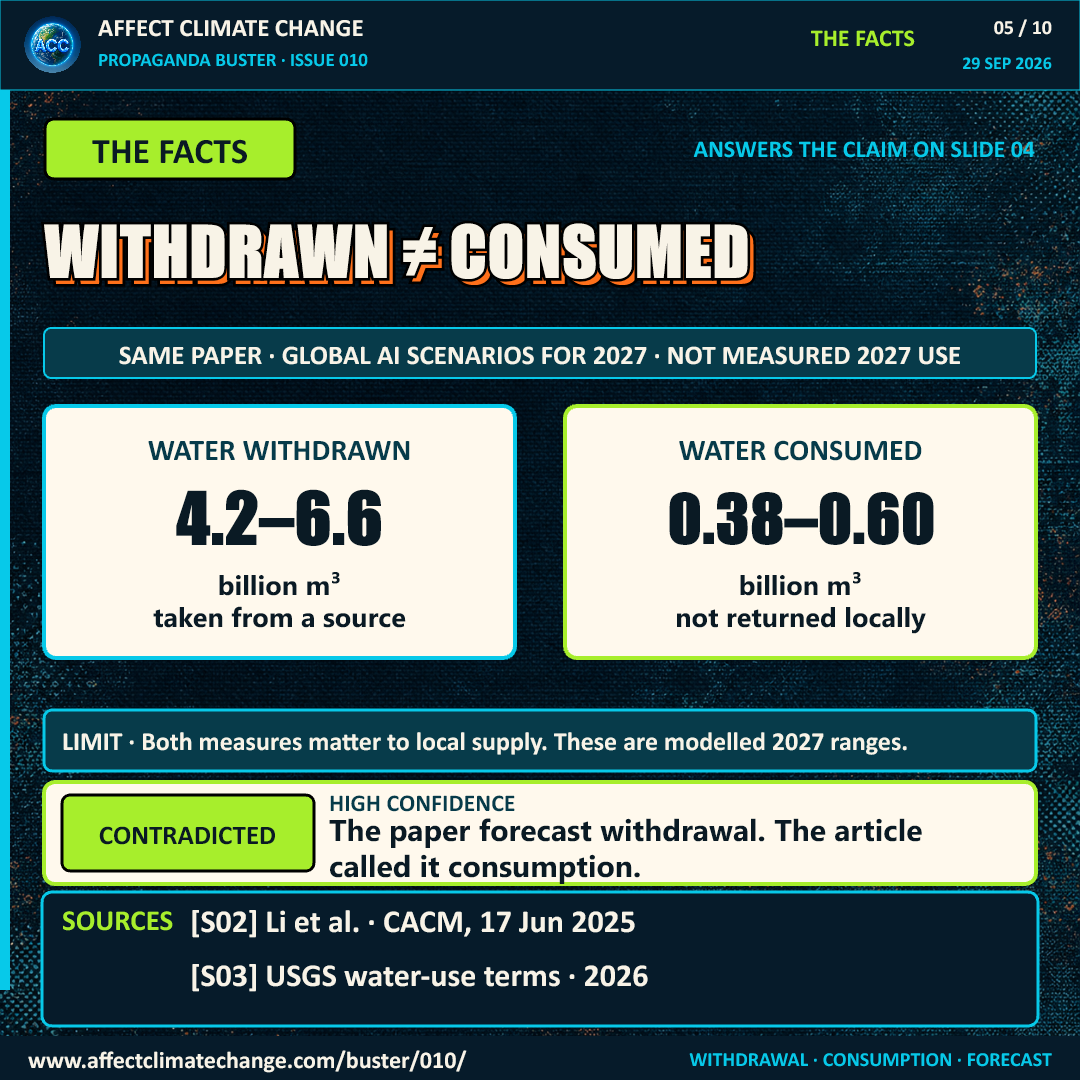
What that research says. Li and colleagues project 4.2–6.6 billion cubic metres of water withdrawal for global AI demand in 2027. In the same paper, 0.38–0.60 billion cubic metres is the modeled consumption range [S02]. Withdrawal means water taken from a source; consumptive use is the portion not returned to the immediate/local water system [S03]. The study includes direct data-center cooling and indirect water associated with electricity generation, and the 2027 numbers are model-derived scenarios rather than measured 2027 totals.
- Authors estimate 500 mL for roughly 10–50 medium-length GPT-3 responses depending on when and where deployed. Sections 2.2 and 4 discuss cooling and electricity-related water, local supply, temporal variation and reporting.
- USGS says not all withdrawn water is lost; consumptive use does not return to local waters or groundwater.
- Both global 2027 figures are model-derived projections, including direct cooling and electricity-related water. They are not measured totals, and both withdrawal and consumption can matter locally.
Evidence chain
Each source is dated and paired with the finding it supports. The original post establishes what was claimed; it does not decide the scientific verdict.
Making AI Less Thirsty: Uncovering and Addressing the Secret Water Footprint of AI Models
Published / source period: 2025-03-26 author manuscript v5; CACM publication 2025-06-17
Pengfei Li; Jianyi Yang; Mohammad A. Islam; Shaolei Ren · Authors estimate 500 mL for roughly 10–50 medium-length GPT-3 responses depending on when and where deployed. Sections 2.2 and 4 discuss cooling and electricity-related water, local supply, temporal variation and reporting.
Accessed September 30, 2026
Water Use in the United States
Published / source period: Page current 2026-09-09
U.S. Geological Survey Water Resources Mission Area · USGS says not all withdrawn water is lost; consumptive use does not return to local waters or groundwater.
Accessed September 30, 2026
What is true
What that research says. Li and colleagues project 4.2–6.6 billion cubic metres of water withdrawal for global AI demand in 2027. In the same paper, 0.38–0.60 billion cubic metres is the modeled consumption range [S02]. Withdrawal means water taken from a source; consumptive use is the portion not returned to the immediate/local water system [S03]. The study includes direct data-center cooling and indirect water associated with electricity generation, and the 2027 numbers are model-derived scenarios rather than measured 2027 totals.
Where the claim fails
Verdict: CONTRADICTED · high confidence, bounded to the word “consume.” The cited 4.2–6.6 range is for withdrawal, not the paper's consumption estimate. Withdrawal and consumption can both matter for water planning, but they answer different questions.
Limits and uncertainty
Both global 2027 figures are model-derived projections, including direct cooling and electricity-related water. They are not measured totals, and both withdrawal and consumption can matter locally.
Assessment after the evidence
The cited research projects withdrawal, not consumption; the verdict is bounded to the swapped metric.
How the framing works
Withdrawal and consumption are substituted even though the source defines them separately.
How scientists know
The author manuscript reports separate modeled global withdrawal and consumption ranges for 2027. USGS defines the two metrics separately; neither is an observed 2027 total.
Editorial boundaries
ACC evaluates the claim. It does not infer intent, coordination, funding, deception, or control without direct evidence specific to that attribution.
The source presentation and reuse decision are documented here: Bounded source-native excerpt for identification and criticism, with attribution and direct links; no license or endorsement implied.
Corrections and revision record
Corrections status: No change to the scientific verdict has been recorded.
R7-web-1 · September 30, 2026
Integrated approved R7 into the website without changing September 29 evidence date or verdict boundary.